Brand Tracking vs Brand Monitoring: Key Differences
Understand the key differences between brand tracking and brand monitoring. Learn when to use each strategy and how to combine them for max brand intelligence
In today's digital landscape, understanding your brand's health requires more than a casual glance at your analytics dashboard. Businesses now have access to two distinct but complementary approaches: brand tracking and brand monitoring. While these terms are often used interchangeably, they serve fundamentally different purposes in your brand intelligence strategy.
According to Business Research Insights, the brand monitoring tools market was valued at $0.68 billion in 2024 and is projected to reach $1.51 billion by 2033, growing at a CAGR of 9.1%. Meanwhile, the broader media monitoring tools market reached $5.46 billion in 2024 and is expected to hit $12 billion by 2030, demonstrating the massive investment brands are making in understanding their audience.
But here's the critical question: are you measuring the right things? Many businesses invest heavily in one approach while neglecting the other, leaving significant blind spots in their brand intelligence. Understanding the difference between brand tracking and brand monitoring isn't just semantic. It's the difference between reacting to a crisis and preventing it, between guessing what customers think and knowing for certain.
Let's break down these two essential strategies and show you how to leverage both for complete brand visibility.
What is Brand Tracking?
Brand tracking is the strategic measurement of your brand's performance over time through quantitative metrics and structured research. Think of it as your brand's regular health checkup, providing a longitudinal view of how your brand is performing in the market.
According to Qualtrics, brand tracking continuously measures your brand's health, analyzing how consumers buy and use your products and what they think and feel about the brand itself. It's a long-term, data-driven approach that focuses on measuring specific key performance indicators (KPIs) at regular intervals.
The Purpose of Brand Tracking
Brand tracking answers fundamental questions about your brand's position in the market:
- How aware are consumers of your brand?
- How do you compare to competitors?
- Is your brand equity increasing or decreasing?
- What is your market share trajectory?
- Are customers loyal to your brand?
These insights help you make strategic decisions about positioning, pricing, product development, and long-term marketing investments.
Key Metrics in Brand Tracking
Brand tracking typically measures:
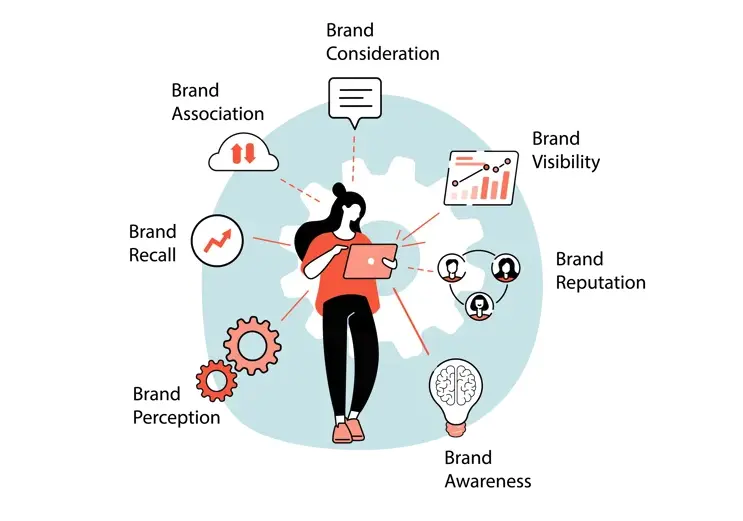
Net Promoter Score (NPS): How likely customers are to recommend your brand on a scale of 0-10. This classic metric gets to the heart of customer satisfaction and loyalty.
Brand Awareness: Both aided (when prompted with your brand name) and unaided (spontaneous recall) awareness help you understand how visible your brand is in the market.
Brand Preference: The percentage of consumers who prefer your brand over competitors when making purchasing decisions.
Brand Equity: The overall value your brand holds in customers' minds, encompassing recognition, loyalty, and perceived quality.
Customer Retention: How many customers continue purchasing from you over time, indicating brand loyalty and satisfaction.
Market Share: Your percentage of total market sales compared to competitors, showing your competitive position.
These metrics are typically collected through surveys, focus groups, and quantitative research studies conducted quarterly, biannually, or annually.
[
](https://app.trigify.io/sign-up)
Source: TapResearch
What is Brand Monitoring?
Brand monitoring takes a completely different approach. Instead of periodic measurement, it involves real-time collection and analysis of brand mentions, conversations, and sentiment across digital channels. It's the always-on radar that catches what people are saying about your brand right now.
Brand monitoring encompasses the systematic tracking of your brand mentions across social media, news sites, review platforms, forums, and other digital channels. It's about understanding what people are saying, how they're saying it, and where the conversations are happening.
The Purpose of Brand Monitoring
Brand monitoring answers immediate, tactical questions:
- What are people saying about our brand right now?
- How are customers reacting to our latest product launch?
- Are there any emerging crises or negative sentiment spikes?
- What are competitors doing that's generating buzz?
- Which influencers or publications are mentioning our brand?
This real-time intelligence enables rapid response to opportunities and threats as they emerge.
Key Activities in Brand Monitoring
Brand monitoring focuses on:
Mention Tracking: Capturing every instance your brand is mentioned across digital channels, including branded and unbranded keywords.
Sentiment Analysis: Determining whether mentions are positive, negative, or neutral using AI-powered text analysis.
Competitor Activity: Monitoring what competitors are doing, how they're being discussed, and where they're gaining traction.
Hashtag and Campaign Tracking: Measuring the reach and engagement of specific marketing campaigns or branded hashtags.
Influencer Identification: Finding who's talking about your brand and whether they have significant reach or influence.
Crisis Detection: Identifying sudden spikes in negative sentiment or mention volume that could indicate an emerging problem.
Channels for Brand Monitoring
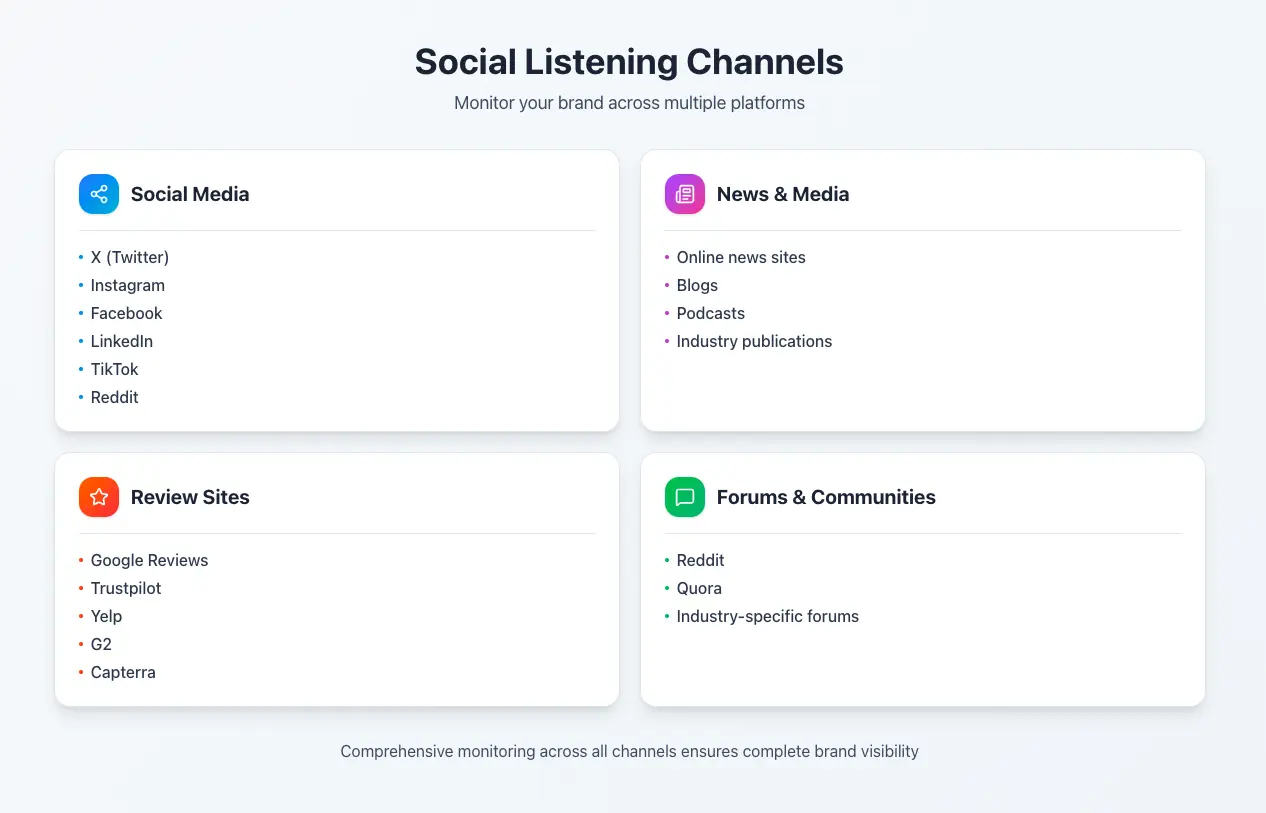
Effective brand monitoring spans multiple channels:
- Social Media: X (Twitter), Instagram, Facebook, LinkedIn, TikTok, Reddit
- News and Media: Online news sites, blogs, podcasts, industry publications
- Review Sites: Google Reviews, Trustpilot, Yelp, G2, Capterra
- Forums and Communities: Reddit, Quora, industry-specific forums
[
](https://app.trigify.io/sign-up)
Brand Tracking vs Brand Monitoring: The Key Differences
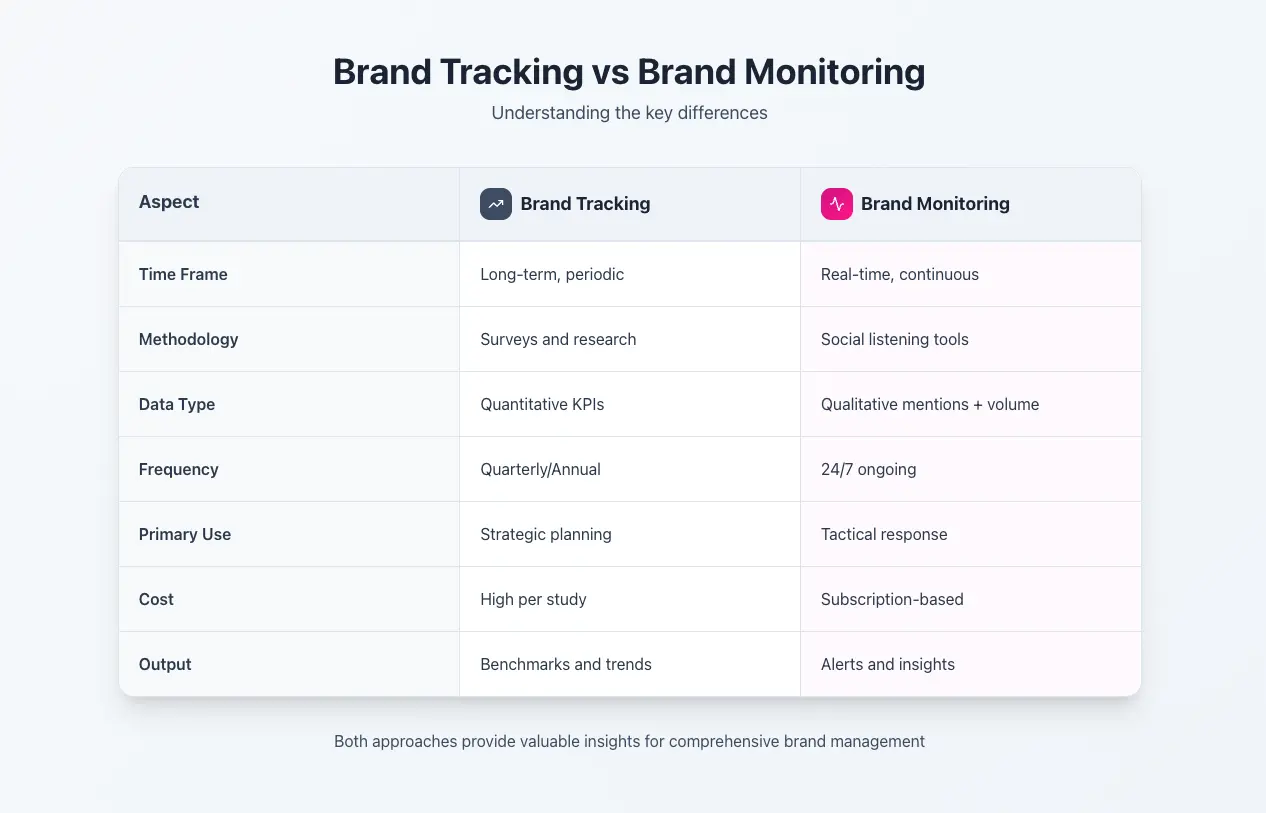
While both strategies aim to understand your brand's performance, they differ fundamentally in approach, methodology, and use cases. Let's examine the critical distinctions:
Time Horizon
Brand Tracking: Long-term and periodic. Data is collected at set intervals (quarterly, biannually, annually) to measure trends over time. It's retrospective, analyzing what has happened and projecting future trends.
Brand Monitoring: Real-time and continuous. Data streams in 24/7, providing immediate visibility into conversations and sentiment. It's focused on what's happening right now.
Methodology
Brand Tracking: Relies on structured research methods including surveys, focus groups, and market research studies. It uses controlled sampling to ensure statistical validity and asks standardized questions for comparison over time.
Brand Monitoring: Uses social listening tools and automated data collection to capture organic mentions and conversations. It analyzes unstructured data using AI and natural language processing.
Data Type
Brand Tracking: Primarily quantitative data. You get hard numbers, percentages, and scores that can be benchmarked and compared. The data is structured, making it easy to analyze statistically.
Brand Monitoring: Mix of quantitative and qualitative data. You get mention volumes (quantitative) along with actual customer comments, reviews, and social posts (qualitative). This provides context and nuance behind the numbers.
Cost and Resources
Brand Tracking: Typically requires significant investment in research design, panel recruitment, and analysis. Annual or quarterly studies can cost thousands to tens of thousands of dollars.
Brand Monitoring: Requires ongoing subscription to monitoring tools, but often more cost-effective for continuous insights. Tools range from free (limited features) to enterprise-level solutions.
Use Cases
Brand Tracking: Best for strategic planning, measuring campaign effectiveness over time, evaluating brand equity growth, and making long-term business decisions.
Brand Monitoring: Ideal for crisis management, customer service, real-time campaign optimization, competitive intelligence, and identifying emerging trends or issues.
[
](https://app.trigify.io/sign-up)
When to Use Each Strategy (And Why You Need Both)
The most successful brands don't choose between tracking and monitoring. They use both in tandem, leveraging the strengths of each approach to create comprehensive brand intelligence.
When to Use Brand Tracking
Evaluating Campaign Effectiveness: After launching a major marketing campaign or rebranding effort, brand tracking helps you measure whether brand awareness, preference, or equity has increased.
Measuring Brand Equity Growth: When you need to quantify your brand's value and track how it changes over time, structured brand tracking provides the hard data needed for board presentations and strategic planning.
Strategic Planning: Making decisions about market expansion, product launches, or competitive positioning requires the benchmarked, statistically valid data that brand tracking provides.
Investor Relations: When communicating with stakeholders or investors, brand tracking metrics provide credible, defensible data about your brand's performance.
When to Use Brand Monitoring
Crisis Management: When negative sentiment spikes or a PR crisis emerges, brand monitoring provides immediate awareness so you can respond quickly before issues escalate.
Identifying Customer Pain Points: Real-time monitoring reveals what customers are struggling with, allowing you to address issues proactively and improve the customer experience.
Building Relationships: By monitoring mentions and engaging with customers who talk about your brand, you can build authentic relationships and turn satisfied customers into brand advocates.
Competitive Intelligence: Monitoring competitors' mentions, campaigns, and sentiment helps you identify opportunities and stay ahead of market shifts.
Campaign Optimization: During active campaigns, monitoring shows you what's resonating (or falling flat) so you can adjust messaging and tactics in real time.
Why You Need Both
Think of brand tracking as your strategic compass and brand monitoring as your tactical radar. The compass shows you where you're heading and whether you're on course toward your long-term goals. The radar alerts you to immediate threats and opportunities so you can navigate successfully.
Brand tracking without monitoring leaves you blind to real-time sentiment shifts, emerging crises, and day-to-day customer feedback. You might discover a problem in your quarterly survey, but by then, the damage is done.
Brand monitoring without tracking gives you reactions without context. You see spikes in mentions and sentiment but can't measure whether these translate to improvements in brand equity, loyalty, or market share.
Together, they create a complete picture. You can respond to immediate issues while measuring your progress toward long-term brand goals.
How Agentic Social Listening Bridges the Gap
Traditional brand tracking and monitoring have operated as separate silos, requiring different tools, teams, and workflows. But AI-powered agentic social listening is changing the game by combining the best of both approaches.
Modern AI platforms can now:
Deliver Real-Time Monitoring with Trend Analysis: Instead of choosing between immediate alerts and long-term trends, AI systems continuously monitor mentions while automatically identifying patterns and trends over time.
Automate Insight Generation: Rather than waiting for quarterly survey results, AI can analyze thousands of conversations daily, extracting key themes, sentiment shifts, and emerging topics without manual analysis.
Provide Predictive Intelligence: Advanced AI doesn't just tell you what's happening now. It predicts where sentiment is heading, allowing you to act proactively rather than reactively.
Replace Manual Surveys with Conversational Analysis: Why ask customers how they feel when you can analyze what they're already saying organically? AI-powered tools extract the same insights you'd get from surveys by analyzing actual customer conversations.
Why Trigify is the Complete Solution
This is where Trigify transforms how businesses understand their brand. Unlike traditional tools that force you to choose between tracking or monitoring, Trigify's agentic social listening platform delivers both in a single, intelligent system.
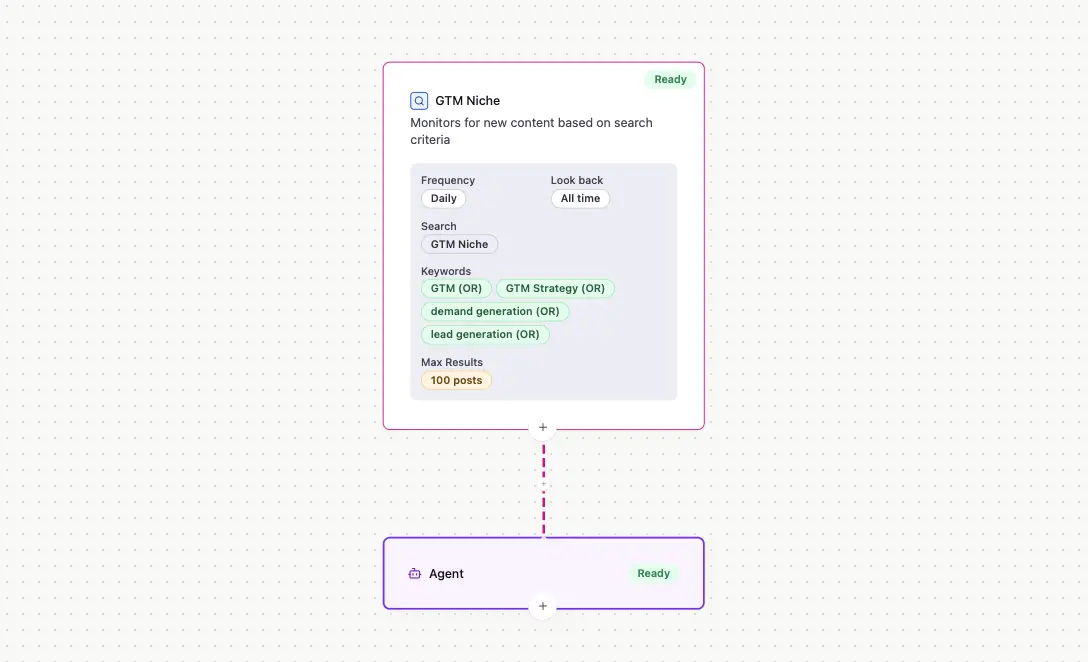
Real-Time Brand Monitoring: Trigify continuously monitors social media capturing every mention of your brand across the digital landscape. You can build workflows to get instant alerts when sentiment shifts or mention volume spikes, enabling rapid response to opportunities and threats.
AI-Powered Trend Analysis: But Trigify doesn't stop at real-time monitoring. Its AI agents automatically identify trends over time, effectively replacing the need for expensive quarterly brand tracking surveys. You get the long-term insights of brand tracking combined with the immediacy of brand monitoring.
Automated Insights, Not Just Data: Traditional monitoring tools give you raw mentions and basic sentiment scores. Trigify's AI agents go deeper, automatically extracting themes, identifying key influencers, detecting emerging issues, and providing actionable recommendations. It's like having a team of brand analysts working 24/7.
No More Data Overload: The biggest problem with monitoring isn't lack of data, it's too much data. Trigify solves this by using AI to filter signal from noise, highlighting only the insights that matter to your business goals.
Strategic and Tactical Intelligence: With Trigify, you can respond to today's crisis while measuring your progress toward long-term brand equity goals. It's the only platform that truly bridges the gap between strategic brand tracking and tactical brand monitoring.
The media monitoring tools market is growing at 14.1% CAGR because businesses recognize they need better brand intelligence. But why invest in multiple tools when one AI-powered platform can deliver everything you need?
[
](https://app.trigify.io/sign-up)
Conclusion
Brand tracking and brand monitoring serve fundamentally different purposes, but both are essential for comprehensive brand intelligence. Brand tracking provides the strategic, long-term view of your brand's health through periodic surveys and quantitative metrics. Brand monitoring delivers real-time awareness of what people are saying right now across digital channels.
The most successful brands don't choose between them. They leverage both approaches, using brand tracking to set strategic direction and measure progress toward long-term goals while deploying brand monitoring for tactical response, crisis management, and continuous customer feedback.
The future of brand intelligence lies in platforms that combine both capabilities seamlessly. With AI-powered tools like Trigify, you no longer need to choose between strategic tracking and tactical monitoring. You get both, plus automated insights that would take a team of analysts weeks to produce.
Your brand is your most valuable asset. Don't leave its health to guesswork or outdated methods. Invest in tools that give you complete visibility into both the immediate conversations and long-term trends shaping your brand's future.
Ready to transform your brand intelligence? Start monitoring and tracking your brand with Trigify's AI-powered social listening. Get immediate alerts AND long-term brand health insights without the lag of traditional research. Try it free today.