How to Build a GTM Signal Engine
Learn how to build a GTM signal engine that scores, enriches, and routes qualified buyer signals to sales automatically.

A GTM signal engine is the layer that decides when your revenue machine should move. It takes real buyer signals, filters the noise, adds context, and routes the right accounts to sales before reps waste time on static lists.
TL;DR
- A GTM signal engine decides which buyer events deserve action, then routes them into the systems your team already uses.
- The engine should filter before enrichment, otherwise you burn credits and rep attention on noise.
- Good routing rules combine signal type, ICP fit, account context, and urgency into one clear next step.
- Start with one high-confidence signal, prove signal-to-meeting conversion, then add more sources.
For the bigger operating model, start with our signal-based selling playbook.
Then read 21 B2B intent signals worth tracking in 2026 for the signals worth feeding into the engine, and our first-party vs third-party intent data guide for the trust rules behind each source.
Most teams do not have a tooling problem. They have an order problem. They buy data, enrich thousands of accounts, and only then ask which ones deserve action. A GTM signal engine flips that sequence. It starts with live signals, scores them against fit and timing, enriches only what passes the bar, and routes clear actions into the systems reps already use.
That shift matters because signal-based selling is being packaged less like a better alert feed and more like a control plane for modern GTM. The strongest operator examples in Trigify's market memory all describe the same flow: signal capture first, quality control second, workflow action third.
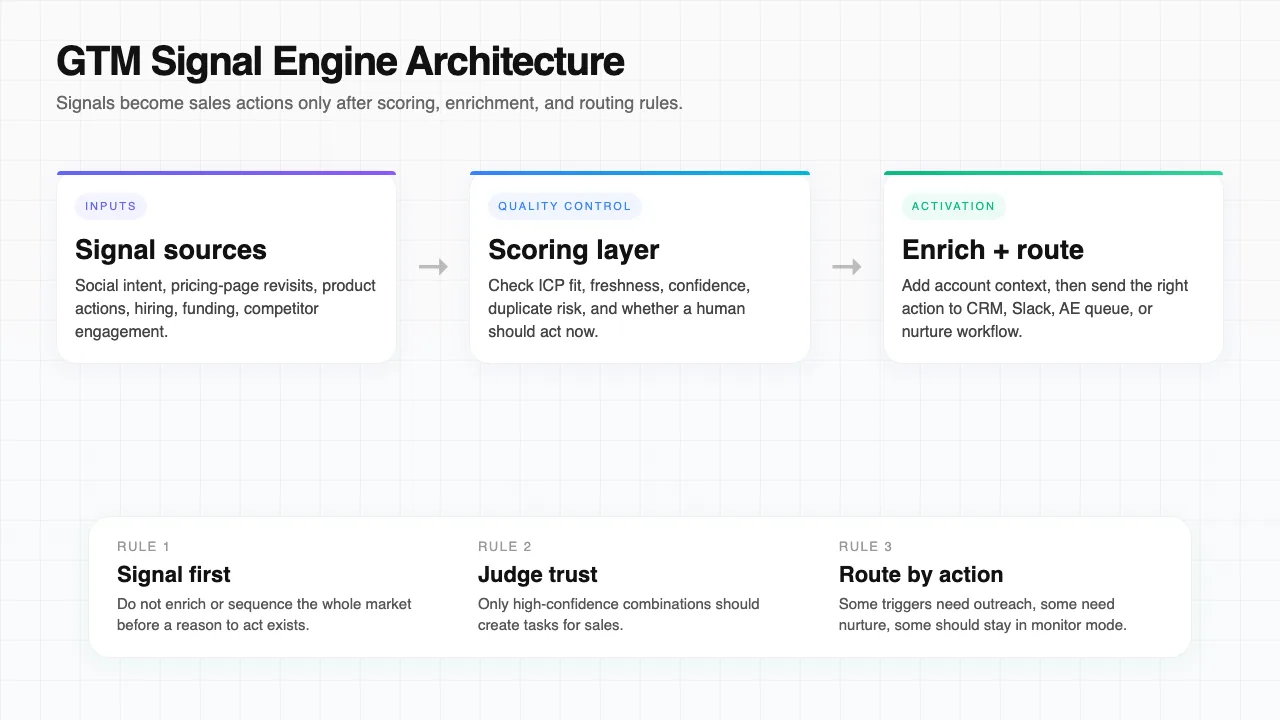
GTM signal engine architecture: sources, scoring, enrichment, routing, CRM, and notifications.
What a GTM signal engine actually does
A GTM signal engine turns scattered buying clues into a repeatable routing system. Instead of asking reps to interpret every trigger manually, it applies a consistent decision layer before anything hits a queue, CRM task, or Slack channel.
The important part is the gate in the middle. Without it, teams confuse activity with intent. A competitor like, a hiring post, or a pricing-page visit can all matter, but not with equal urgency. The engine exists to protect sales from weak triggers.
Start with signals, not lists
High-performing outbound teams increasingly work from a live intent graph, not a frozen account spreadsheet. That matches the pattern sitting across Trigify's Brain: public signals, scoring logic, enrichment, then execution.
The difference is practical.
The second model is usually leaner and easier for reps to trust. If an account engaged with a competitor thread, visited a solution page, and matches your ICP, that is easier to act on than a broad database score with no visible reason attached.
This is also why the article on B2B intent signals matters upstream. Not every trigger deserves a workflow. Your engine should start with signals that have both timing value and a plausible commercial explanation.
The five-part architecture of a strong GTM signal engine
1. Signal inputs
Feed the engine with signals that show intent, change, or urgency. Good inputs include pricing-page revisits, product-qualified actions, competitor engagement, job changes, funding events, hiring spikes, and public category conversations.
Mixed-source coverage is important, but trust rules matter more than source count. Use the framework from our first-party vs third-party intent data guide: first-party signals are strongest for routing, third-party signals are strongest for coverage, and visible social signals often supply the missing context.
2. Qualification logic
This is the core of the engine. Define what counts as a real sales-worthy moment.
If you skip this layer, reps stop trusting the system. The market is already saying the same thing in plain English: signal capture without scoring logic pollutes the CRM.
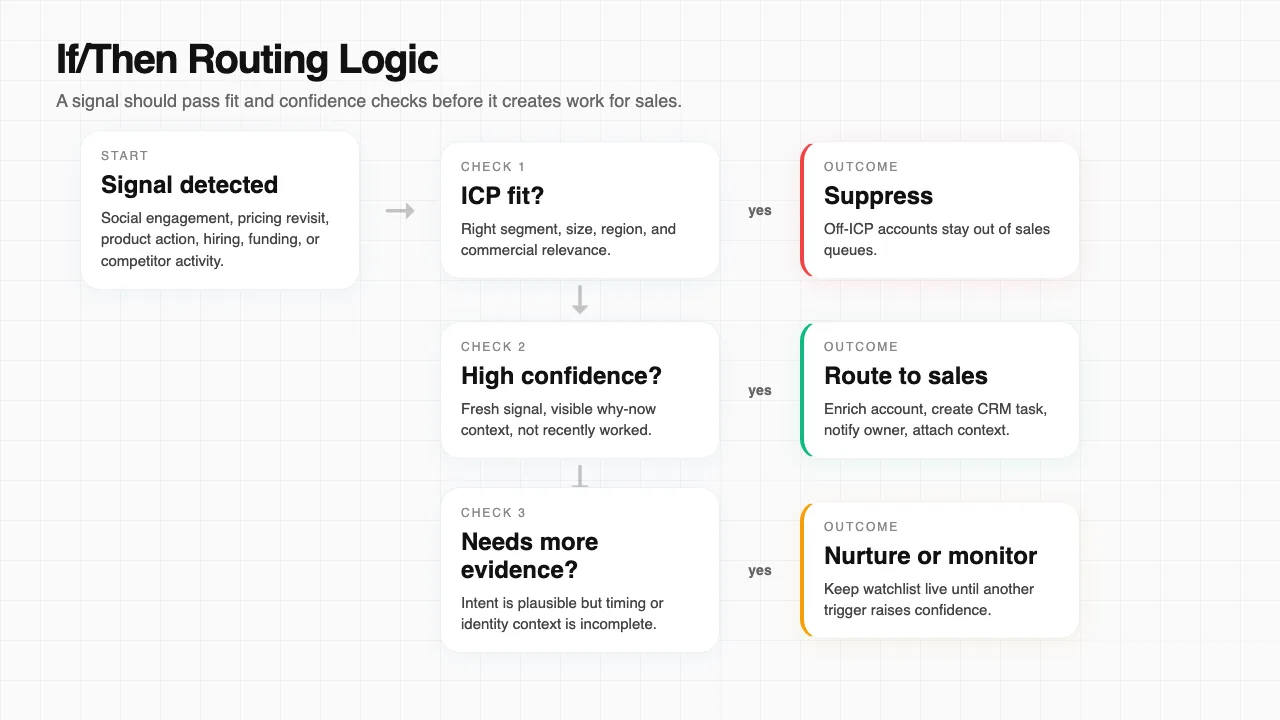
Routing logic for turning raw buyer signals into qualified sales actions.
3. Selective enrichment
Only enrich what passes the threshold. Once an account shows a credible signal, pull the company context, contact details, CRM history, or recent activity needed to make the next step useful.
This keeps costs lower and improves relevance. It also prevents a common GTM mistake: enriching huge static lists before a reason to act exists.
4. Routing and handoff
Routing should reflect signal type and confidence, not just account ownership.
A good engine also decides destination by workflow. Some signals belong in Slack for fast human review. Others should create a task in HubSpot, Salesforce, or Attio. Others should trigger a sequence in Smartlead or HeyReach.
5. Feedback loop
The engine gets better when you learn which combinations convert. Track which signals led to replies, meetings, opportunities, and closed-won deals. Then tighten the scoring rules.
That feedback loop is what turns a clever automation into a real pipeline system. It also gives marketing and RevOps a shared language for what counts as buying intent.
How to route signals automatically without spamming sales
Automation only works when the routing rules are conservative enough to protect trust. Start narrow, then expand once the data proves itself.
This is where teams usually win or lose. If every small trigger becomes a task, the engine dies from alert fatigue. If only the sharpest combinations route through, reps start to rely on it.
A practical example is a target account that comments on a competitor post, revisits your pricing page, and matches the ICP by headcount and region. That should not sit in a spreadsheet. It should arrive with the why-now context already attached.
What the minimum viable stack looks like
You do not need a giant RevOps rebuild to start. A simple GTM signal engine often has six parts.
That stack is enough to prove whether signal-first routing beats list-first outbound for your market. Most teams should earn that proof before adding more complexity.
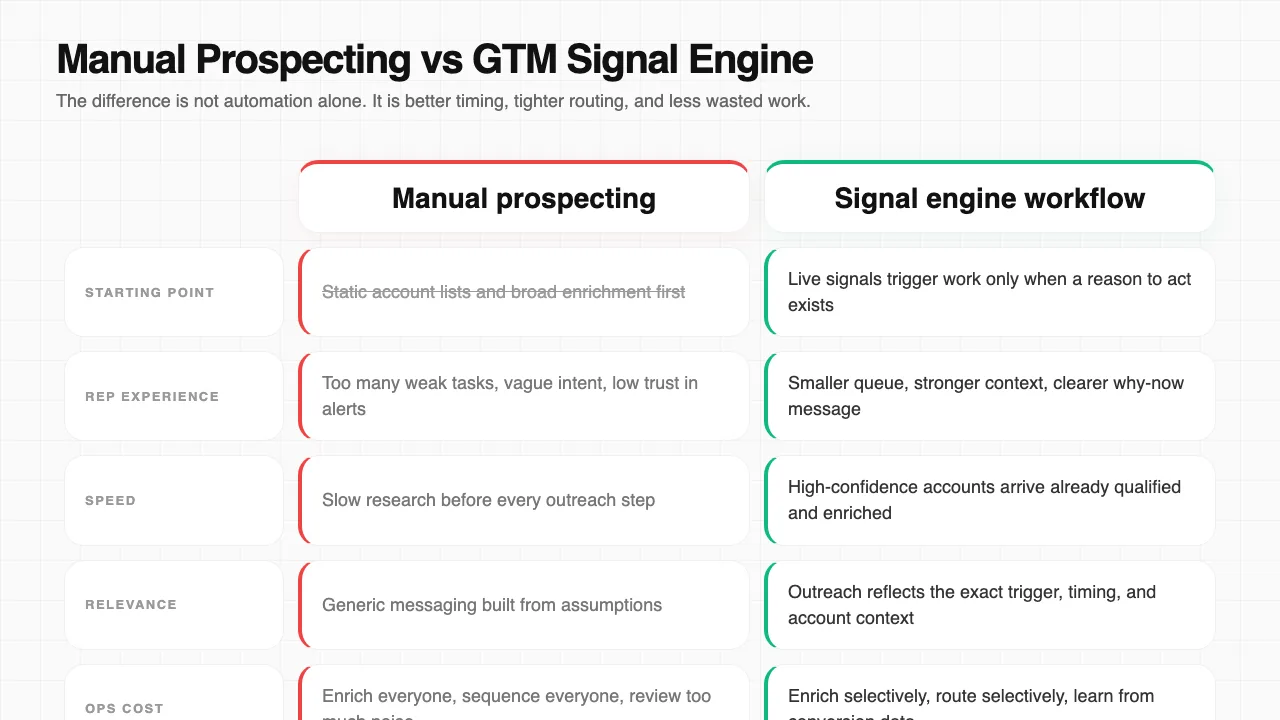
Manual list-building versus automated signal routing in a modern GTM workflow.
Where Trigify fits
Trigify helps teams monitor social and intent-rich signals, qualify what matters, and push the right opportunities into downstream workflows. That makes it a strong front-end layer for a GTM signal engine because many useful buying signals appear in public before a form fill or demo request ever happens.
For B2B teams building this motion now, the simplest rule is still the best one: start with a real signal, score it before enrichment, then route only what deserves action. That is the cleanest path to better timing, better relevance, and less wasted outbound effort.
If you want to build that system, read the pillar on signal-based selling, review our social listening workflow to CRM guide, or start a free Trigify trial.
For a deeper Trigify workflow view, see ai sales tools and build ai marketing agents with social listening workflows.
A GTM signal engine is not another dashboard. It is the decision layer that tells your GTM machine when to act.