LinkedIn Lead Generation: How to Get More Customers
Learn how to get more B2B leads on LinkedIn with our step-by-step guide. Discover proven strategies to find qualified prospects and convert them into paying cus

LinkedIn is the best place to find B2B leads who match your ICP and are interested in your offering.
However, most people don’t know how to get B2B leads on LinkedIn and close deals.
They follow the same outdated playbooks preached by LinkedIn gurus and influencers.
They spam inboxes with generic and irrelevant pitches.
They use AI to engage with other people only to end up looking like robots or spammers.
People don’t know how to build relationships with B2B leads on LinkedIn and turn those relationships into deals.
This article will show you the ultimate playbook for getting B2B leads on LinkedIn.
We called it The Network Effect Playbook.
How do we know that it works?
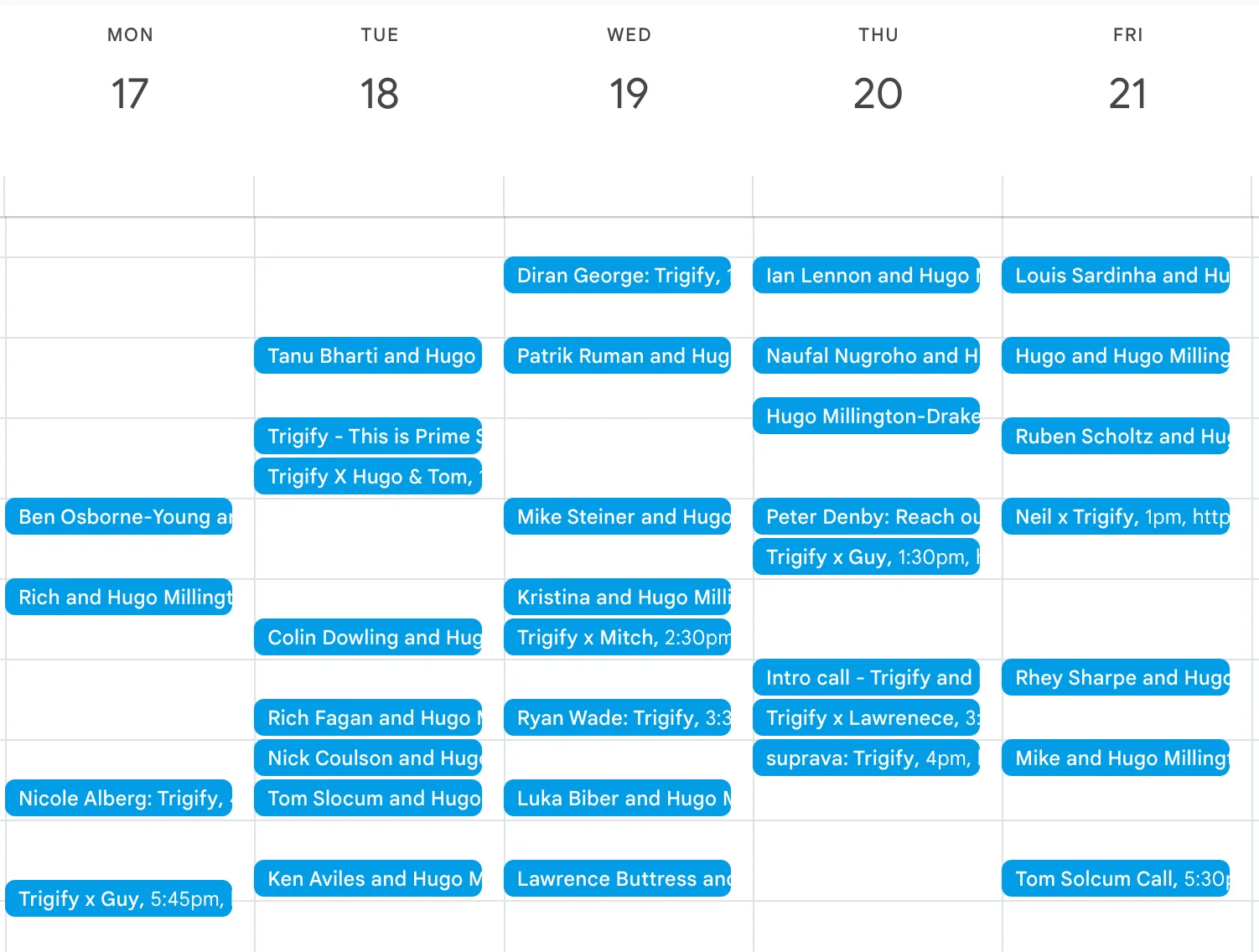
With this playbook, we get 20-30% reply rates on our campaigns and book 100+ meetings every month (proof below).
We’ll show you how to use The Network Effect Playbook to:
- Identify strangers who are interested in buying a product like yours.
- Engage with those strangers and build relationships with them.
- Turn those relationships into leads and deals.
But to understand this winning process, we must first bust some myths and show why other strategies (preached by LinkedIn gurus) don’t work.
Busting Biggest Mistakes & Myths About Getting B2B Leads on LinkedIn
When it comes to getting B2B leads on LinkedIn, there’s no shortage of bad advice praised by LinkedIn gurus.
Let’s clear the air and bust some of the biggest LinkedIn lead generation myths.
Myth #1: You Need to Contact More People to Get Deals
"More leads, more deals" is the mantra many sales influencers swear by.
But here’s the truth: going after quantity over quality is one of the fastest ways to burn your leads and ruin your reputation.
Sending generic pitches to thousands of people doesn’t just lower your chances of success—it makes you look like you don’t know what you’re doing.
Most of your messages will be ignored, and you’ll come across as another spammer.
Instead, the focus should be on relevance and quality.
You’ll see better reply rates and more deals closed by targeting the right audience and building meaningful connections.
Let’s quickly compare these two approaches:
We’re focusing on quality and relevance over quantity. Our campaigns have 100-150 prospects, and we get 20-30% reply rates. That’s 20-40 new potential leads.
Here’s the proof from one of our recent LinkedIn campaigns:

LinkedIn gurus that follow the quantity approach are bragging about getting one lead on every 600 contacted people (and that’s considered a good result for them). That means that to get the same results as our approach, you need to contact at least 12.000 different people.
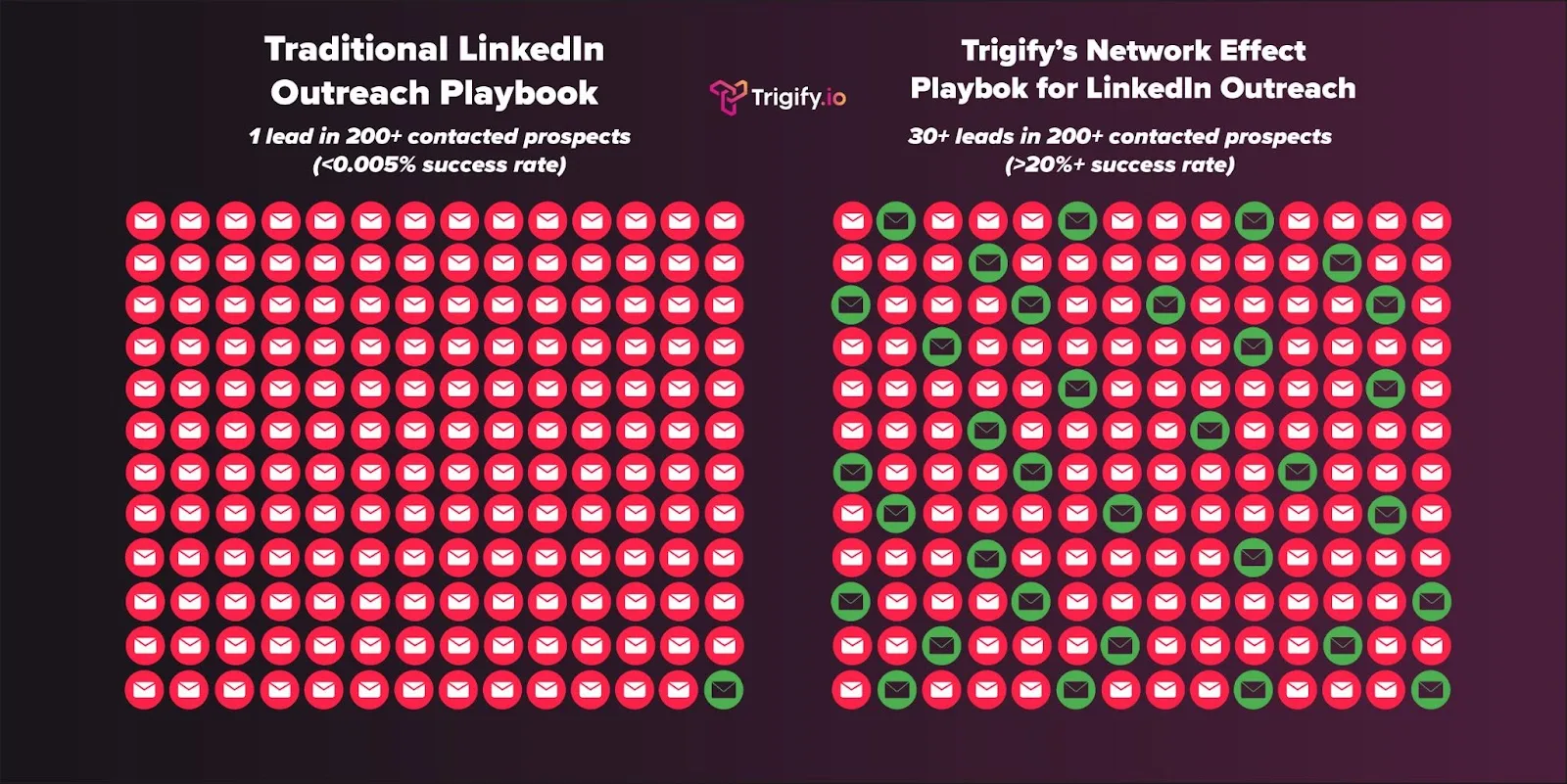
Do you see the difference?
At the end of the day, our calendar tells everything:
Myth #2: Personalization is the Key to Getting Replies
Personalization is important—but it’s also widely misused.
Many people think they need to overpersonalize their outreach, spending hours digging up personal details about their prospects.
They mention hobbies, favorite foods, education, or even vacation photos, believing this will grab attention.
In reality, this level of personalization feels awkward and forced.
It’s not about showing prospects you know their favorite ice cream flavor—it’s about demonstrating that you understand their problems.
Slight personalization tied to business relevance works far better.
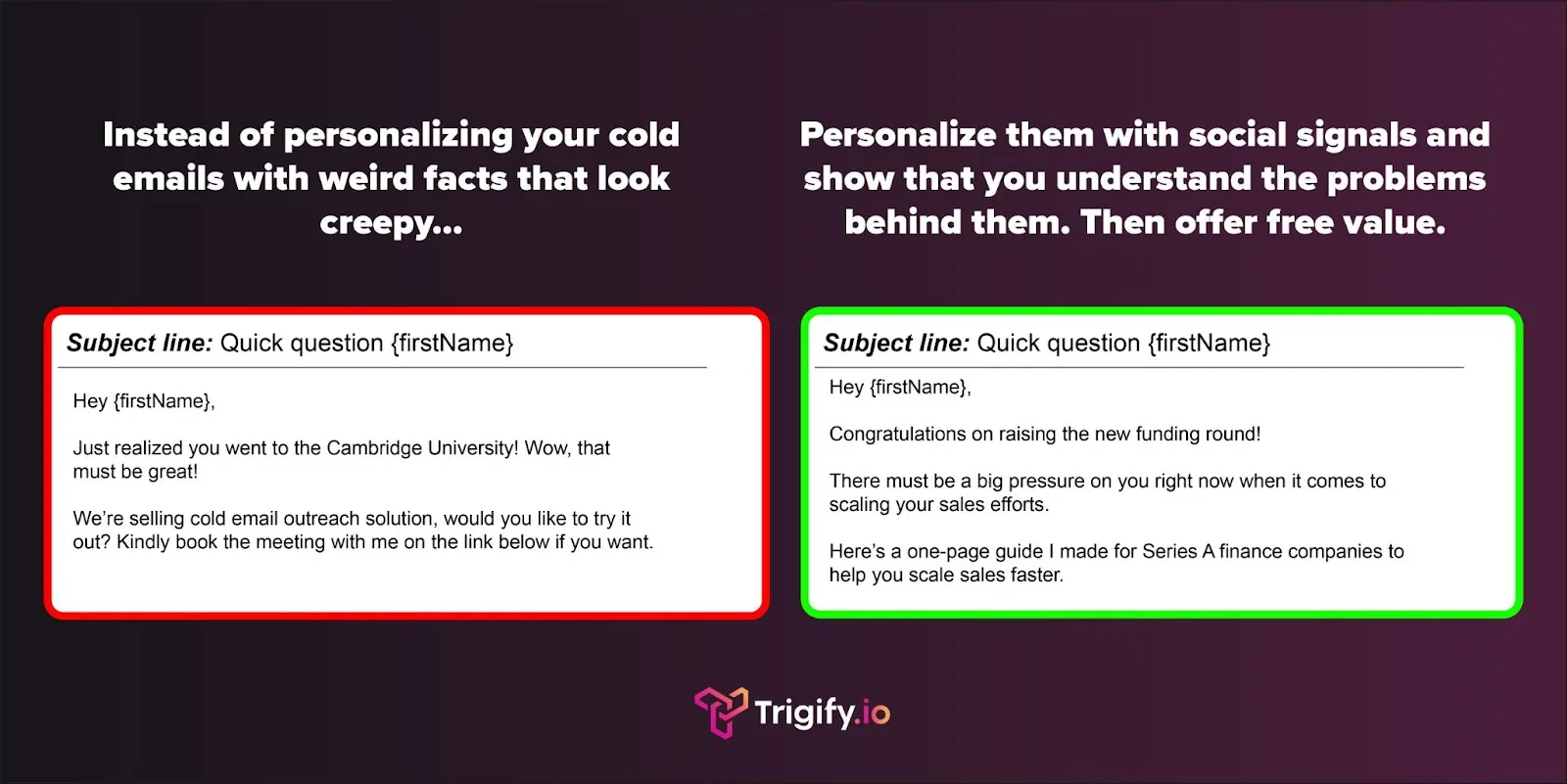
For example, instead of saying:
“Hey {firstName}, I noticed you attended Cambridge University, that must be great!” and then going straight into the pitch that’s not relevant to what you just said, you can write something like:
“Congratulations on your recent funding round! I imagine there’s a lot of expectation and focus on scaling your team right now. Here’s a guide on scaling sales teams post-funding.”
Keep it short, relevant, and tied to the prospect’s goals, not their personal life.
The idea is to use social signals to identify people with problems, show them that you understand their struggles, and then build relationships with them by offering pro bono solutions to those problems.
Closing deals comes later.
Myth #3: Misusing Social Signals
Social signals, like promotions, funding announcements, or team expansions, are goldmines for identifying potential leads.
But many misuse these signals by jumping in too aggressively.
They see a signal and immediately send a pitch, failing to consider what the signal actually represents.
The key is to understand the challenges & problems behind the signals.
For example, when a VP of Sales gets promoted, they’re likely focused on gaining their team’s trust or building a roadmap for success. You're wasting the opportunity if your outreach doesn’t address those challenges.
The secret lies in solving problems, not selling products.
Introducing The Network Effect Playbook: The New Way of Getting B2B Leads on LinkedIn
So, we know that the way people approach LinkedIn sales is outdated.
There’s a better way to get B2B leads on LinkedIn than just pushing pitches and chasing transactions.
It’s called The Network Effect Playbook, and it flips the old approach on its head.
Instead of focusing on selling, it’s about building relationships.
Instead of blasting cold pitches to people who “just fit our ICP,” it uses data and social signals to engage interested leads and turn interest into intent.
Let’s explore the two main pillars that build the foundation of the Network Effect Playbook.
Using Social Signals in LinkedIn Sales
Social signals are breadcrumbs people leave behind on LinkedIn.
A new job, a funding announcement, or a promotion are all key signals—but the most common and often overlooked is engagement with influencers in your space.
These untapped moments reveal when someone might need help and be interested in your offer.
But here’s most people's mistake: they see the signal and pitch right away. This rarely works and makes you look weird (not to say creepy).
The real power lies in analyzing the challenges behind the signals.
For example, if someone asked for a lead magnet on a LinkedIn post from your competitors (or other content creators in the space), that doesn’t mean they’re interested in buying from you immediately.
But it’s a good signal that they’re aware of the problem and are willing to solve it.
This is a perfect opportunity to reach out and use that as a conversation starter.
Tools such as Trigify can help you collect this data without compromising your LinkedIn Account safety.
For example, you can use Trigify to identify people who engaged with competitors' content on LinkedIn more than three times in the last 30 days.
This indicates that they have shown extreme interest in that type of content (or service).
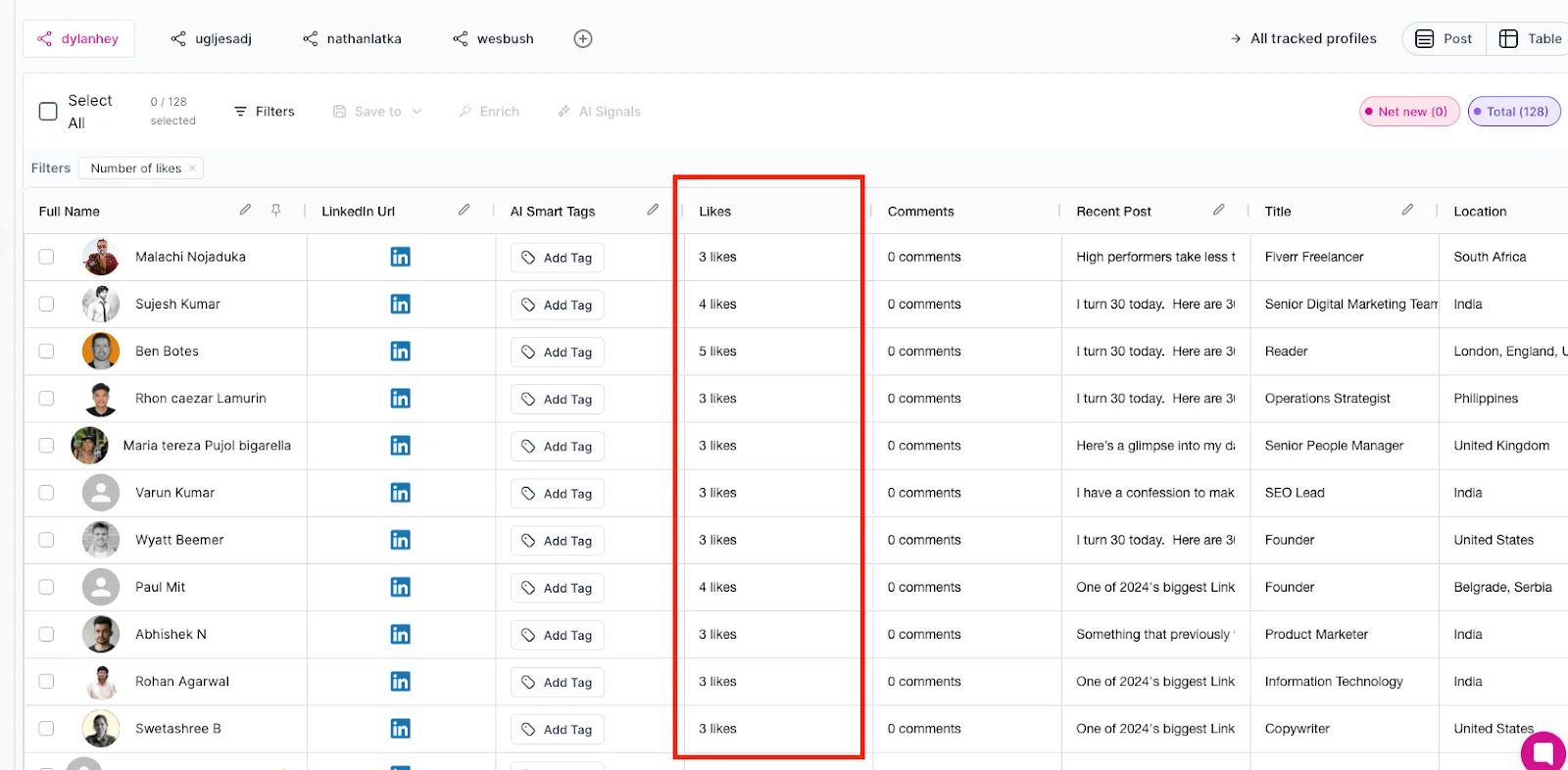
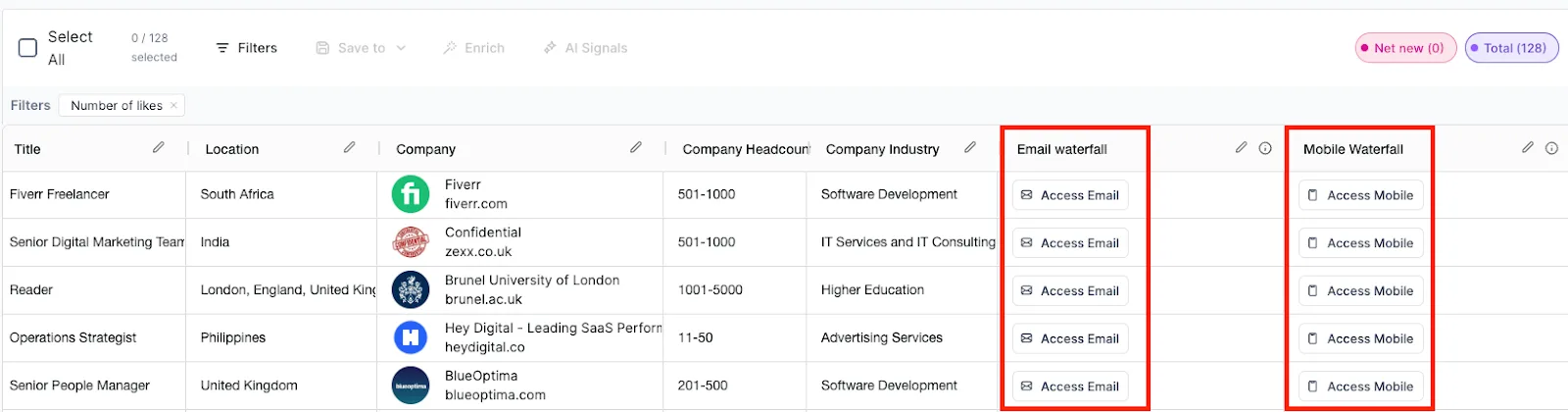
You can even access their emails immediately and push them directly into your outreach software.
Relationships Over Transactions
Here’s the truth: people don’t want to be sold to. They want help solving their problems.
The Network Effect Playbook is about starting conversations, not closing deals.
We’ll easily close the deal if we have a great relationship with the prospects beforehand (not to mention that deals would be bigger).
Comment on a prospect’s post, congratulate them on their recent promotion and share something valuable that addresses their pain points.
When you focus on relationships, trust builds naturally. And when the time comes to talk business, it doesn’t feel forced—it feels like the next step.
This approach is why The Network Effect Playbook campaigns see 20-30% reply rates.
It’s not magic. It’s just about being human.
If you’ve been treating LinkedIn like a numbers game, it’s time to stop.
The future of LinkedIn sales is about relationships, signals, and intent.
So, now that we have changed our approach to this game, how can we use all of this to generate B2B leads on LinkedIn?
It’s time for our actionable, step-by-step guide on how to get hundreds of B2B leads on LinkedIn.
Make your LinkedIn profile ready to get leads
No one will respond to you, let alone buy from you if you don’t have a proper LinkedIn profile.
You can find many tips online on how to make your profile page stand out and optimize your bio, summary, or LinkedIn banner.
But none of this matters if you don’t publish high-quality content.
Great LinkedIn profile is 10% profile optimization and 90% content worth reading.
So, how do we do that? I’m going to give you five most essential tips on how to write great content for LinkedIn, but first, let us just clarify one thing:
Creating great LinkedIn content isn’t about going viral. It’s about offering value and building trust with your audience. Whether you’re sharing a post, an article, or a video, the key is to focus on what matters to your target audience.
Focus on Your Audience’s Pain Points
LinkedIn content should address the challenges your prospects are facing.
Instead of talking about your product or service, share actionable tips, insights, or stories that resonate with their struggles.
For example, if your audience struggles with scaling their sales team, share a quick guide or lesson you’ve learned.
Here’s an example of Max’s posts that offered a solution to one of our audience's main problems: scaling outbound efforts without sacrificing the quality:
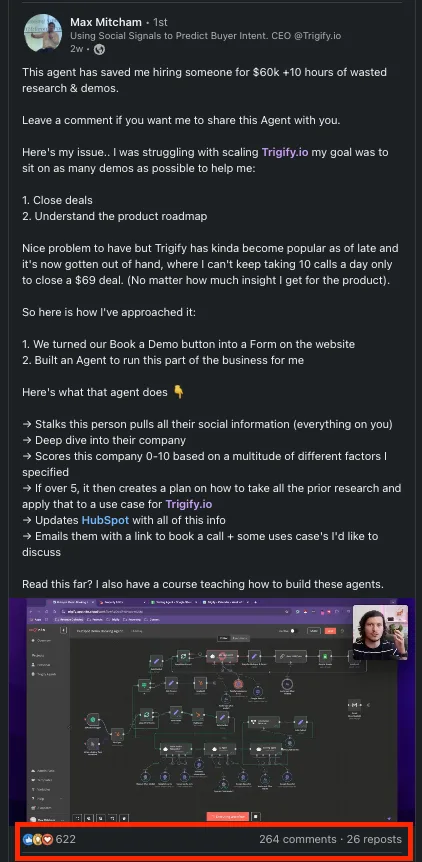
You will gain traction when you truly understand ICP’s pain points and offer genuine solutions and secret knowledge.
This post got 600+ likes, 260+ comments, and over 25 shares. Not bad.
Keep It Relatable and Personal
People connect with people, not companies.
Don’t be afraid to share personal experiences or stories that highlight your expertise in a way your audience can relate to.
A post that says, “Here’s a mistake I made and how I fixed it,” is more engaging than “Our product does XYZ.”
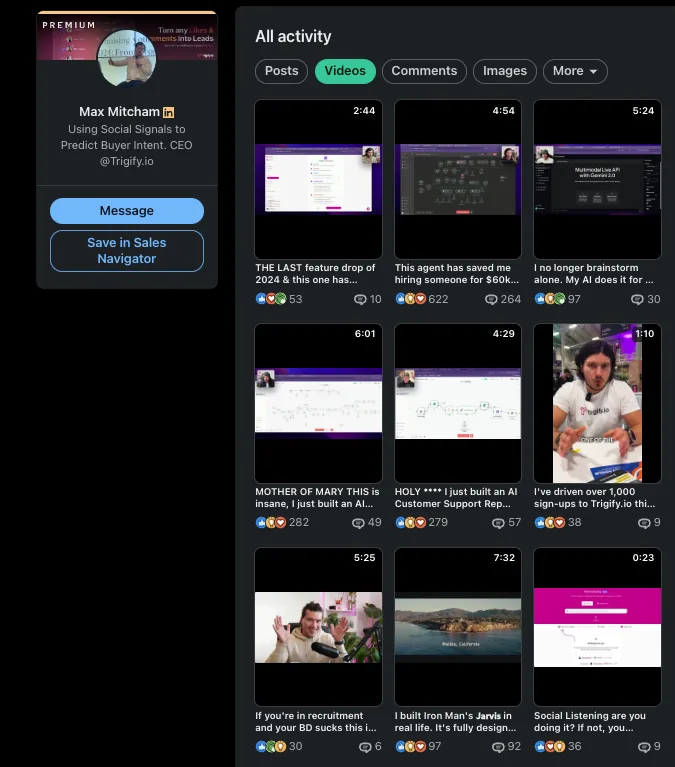
For example, one of the key reasons Max’s LinkedIn account got a lot of followers was that he used videos in almost every post to build better relationships with the audience (and for the people to connect with his voice and face).
Leverage Social Proof and Insights
Sharing data or success stories can make your content stand out. Max recommends using case studies or statistics to back up your points.
But keep it short—LinkedIn users don’t have time for essays.
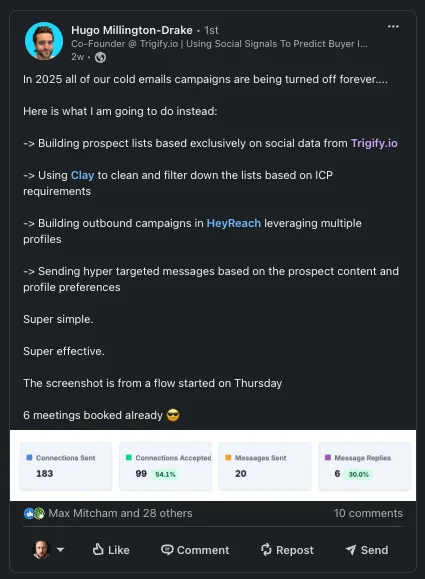
Here’s how Hugo from our team uses his results to get loyal fans and potential leads:
Use Strong Hooks
Your first line needs to grab attention.
Questions, bold statements, or intriguing insights work well.
For example, “Did you know 90% of LinkedIn messages go unread? Here’s how to fix that.”
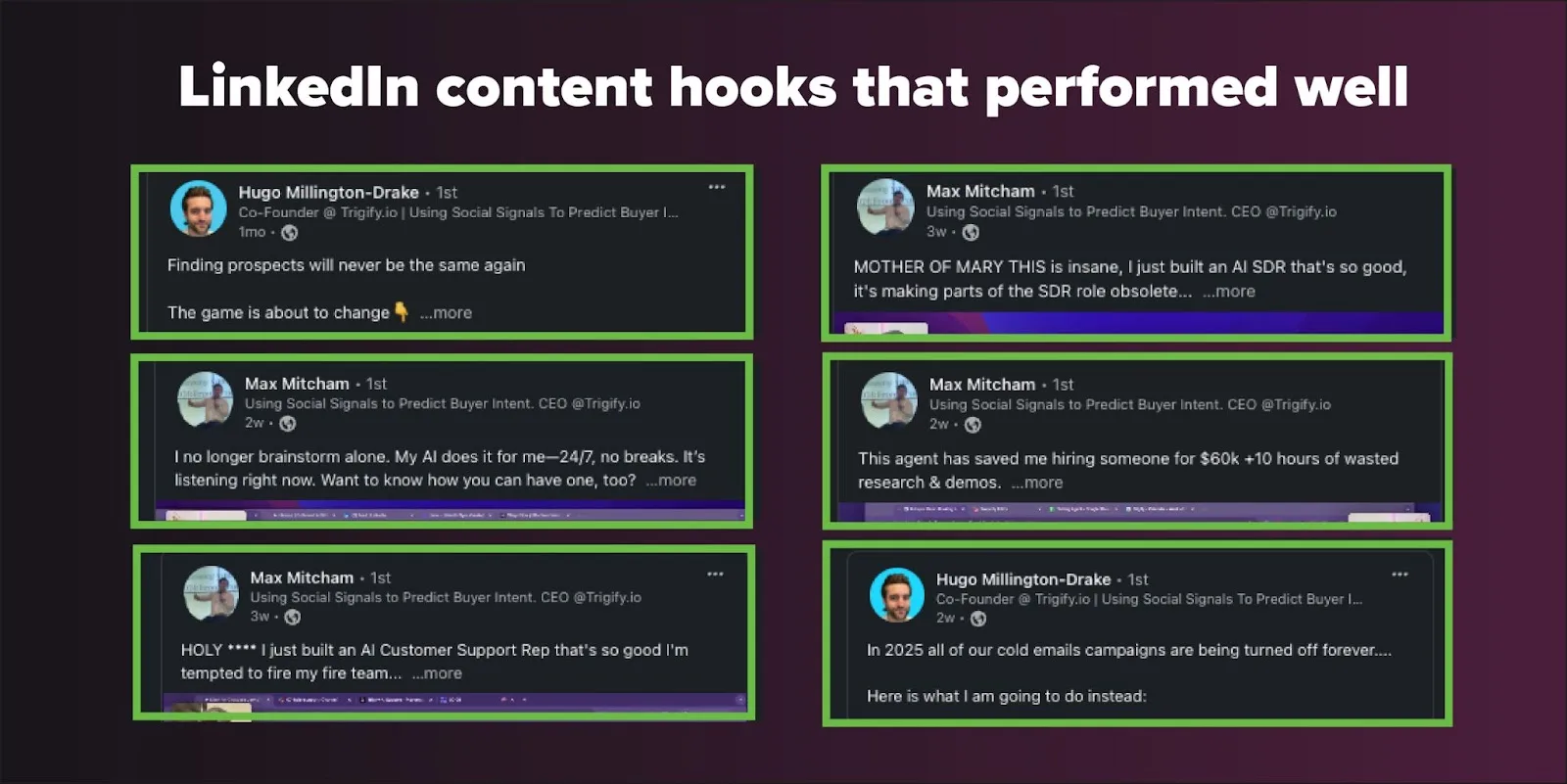
Here’s a small collection of the hooks that performed very well for our posts:
Be Consistent
Consistency is key. Posting 2-3 times a week is enough to keep your name in front of your audience without overwhelming them.
However, posting three times this week and then taking a two-week pause will nullify everything you have done so far.
So once you decide to get B2B leads from LinkedIn, start posting content at least three times a week and stick to it.
How to find B2B leads on LinkedIn by using social signals (The Ultimate Guide)
This is the funniest (and most important!) part.
I'm sorry for taking a bit longer to discuss this topic, but everything we have mentioned so far is crucial for understanding the overall process.
Finding B2B leads on LinkedIn is like navigating a crowded room. Everyone’s there, but how do you find the people interested in your offering?
This is where social signals and Trigify come into play.
Here are a few step-by-step guides to finding prospects on LinkedIn.
Track Competitors’ Engagements
Your competitors’ audience is often your ideal customer base. If someone is engaging with their content, there’s a good chance they’re interested in similar solutions.
You can use Trigify to monitor competitor posts and identify people who have interacted with them more than three times in the past 30 days (we’re using this filter to ensure the prospect is interested).
Company pages get less engagement, so focusing on top voices at competitor companies may be more lucrative.
For example:
Our competitor posted a guide on how to use ChatGPT prompts to generate email intro ideas for signal-based prospecting:
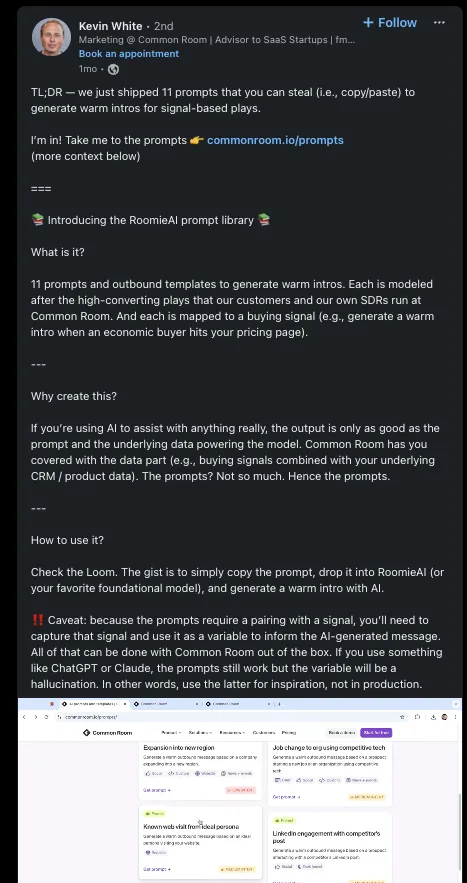
Our playbook is to now go to Trigify, see who engaged with this post, and if they show interest, we’ll start building a relationship with them by sending them a similar guide or a video (for example, how to use social signals to close more B2B leads)
- Create your Trigify account.
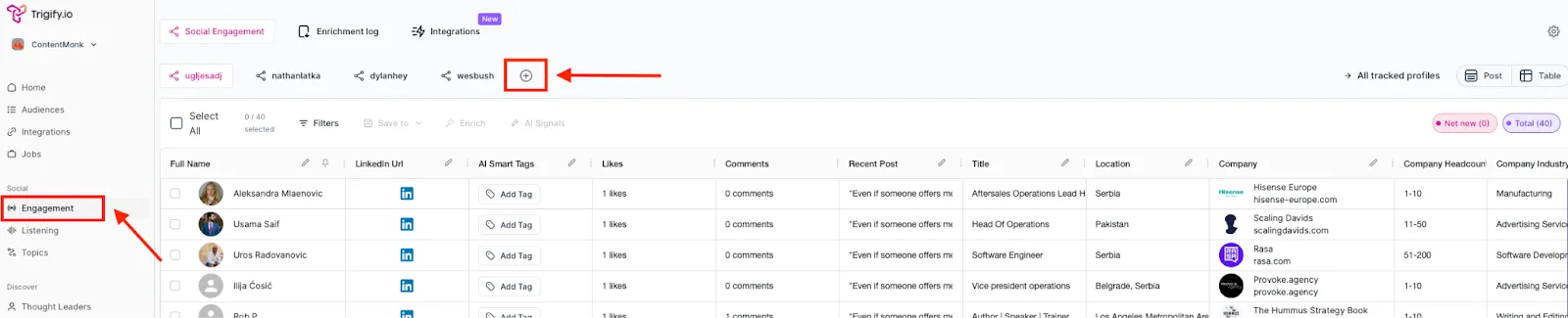
- Click on the Engagement tab on the left and then on the plus icon in the upper nav menu (to enable tracking of a new LinkedIn profile)
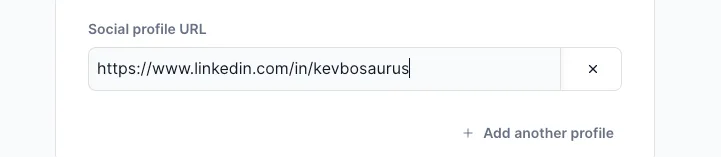
- Add a competitor profile URL and click Next. This will enable Engagement tracking for that particular profile.
- By default, Trigify displays a table of the competitors’ most active (and recent) engagers. However, in this case, we need to see people engaging with specific LinkedIn posts. Click the Posts button in the upper right corner to filter the view by posts.

- This will give you a list of the most recent LinkedIn posts. Find the one you need and click on it:
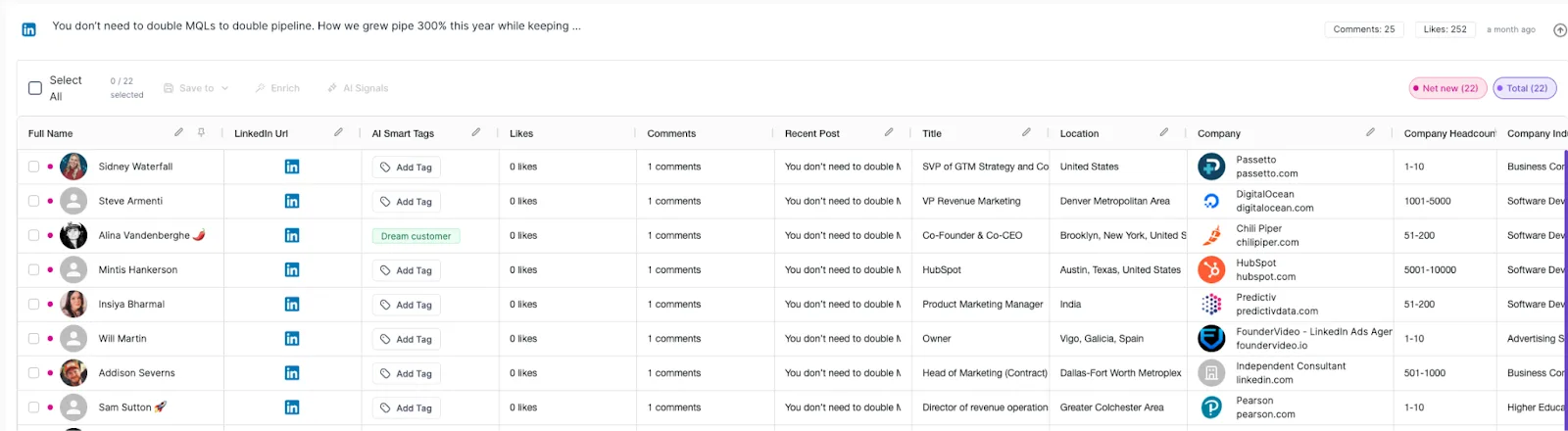
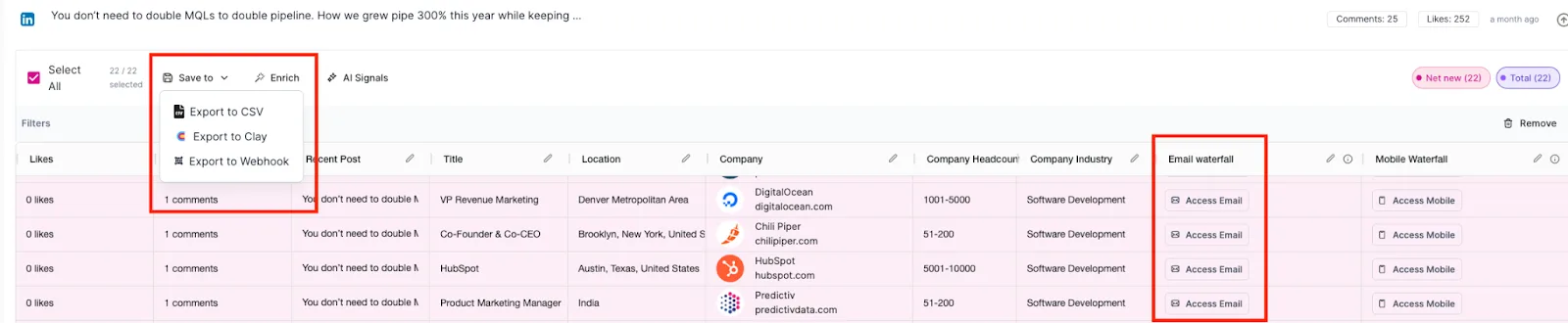
- Filter through the ones you like that fit your ICP profile, and export them. You can also access their emails and phone numbers straight from the Trigify:
Now that we know who our prospects are, what’s the next step?
The next step is the outreach!
You can reach out to them either by email or LinkedIn. Both approaches work, so test out what works best for you.
You can write your message once you import your list into an outreach tool, such as SmartLead, Instantly, HeyReach, Expandi, lemlist, or others.
Instead of going with a direct-sales approach, the goal is to build relationships first!
We’ll do that by sending them additional resources and high-quality content on the data they’re already interested in (the content they engaged with).
For example, we can send them our guide on how to close more leads on LinkedIn.
With that in mind, our message can go like this:
Hey {firstName},
_I saw on one of the posts you’re experimenting with using social signals in sales. I made a quick guide for my colleagues on how I used social signals to get 20+ meetings last month.
Thought you’ll find it interesting as well! {url}
P.S.
{competitorName} is a good source for this as well!_
Why is this message good?
- It’s relevant to their current interests (social signals)
- It doesn’t come off as promotional or made exclusively for getting leads (I made a quick guide for a colleague)
- It offers social proof + results to intrigue the prospect (20+ meetings last month)
- Cheesy personalization at the bottom (it’s less creepy than saying: I saw you liked XYZ post from Y person, as this would make it look like you’re stalking them).
That’s how you use competitors’ audiences to get relevant B2B leads on LinkedIn.
Let’s move to the next tactic.
Convert Influencers’ audience into new leads
This playbook is similar to the previous one - except that in this case, we don’t use competitors’ audience, but rather an audience from thought leaders and other content creators in the field.
Even the audience from “complementary companies” (companies that serve the same audience as you but are not direct competitors) can be useful.
The first step is to determine the best content creators in your industry.
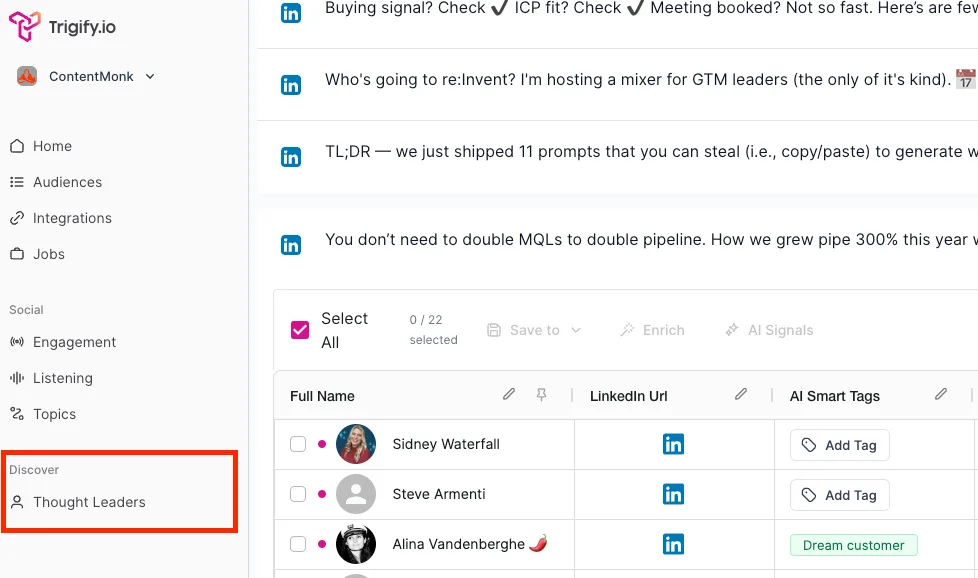
To do that, go to Trigify, and click on the Thought Leaders tab on the left side:
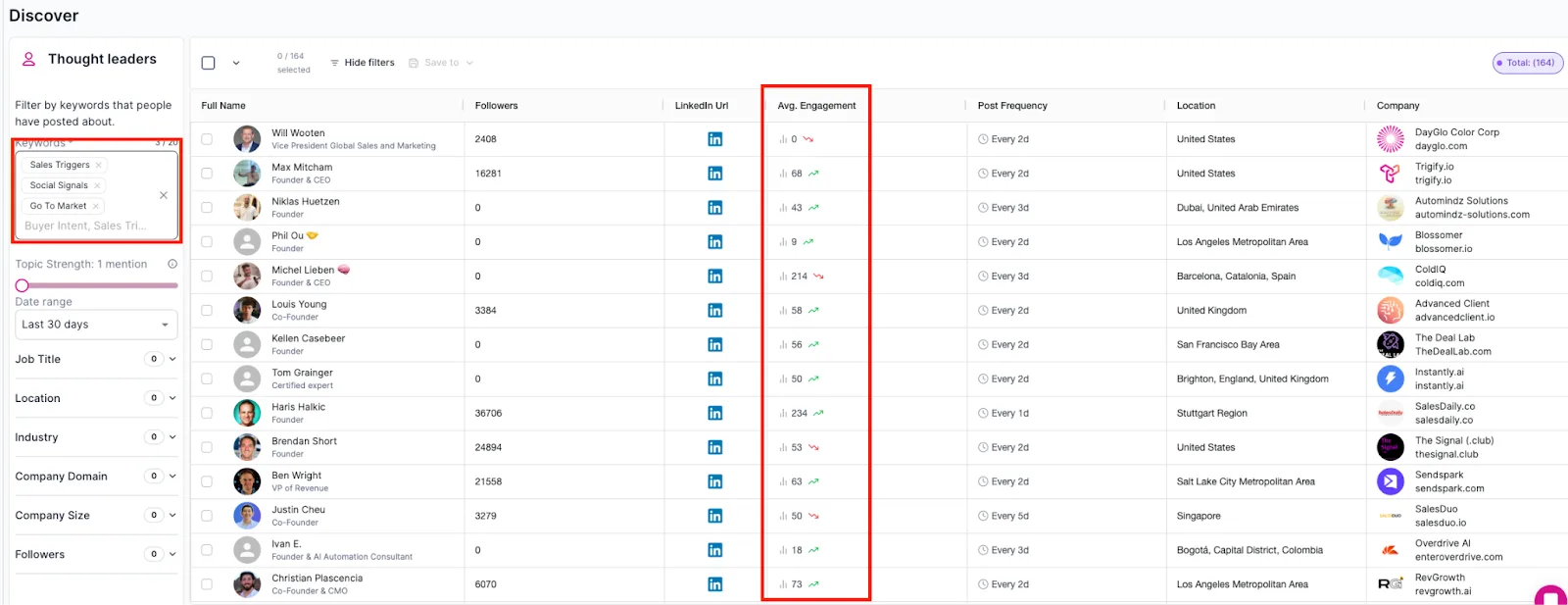
- Now, put filters on the left side. You can include the keywords (relevant to the content your audience likes) and other data such as job title, location, etc.
- This will give you a list of all content creators who fit your criteria. The table shows their average engagement per post so that you can focus on the ones with the most audience (and the best-quality content).
What do you do once you identify thought leaders?
Follow the playbook we described in the previous chapter.
Add influencers to the Engagement tab and monitor people who engage with their content.
Build your list of leads by selecting the ones that fit the most, and reach out to them by offering value and building relationships.
Find leads on LinkedIn who engage with specific topics
The first two playbooks were based on engaging with other people’s audiences.
This one is based on finding B2B leads on LinkedIn that engaged with specific topics in the near past.
Let’s say you have a lead magnet showing people how to build AI agents.
Instead of using a spray-and-pray method and distributing it to everyone, you can use Trigify to find people who recently engaged with relevant topics on LinkedIn, such as ChatGPT, or AI agents specifically.
How do you do this?
- Click on the Topics tab on the left side of your Trigify dashboard:
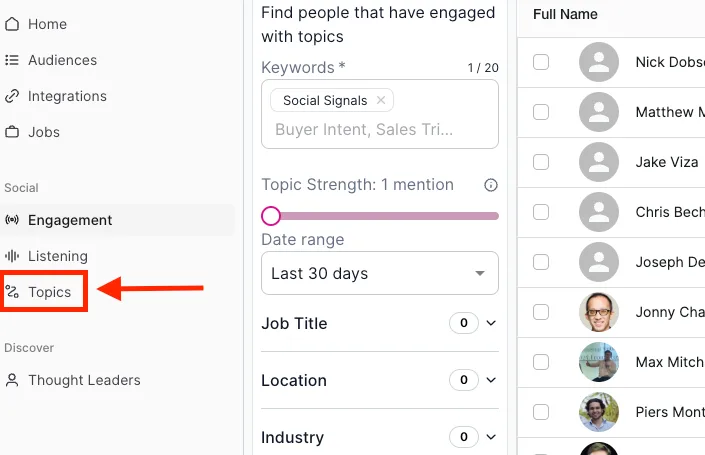
- You can enter the keywords you want and other filtering data (such as job title, location, etc.). In our case, 600+ founders engaged with ChatGPT or AI Agent topics in the past 24 hours.
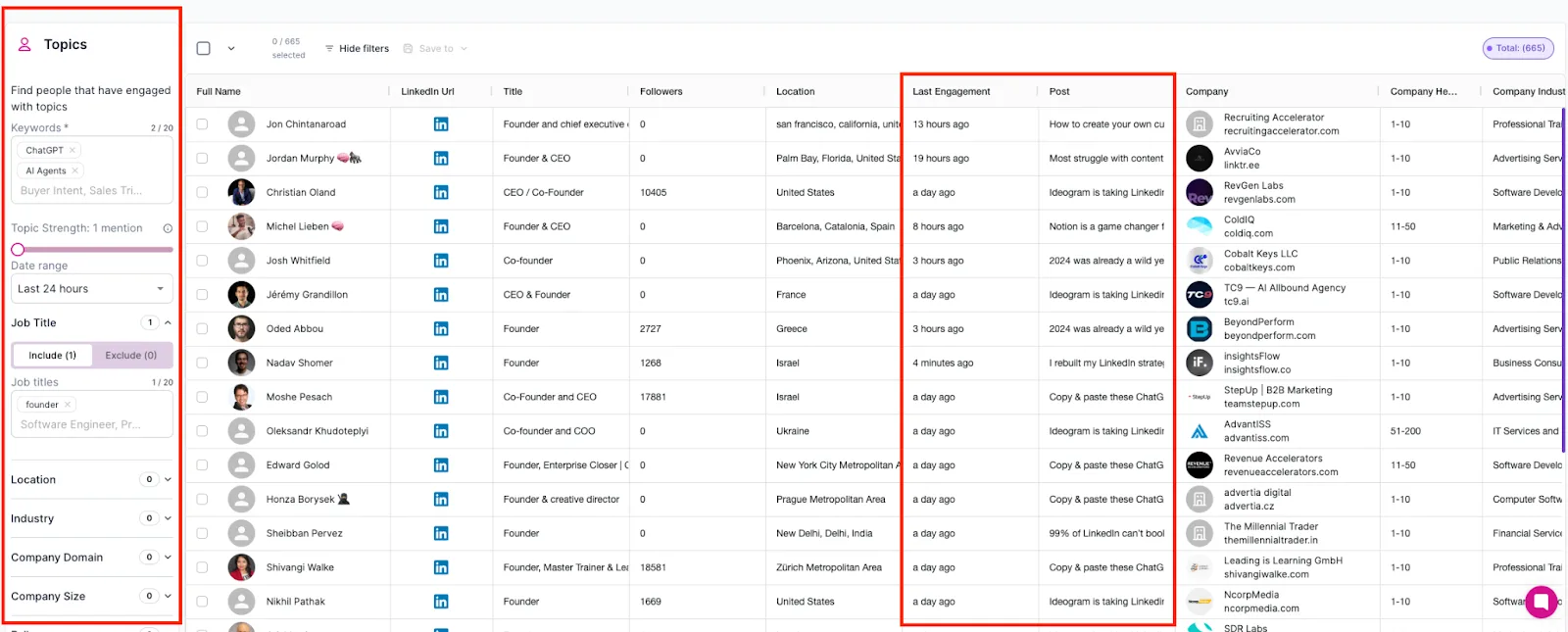
Once you export your leads, follow the same playbook as in the previous chapters.
How to write outreach messages that get replies?
To get B2B leads on LinkedIn, once we find our prospects, we need to write them emails (or LinkedIn messages).
Let’s go through the basic principles of cold outreach copywriting.
First of all, many people get it all wrong.
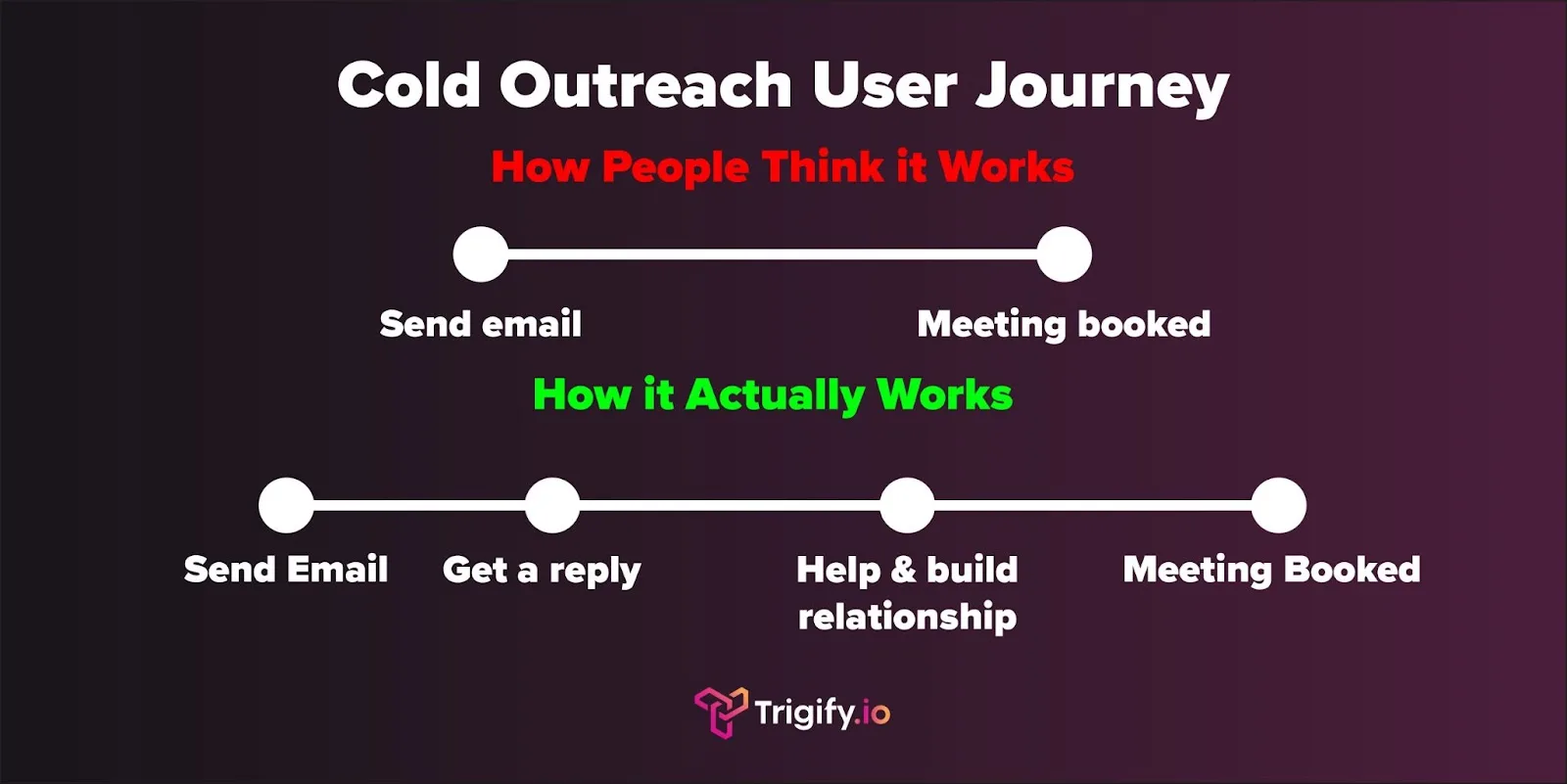
They think the primary goal of cold outreach is to sign a deal.
But guess what? That isn’t the goal at all!
Instead of using cold outreach to get more sales, you should use it to build more relationships.
The first goal is to get a reply. Then, use that reply to build a relationship.
Once you have a solid relationship with potential customers, they trust you more and are more likely to sign the deal with you (especially if we’re talking about high-ticket deals).
This section will show you how to write cold outreach messages that get you a 20-30% reply rate (based on psychology, copywriting, and human nature).
The Immutable Law of Copywriting
First, let’s change your perspective on how you should approach the writing of cold outreach messages.
Instead of blindly writing sentences that might appeal to your prospects, we need a more scientific approach.
The most important law of copywriting that you should always follow no matter what you write (whether it’s a LinkedIn outreach message, cold email, or even a LinkedIn post), is this:
Every sentence you write has a goal. The goal of the first sentence is to make your readers read the next. The goal of the next sentence is to make people read the next, and the next, and the next. Until they reach the end, where your last message should make them act.
You need to write your emails in a way that makes them want to read the entire email.
This doesn’t mean that you need to write essays. You should focus on short and crisp sentences but write them in a way that entices the reader to read the next sentence.
But how should you do this?
First, let’s look at the basic structure of cold outreach messages (that, again, most people don’t know).
The Four Pillars of Cold Outreach
Note: You’ll notice that I’m referring to this as “cold outreach messages” because the same principles can be applied to both LinkedIn outreach messages and cold emails.
There are four main pillars for a successful cold email outreach campaign:
- Relationship
- Hook
- Relevancy
- Achievable Dreams
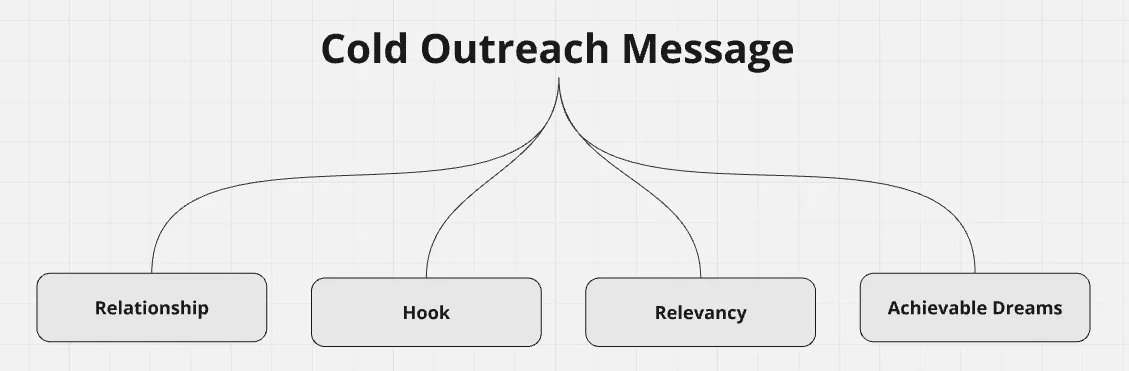
Let’s go through each one of them
The Relationship
The relationship happens outside of your cold email outreach campaign.
The best cold email campaigns are the ones that are not cold at all.
In other words, if someone knows you, they are more likely to respond to you.
They don’t need to know you in person, but knowing who you are and what you do will make them more likely to open your email or message and reply.
That’s why personal branding and publishing LinkedIn content, which we discussed at the beginning of this article, are essential.
In other words, warm cold email outreach always delivers a few times better results than cold outreach.
You can build a relationship with someone before reaching out by:
- Engaging with their content on LinkedIn or Twitter
- Engaging with the content of the people they follow (which is where our influencer and competitor playbooks that we discussed earlier come into the game).
People need to see and get to know you. When your message arrives in their inbox, they'll immediately know who you are.
The Hook
Relationships are nice to have. However, the following three pillars are a must.
Unlike the relationship, the hook is an actual part of your cold outreach message.
It’s the subject line and the first sentence that your prospects see.
In the case of cold emails and InMails, it’s both the subject line and the first sentence (since you can write a subject line).
In the case of ordinary LinkedIn messages, it’s just the first sentence.
Soon, we’ll explore how to write winning hooks that grab attention.
The Relevancy
Once you grab the attention with a hook, it’s time to hold it with relevancy.
Relevancy keeps them interested and engaged in what you have to say.
The relevancy can either be:
- Niche-relevant - something that’s relevant to the client’s niche
- Account-relevant - something that’s relevant to the specific account
Either way, the best way to find relevance is to address the pain they may be experiencing from the social signals we discussed in the first part of this massive guide on getting B2B leads on LinkedIn.
But, using relevancy and social signals in the outreach messages comes with a little danger:
It’s easy to mix up useful, helpful relevant information with relevant spam.
Over-personalization and using unnecessary things will scream SPAM from miles away.
For example, sentences that go like this:
Hey {firstName}, how’s the weather in {city}?; or even worse; Hey {firstName}, I saw you went to {university}, how it is to study there?; are obviously relevant spam.
On the other hand, sentences such as Hey {firstName}, congrats on raising series A a few days back! From my experience, founders in your stage need the most help scaling their hiring processes. Here’s a quick guide I made; it is better to show that you understand and care about their problems.
The Achievable Dreams
So far, we know that the hook is used to grab prospects’ attention. Relevancy helps us keep them engaged and interested in what we say, but how do we make them act and respond to us?
We do that by making their dreams achievable.
There are a few ways how you can do this:
- Offering value without asking for anything in return (my favorite!)
- With social proof (success stories from other people in the same industry as your prospects - use this if you wanna take the direct sales route)
- Good offer
- Showing people what their life can look like without the problems you’re solving
- Or by simply mentioning the benefits
- A unique one to us is running their profiles through our system to show them the leads they are missing out on.
I always take the first approach (offering value) because it helps me build the best relationships with prospects.
These would be the four key pillars of cold outreach messages.
Use them to your advantage to get replies.
However, to make your messages more effective (and help you not stray away), here are a few tips on writing effective emails and LinkedIn messages to get B2B leads on LinkedIn.
Final tips for writing cold outreach messages that get you B2B leads on LinkedIn
Everything we have mentioned so far in this article is a must if you want to get B2B leads on LinkedIn.
However, the following is a niche guidebook and reminder on writing cold outreach messages that get you replies and deals. Print it out somewhere and always visit it when creating new campaigns.
Relevance Over Personalization
Overpersonalization, such as “I see you love hiking,” feels awkward and forced. Instead, tailor your message to the prospect’s business needs or, even better, the pain they may be experiencing.
For example:
Instead of: “I noticed you went to Cambridge—must’ve been great!”
Try: “I saw your company just raised funding—congratulations! I’m sure there is a lot of expectation for you to scale your team. Here’s a quick guide on scaling sales teams post-funding.”
Focus on problems or opportunities your prospect is actively facing. This will make your message feel relevant and valuable.
Use Social Signals to Start the Conversation
Social signals - like a promotion, funding announcement, or engagement with industry posts - are the perfect conversation starters. But don’t jump straight to pitching.
For example:
“Congrats on your promotion to VP of Sales! Many new VPs focus on building 30-60-90-day plans. I’ve created a resource that might help - would you like me to send it?”
This approach builds trust and positions you as a helpful contact instead of just another salesperson.
Keep It Short and Clear
People skim messages, especially on LinkedIn or email. Here’s how to keep yours tight:
- Start with a strong hook: “Did you know 80% of VPs feel overwhelmed in their first 60 days?”
- Keep your message to two to three sentences long. Address a specific problem, offer value, and include a clear call to action.
- End with a simple ask: “Would you like me to send over more details?” or “Is a quick call next week an option?”
Offer Lead Magnets
Lead magnets are a secret weapon. They give prospects a reason to respond without committing to anything.
For example:
“I noticed you’ve been engaging with posts about sales automation. I’ve created a one-pager on automating without losing quality—want me to share it?”
This shows you’ve done your homework and positions you as a trusted resource.
Avoid Sounding Robotic
It’s not forbidden to use AI to structure your messages, but make sure they don’t feel automated.
Use a conversational tone that shows genuine interest.
Messages should feel tailored, even if they’re not deeply personalized.
Follow Up Without Overdoing It
Limit your follow-ups:
- Email - Send a maximum of two follow-ups.
- LinkedIn - If they haven't responded, send a polite reminder after a week.
Keep follow-ups short and focused, such as “Just following up—let me know if the guide would be helpful.”
This approach keeps your outreach respectful and professional.
The Bottom Line
So far, we learned that:
- You don’t need to contact too many people. Quality always beats quantity, so don’t burn your entire TAM.
- Personalization is not the most important aspect of getting B2B leads on LinkedIn. Instead, relevant outreach backed up by social signals always delivers great results. Outreach should be relevant, not personalized.
- You must deeply understand your ICP and its challenges to plan your outreach and create campaigns that book meetings.
- Use The Network Effect playbook to find prospects interested in your solution right now - there’s no better prospecting method. You can use Trigify to:some text
- Track Competitors Engagement and reach out to people who engage with your competitors
- Convert Influencers’ and Thought Leaders’ audience into your customers
- Identify leads who engage with specific topics
- Reach out to prospects who are hiring for specific jobs
- To write effective cold outreach messages that have a 20-30% reply rate, you need to:some text
- Follow the immutable law of copywriting
- Build your cold outreach campaign around the four pillars (relationships, hook, relevancy, achievable dreams)
- Keep your emails and LinkedIn messages short, crisp, relevant, and straight to the point.
- Remember - the goal of cold outreach is not to get leads, but rather to build relationships. Look at it that way, and the B2B leads on LinkedIn will come.
All of this is a lot, so what’s the first step?
The first step is to use social signals to identify prospects who have the problems you solve.
You can take Trigify’s free trial, and start executing the playbooks we mentioned right now.