What is Brand Tracking? Definition & Best Practices
Learn what brand tracking means for B2B companies, key metrics to measure, and best practices to monitor brand health and outperform competitors.
In the B2B world, perception is everything. But how do you actually measure what buyers think about your brand? That is where brand tracking comes in.
Brand tracking is the process of continuously measuring how your brand performs within its market and relative to competitors over time. Unlike one-off brand surveys, tracking creates a sustained view of your brand health, allowing you to spot perception shifts before they impact your bottom line.
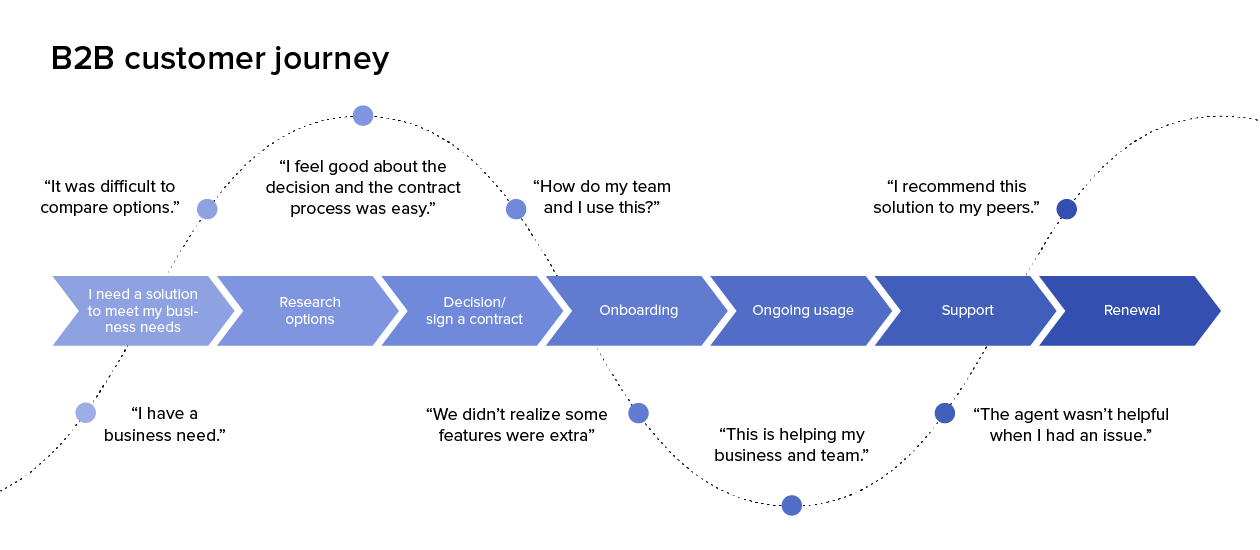
For B2B companies specifically, brand tracking matters even more. With an average B2B customer journey lasting 211 days and involving an average of 6.8 stakeholders across 3.7 channels, you cannot afford to wait for quarterly surveys to tell you something went wrong. The stakes are higher, the sales cycles are longer, and the decision-making process is more complex.
In this guide, we will define brand tracking for B2B, explore the key metrics you should monitor, and share best practices that help you stay ahead of perception shifts and outpace your competitors.
What is Brand Tracking?
Brand tracking is a continuous research methodology that measures how your brand is performing within your market and compared to competitors. It is not a single snapshot. It is an ongoing measurement system that monitors changes in brand perception, awareness, consideration, and preference over time.
Think of brand tracking as your brand health dashboard. Just as you would not run a business by checking revenue once a year, you should not measure your brand perception only when you launch a campaign or rebrand. Brand tracking gives you real-time (or near real-time) visibility into how your target audience views your brand at any given moment.
Why Brand Tracking Matters for B2B
The B2B buying process is fundamentally different from B2C. According to research from Dreamdata, B2B deals require an average of 76 different touchpoints before a purchase decision is made. These touchpoints span months, involve multiple stakeholders from different departments, and cross numerous channels.
When your customer journey spans over seven months and requires convincing nearly seven different people, you need to know how each interaction shapes their perception of your brand. Are your sales enablement materials reinforcing the right positioning? Is your LinkedIn presence building credibility? Are prospects associating your brand with the key attributes that matter most to decision-makers?
Brand tracking answers these questions before your pipeline does.
Additionally, traditional performance metrics like click-through rates and lead conversion tell you what happened, but not why. Brand tracking metrics tell you the underlying perceptions driving those behaviors. When brand awareness climbs but purchase intent does not, you have uncovered a positioning problem. When sentiment declines in a key market segment, you know to investigate before revenue follows.
[
](https://app.trigify.io/sign-up)
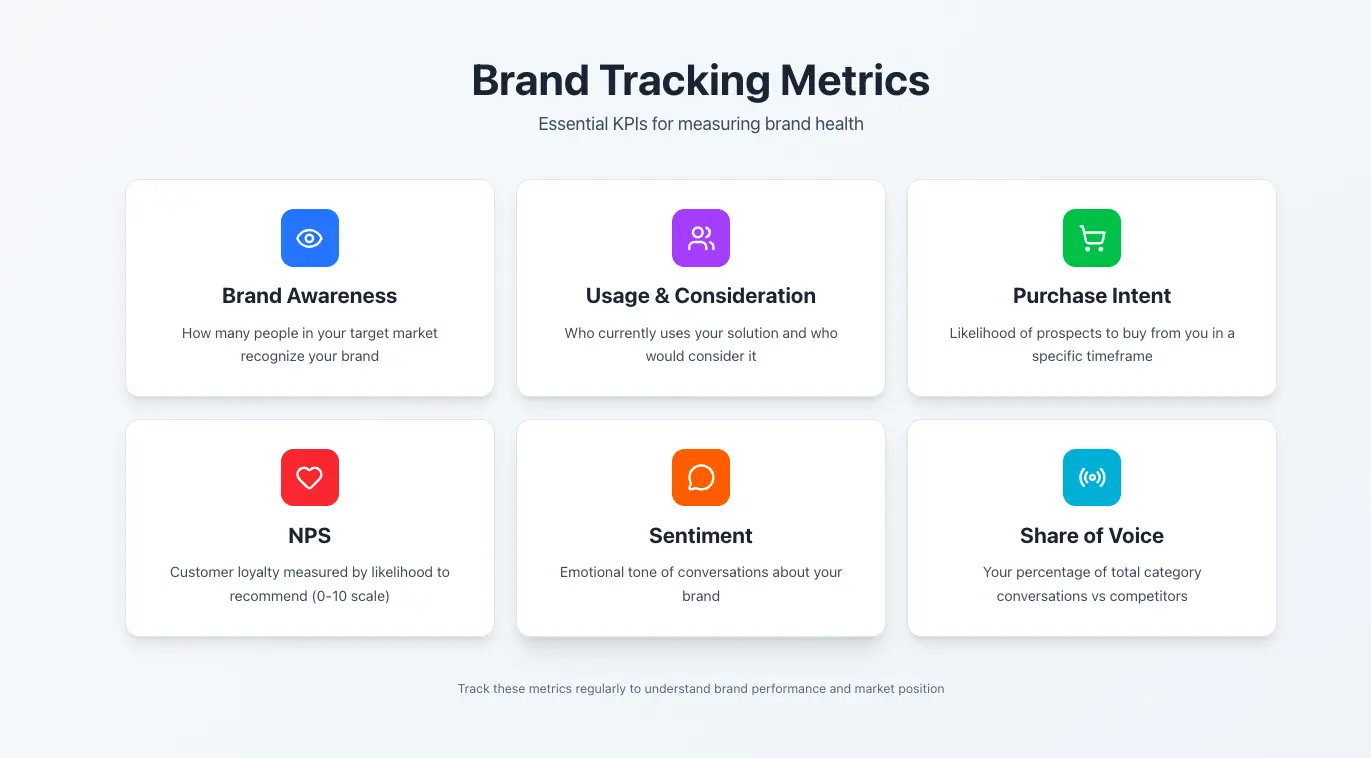
Key Brand Tracking Metrics for B2B
Now that you understand what brand tracking is and why it matters, let us explore the essential metrics every B2B company should measure.
1. Brand Awareness
Brand awareness measures how many people in your target market know your brand exists. In brand tracking studies, awareness is typically measured in three ways:
- Top-of-mind awareness: The first brand a respondent mentions when thinking about your category
- Spontaneous (unaided) awareness: Brands mentioned without prompting
- Prompted awareness: Recognition when your brand name is shown alongside competitors
For B2B brands, awareness must be measured among the right people. It does not help if everyone has heard of you if your ideal customer profile (CFOs at mid-market SaaS companies, for example) has never encountered your brand.
According to B2B International research, tracking awareness across different stakeholder levels is crucial in B2B. The executive who approves budgets may have different awareness patterns than the manager who evaluates solutions day-to-day.
2. Brand Usage and Consideration
Usage tracks how many prospects in your market currently use your solution, while consideration measures how many would consider your brand when making a purchase decision.
These metrics are particularly important in B2B because switching costs are high. Even if awareness grows, prospects may not consider your brand if they perceive the risk of switching as too high or if you have not established credibility in key evaluation criteria.
3. Purchase Intent
Purchase intent measures how likely prospects are to buy from you in a specific timeframe. This forward-looking metric helps predict future pipeline health.
In B2B, asking about purchase intent requires contextualizing the question properly. Instead of "Would you buy this product?" you might ask "When your current contract expires, how likely are you to evaluate [your brand] as a replacement?"
4. Net Promoter Score (NPS)
NPS measures customer loyalty by asking: "On a scale of 0-10, how likely are you to recommend our brand to a colleague?"
Respondents who score 9-10 are promoters, 7-8 are passives, and 0-6 are detractors. Your NPS is the percentage of promoters minus the percentage of detractors.
In B2B, NPS is particularly powerful because business buyers rely heavily on peer recommendations. A strong NPS often correlates with organic growth through word-of-mouth and referrals, which tend to close faster and at higher rates than cold outbound leads.
5. Brand Sentiment
Sentiment measures the emotional tone of how people talk about your brand. Is the conversation positive, negative, or neutral?
Brand sentiment has moved beyond survey-only measurement. With social listening tools (more on this later), you can now track sentiment in real-time based on actual online conversations, not just survey responses.
Sentiment is especially valuable when tracked over time and by audience segment. A decline in sentiment among existing customers signals churn risk. A spike in negative sentiment in a specific industry may reveal a competitive threat or product issue before it impacts sales.
6. Share of Voice
Share of voice measures what percentage of the total conversation in your category belongs to your brand compared to competitors.
For example, if 100 conversations happen about social media management tools this month, and your brand is mentioned in 25 of them, you have a 25% share of voice.
This metric is crucial for understanding your competitive position. You can have strong brand awareness in absolute terms but still be losing ground if competitors are capturing a growing share of the conversation.
Best Practices for B2B Brand Tracking
Understanding what to measure is just the first step. How you measure it determines whether your brand tracking program delivers actionable insights or just more data to ignore. Here are four best practices that separate effective brand tracking from wasted research budgets.
1. Know Your Audience: Target the Right Decision-Makers
Brand tracking is useless if you are measuring the wrong people. In B2B, this means identifying not just your target companies, but the specific roles and stakeholders within those companies.
For example, if you sell marketing automation software, you need to track brand perception among:
- Marketing operations managers (who use the tool daily)
- CMOs (who approve the budget)
- IT/security teams (who approve the vendor)
These stakeholders have different priorities and interact with your brand differently. Your brand tracking sample must reflect this reality. Definition Agency emphasizes that "brand tracking can become redundant if it is not targeted towards the right people."
Carefully screen survey respondents to ensure they match your ICP. Use firmographic filters (company size, industry, revenue) and job title filters. Do not dilute your data by tracking perception among people who would never buy from you.
2. Be Consistent: Do Not Change Your Questions
One of the biggest mistakes in brand tracking is changing question wording between waves. When you alter phrasing, you can no longer compare results over time. What looks like a shift in brand perception may just be respondents interpreting a different question.
Research best practices from Definition Agency state: "Changing key words or question phrasing over the course of brand tracking can have a huge impact on scores and create false reads on the data."
Lock in your core tracking questions from wave one. These should remain unchanged for at least 12-18 months. If you must update questions due to market changes or business pivots, track both old and new wording for one wave to establish a bridge between measurement periods.
3. Contextualize Metrics: Pair with Supporting Questions
Raw metrics without context tell incomplete stories. When purchase intent drops, is it because your product positioning weakened, or because budget freezes hit your target market?
Pair your core brand tracking KPIs with diagnostic questions that explain changes. For example:
- Awareness + "Where did you first hear about [brand]?"
- Purchase intent + "What factors would most influence your decision?"
- NPS + "What is the primary reason for your score?"
This contextualization transforms brand tracking from a scoreboard into a strategic tool. Instead of just knowing sentiment declined, you know it declined because a competitor launched a feature your customers wanted.
4. Combine Quantitative and Qualitative Research
Numbers tell you what changed. Qualitative research tells you why.
While brand tracking relies heavily on quantitative surveys (which allow for statistical significance and trend analysis), the most valuable programs supplement with periodic qualitative research.
When you notice unexpected shifts in your tracking data, deploy quick qualitative methods:
- Customer interviews: Talk to 10-15 customers or prospects to understand the "why" behind score changes
- Social listening: Analyze actual conversations to see how people talk about your brand in their own words
- Win/loss analysis: Interview recent buyers and lost deals to understand perception at the moment of decision
According to Determ's brand tracking research, "it is inevitable that there will be shifts in the data that cannot be explained by brand tracking alone or need further exploration. For shifts that are business critical, pairing the tracking with some qualitative research allows for understanding of the why around consumer behavior."
How Social Listening Powers Modern Brand Tracking
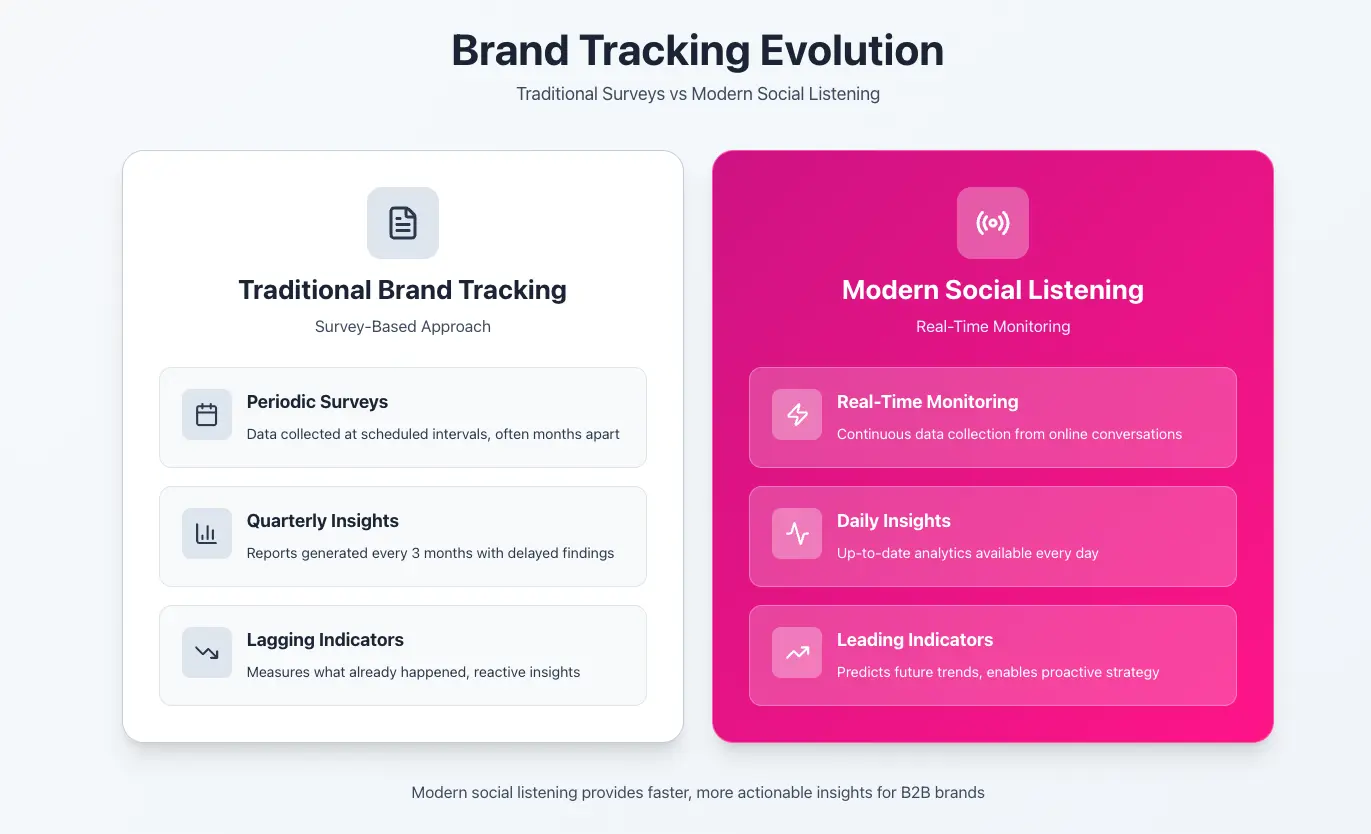
Traditional brand tracking relies on periodic surveys. You design questions, recruit respondents, field the survey, wait for responses, analyze data, and generate insights. This process can take weeks and provides a snapshot of perception at a single point in time.
But in today's B2B landscape, brand perception shifts happen in real-time. A competitor announces a major product update. A customer posts a frustrated LinkedIn rant about your support team. An industry analyst publishes a report that reshapes how buyers think about your category.
If you are waiting for your quarterly brand tracker to tell you about these shifts, you are already behind.
The Real-Time Complement to Traditional Tracking
This is where social listening transforms brand tracking from periodic to continuous.
Social listening tools monitor online conversations across social media, news sites, blogs, forums, and review sites. Instead of asking people what they think in a survey, social listening captures what people actually say when they are not being asked.
For B2B brands, LinkedIn is the most critical platform to monitor. It is where your buyers share insights, ask for recommendations, discuss vendors, and shape perception among their peers. According to Dreamdata's research, LinkedIn delivers 113% return on ad spend for B2B companies versus 78% for Google Search and just 29% for Meta. That audience engagement makes LinkedIn conversations a goldmine for brand tracking insights.
Social listening allows you to track:
- Real-time mentions: See every time your brand is mentioned, by whom, and in what context
- Competitive mentions: Track how often competitors are mentioned alongside you and what comparisons people make
- Sentiment shifts: Detect changes in how people talk about you before they show up in surveys
- Topic associations: Understand what themes, problems, and use cases people connect with your brand
- Influencer conversations: Identify who shapes opinion in your market and what they are saying
From Surveys to Continuous Monitoring
The most sophisticated B2B brands use social listening as the real-time layer on top of traditional brand tracking surveys. Surveys establish baselines and measure statistically significant shifts across large samples. Social listening provides early warning signals and explains the narrative behind the numbers.
For example, your quarterly brand tracker might reveal a 5-point drop in brand sentiment. But your social listening tool identified the cause two weeks ago: a popular LinkedIn influencer in your industry published a critical post about your pricing that generated hundreds of comments. Without social listening, you would be guessing at the cause. With it, you know exactly what happened and can respond strategically.
How Trigify Transforms B2B Brand Tracking
Remember that 211-day B2B customer journey? You cannot afford to wait months to discover that perception is shifting. By the time your quarterly brand tracker reveals a problem, you have already lost deals.
This is where Trigify changes the game.
Trigify is the modern, agentic approach to brand tracking. Instead of waiting for survey results, Trigify continuously monitors social conversations, particularly on LinkedIn where B2B buying decisions are shaped. Our AI-powered agents track brand mentions, sentiment shifts, and competitor movements as they happen, giving you real-time visibility into your brand health.
With Trigify, you can:
- Monitor brand perception 24/7: Never miss a conversation about your brand, competitors, or industry
- Track sentiment in real-time: Detect perception shifts the moment they emerge, not weeks later
- Benchmark against competitors: See your share of voice and sentiment compared to competitors, updated daily
- Identify brand advocates and detractors: Know who is championing your brand and who needs attention
- Understand positioning gaps: See what themes and attributes prospects associate with you versus competitors
Instead of asking people what they think once per quarter, Trigify captures what they actually say every single day. It is the continuous brand tracking system that complements your traditional research and keeps you ahead of market perception.
Explore Trigify's features to see how social listening transforms brand tracking, or view our pricing to find the plan that fits your needs.
Make Brand Tracking Continuous, Not Periodic
Brand tracking is no longer optional for B2B companies. With longer sales cycles, more stakeholders, and increasing competition, understanding how your target market perceives your brand is essential to staying competitive.
The key metrics (awareness, usage, intent, NPS, sentiment, and share of voice) provide a comprehensive view of brand health. The best practices (targeting the right audience, staying consistent, contextualizing data, and blending quantitative with qualitative research) ensure your tracking program delivers actionable insights.
But in an always-on digital world, periodic surveys alone are not enough. Modern B2B brand tracking requires continuous monitoring through social listening. You need to see conversations as they happen, detect sentiment shifts in real-time, and understand competitive positioning before it impacts your pipeline.
That is exactly what Trigify delivers. Our agentic social listening platform tracks your brand health continuously, giving you the insights you need to stay ahead of perception shifts and outmaneuver competitors.
Ready to move beyond quarterly surveys to real-time brand tracking? Try Trigify free