Intent Data vs Social Listening for ABM: Which Signal Layer Should You Trust?
Compare intent data vs social listening for ABM, where each fits, and how B2B teams should stack both signal layers.

Most ABM teams do not have a data shortage. They have a trust problem.
Intent platforms promise scale. Social listening gives you visible triggers. The hard part is deciding which signal layer deserves action when an account enters view.
For most B2B teams, the answer is not picking one and ignoring the other. Intent data is useful for coverage and account prioritisation. Social listening is stronger when you need freshness, context, and a clear reason to change messaging or route sales attention. If you want the wider operating model behind that stack, start with our pillar guide to social listening for account-based marketing. If you want the engagement layer that often sits inside it, read 15 LinkedIn engagement signals that show an account is moving in-market.
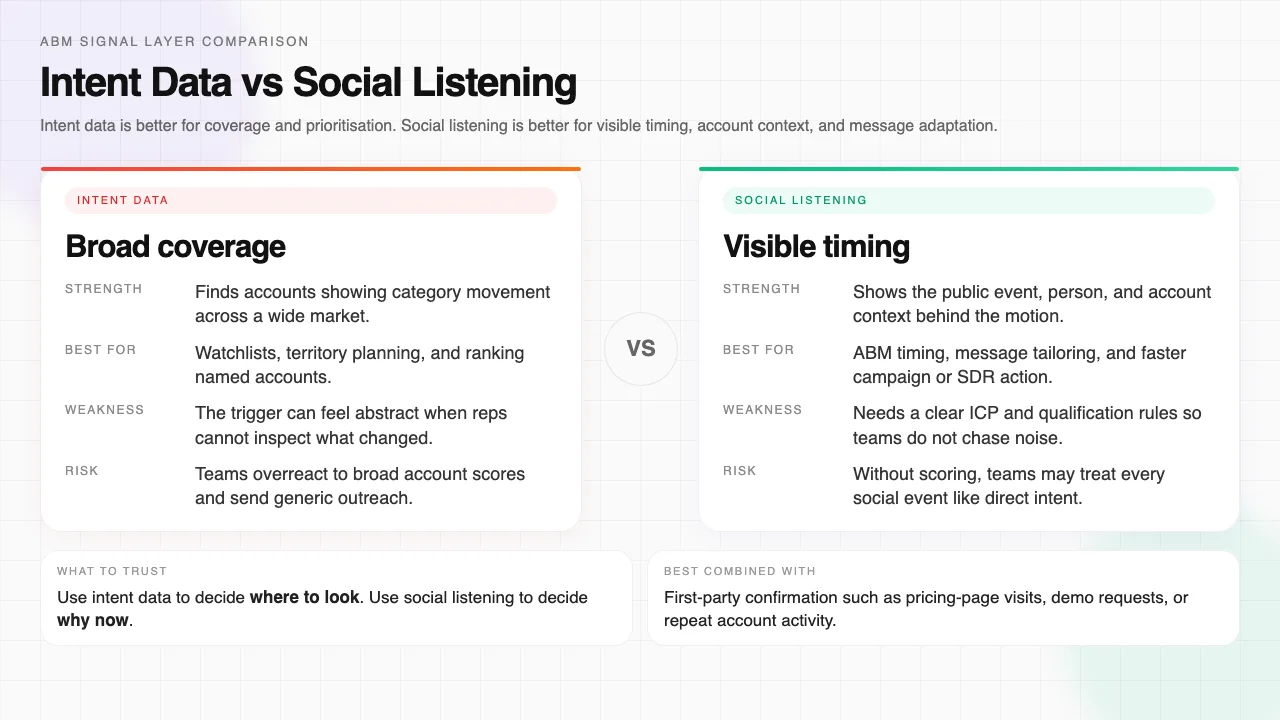
What intent data and social listening each tell you
Intent data usually tells you that an account may be researching a category. Depending on the provider, that signal can come from publisher networks, content consumption, review-site activity, first-party website behaviour, or topic surges packaged into an account score.
Social listening tells you what happened in public and why it may matter now. That can include LinkedIn engagement, competitor-post interaction, hiring changes, founder comments, recommendation requests, event chatter, or category pain surfacing in a real conversation.
That difference matters because the two sources answer different ABM questions.
- Intent data answers, "Which accounts should we watch more closely?"
- Social listening answers, "What changed, who moved, and what should we do next?"
ABM teams usually need both. The mistake is expecting both layers to do the same job.
Why intent data still matters in ABM
Intent data earns its place because it widens the market you can see. If your category has low branded demand or only a small share of buyers will touch your site early, intent tools help you build a broader priority map.
That is useful in three situations.
- you are working a large total addressable market and need a fast way to narrow accounts
- your outbound team needs ranked territory coverage, not a static named-account list
- you want earlier awareness of category research before a buyer engages your brand directly
This is why intent data often works best as a planning and prioritisation layer. It helps marketing choose which accounts deserve tailored air cover. It helps sales decide which named accounts should move up the queue.
The weakness is transparency. Many teams get an account-level score without enough evidence behind it. When the rep cannot inspect the underlying trigger, trust drops. That is a real problem in ABM because good campaigns depend on message precision, not just account selection.
Where social listening is stronger
Social listening is usually stronger when your team needs explainable timing.
A comment on a competitor post, a founder asking for recommendations, or a burst of engagement around hiring for demand gen tells a very different story from a generic topic spike. The signal is visible. It is easier to tie to a person, a role, and a likely initiative.
That makes social listening more useful for:
- message relevance, because you can see the language and the problem in public
- faster routing, because the trigger is fresh and easier to qualify inside a 24 to 48 hour window
- account context, because the behaviour can be tied to named stakeholders instead of an anonymous surge
- cross-functional ABM, because marketing can turn the same signal into audience selection, content, and sales enablement
Our Trigify Brain keeps reinforcing the same category shift: the winning lane is not generic monitoring. It is public trigger, judgement, then workflow action. That fits ABM better than black-box scores because teams can adapt messaging around something real.
Intent data vs social listening: the trade-offs that actually matter
The real trade-off is not old versus new. It is breadth versus clarity.
- Coverage: intent data usually wins because it can surface more accounts across a wider market.
- Freshness: social listening often wins because the public trigger is immediate and tied to a moment.
- Transparency: social listening wins when buyers and reps need visible evidence behind the alert.
- Actionability: social listening usually produces a clearer next move, while intent data often needs more qualification.
- Scale: intent data is better for territory planning and broad prioritisation.
- Message quality: social listening is better when you need to tailor outreach, ads, or content around a live problem.
That is why ABM teams should stop asking which source is universally better. The better question is which layer you trust for which decision.
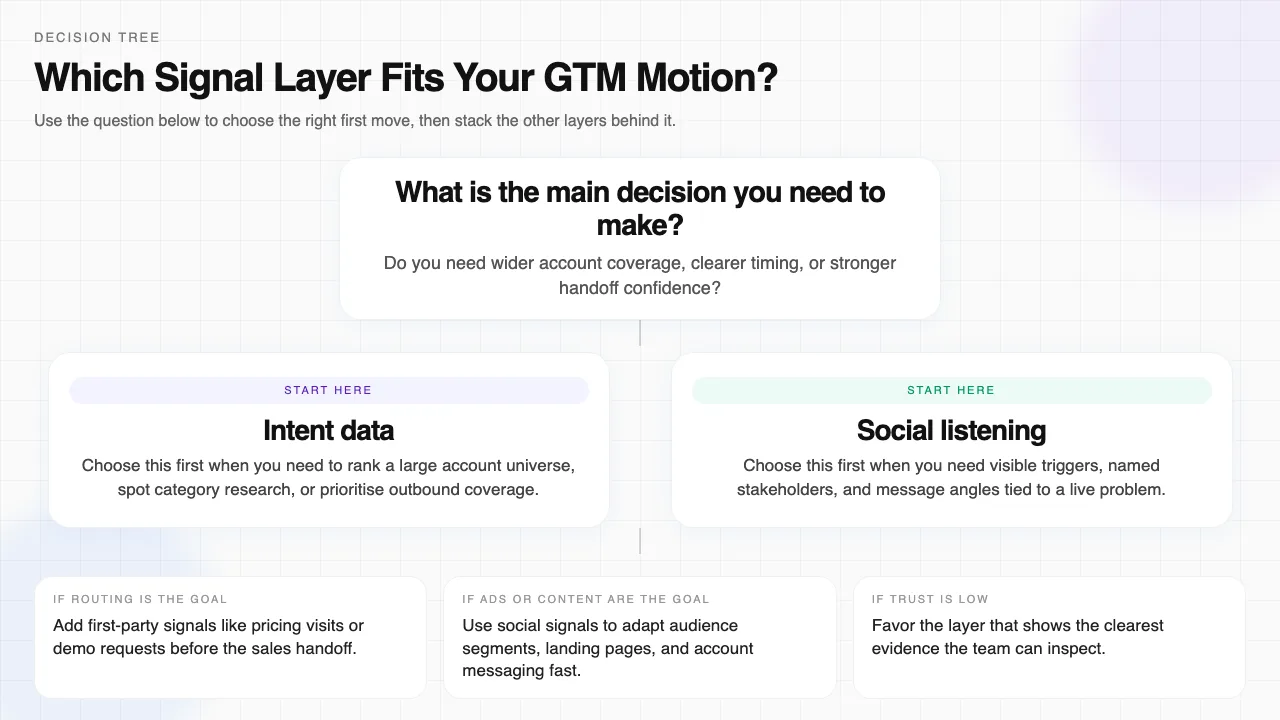
Which signal layer should you trust for each ABM job?
The simplest answer looks like this.
- Trust intent data for account prioritisation. It helps you decide where to look first across a large universe.
- Trust social listening for campaign timing and message adaptation. It helps you understand what changed and how to respond.
- Trust your first-party data for final routing. If the account then visits pricing, engages a use-case page, or converts in-product, the handoff becomes much stronger.
That layered approach lines up with how modern signal-based selling is evolving. Operators do not want more alerts. They want a system that tells them who is moving, why now, and what to do before the window closes.
This is also where many intent-led ABM programs stall. They create a ranked account list, but the downstream team still lacks context. Without that context, sales falls back to generic outreach and marketing falls back to broad nurture.
The strongest ABM setup is a stacked signal model
The best-performing setup is not intent data alone or social listening alone. It is a stack.
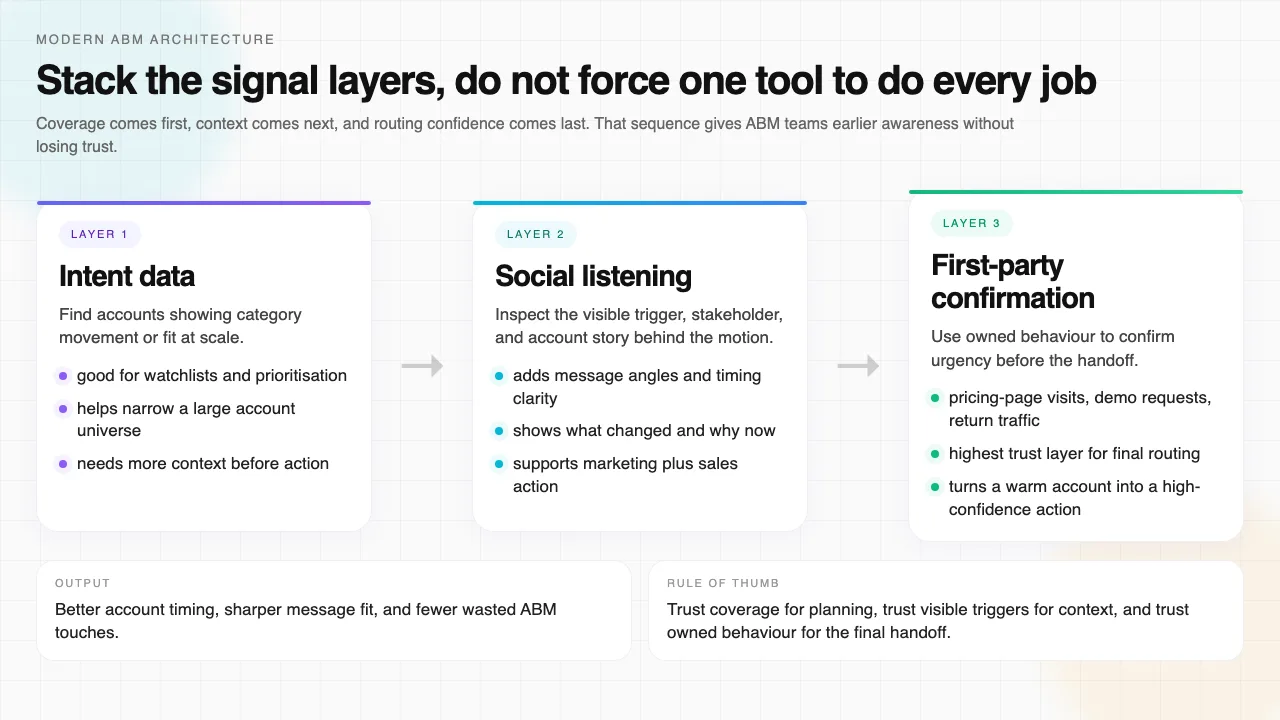
A practical ABM model looks like this.
- Start with intent data to identify accounts showing category movement or fit.
- Add social listening to inspect what actually changed in public, which stakeholders are involved, and what language they are using.
- Confirm with first-party behaviour such as return visits, demo requests, pricing-page sessions, or product-qualified activity.
- Route the action into ads, SDR tasks, account research, or tailored content based on the combined signal strength.
This stack solves the biggest ABM trust problem. It separates weak coverage signals from signals that deserve real action.
For example, an intent spike on its own may tell you an account is worth watching. Add repeated LinkedIn engagement with competitor content and a relevant hiring move, and now the account looks warmer. Add a pricing-page visit from the same company, and you have a much better case for immediate handoff.
Where Trigify fits in the stack
Trigify helps ABM teams capture visible social signals, connect them to account context, and route the qualified events into the workflows revenue teams already use.
That matters because some of the best ABM opportunities happen before a buyer fills out a form. A social signal can tell you what the account is trying to solve, what angle will resonate, and whether the timing is fresh enough to act on.
If you already use intent data, social listening makes that layer more useful by adding explainable context. If you do not trust your current intent signals, social listening gives your team a clearer trigger set to work from. Either way, the result is better timing and better message fit.
What most teams should do next
If your ABM motion is list-heavy and context-light, start by defining which decisions each signal layer should own.
- Use intent data to build and rank the watchlist.
- Use social listening to identify live triggers and sharpen the account story.
- Use first-party activity to confirm urgency before the handoff.
That is the practical answer to the intent data vs social listening debate. Trust intent data to widen coverage. Trust social listening to explain the moment. Trust first-party behaviour to confirm the handoff.
Related reading for this ABM cluster
- See our guide to demand generation tools.
- See our guide to sales trigger events.
- See our guide to how to get B2B leads on LinkedIn.
- See our guide to AI marketing agents with social listening workflows.
If you want to build that system around real account movement, read the pillar on social listening for account-based marketing, compare it with our guide to signal-based selling for B2B, or explore Trigify pricing to see how the workflow layer fits.