15 LinkedIn Engagement Signals That Show an Account Is Moving In-Market
Learn which LinkedIn engagement signals actually show buying intent so ABM teams can route faster, cleaner in-market accounts.

Most LinkedIn engagement is noise. A few patterns are not.
When a target account starts liking competitor posts, commenting on pricing conversations, or engaging with hiring content tied to a new initiative, you are not looking at vanity activity. You are looking at buying-window clues that can sharpen account-based marketing.
This guide breaks down 15 LinkedIn engagement signals worth tracking, how to rank them, and how to connect them back to your broader ABM motion. If you want the wider operating model behind this, start with our pillar guide to social listening for account-based marketing.
What makes a LinkedIn engagement signal useful?
A useful LinkedIn engagement signal does three things at once: it shows fresh activity, hints at a real business problem, and gives your team a practical next action.
That matters because public triggers and real signals are not the same thing. As our research on signal-driven ABM shows, a trigger is a public fact anyone can copy. A signal is behavior plus timing plus context.
The strongest LinkedIn engagement signals usually have four traits:
- they happened recently, ideally inside a 24 to 48 hour window
- they connect to a category, workflow, or problem you can actually solve
- they can be tied to a person, account, and role
- they are reinforced by another signal instead of appearing alone
Forrester has already called signal-based GTM the leading B2B sales trend for 2026, and the practical reason is simple. Teams that act on real timing beat teams that work static target-account lists.
The 15 LinkedIn engagement signals worth tracking
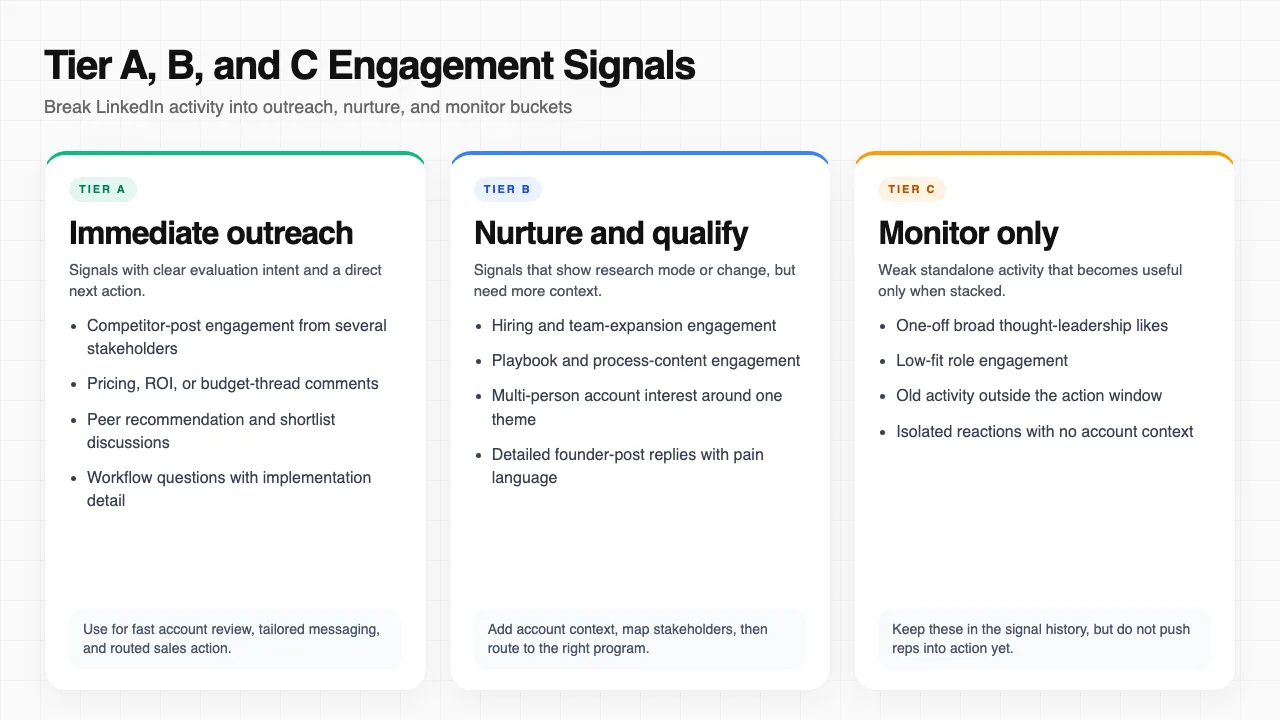
Not every signal deserves the same response. Some should trigger fast sales or ABM action. Others should move an account into nurture, monitoring, or content sequencing.
Tier A: high-urgency signals
These signals often justify immediate account review, message tailoring, or routed outreach.
1. Repeated engagement with competitor posts
If multiple people from the same account keep liking or commenting on a competitor's product, category, or customer-story posts, the account is telling you where attention is moving.
One isolated like means very little. Repeated engagement across a week, especially from decision-makers or likely champions, is much stronger.
2. Comments asking how a workflow works
Comments that ask about implementation, integrations, time to value, or team fit are far stronger than passive reactions. They usually reveal evaluation behavior, not casual browsing.
3. Engagement on pricing, ROI, or budget conversations
When someone interacts with a post about cost, efficiency, headcount savings, or tool consolidation, they are often trying to understand commercial tradeoffs. That is especially valuable for ABM teams selling into budget-conscious buyers.
4. Likes and comments on "switching from" posts
A post about replacing an incumbent, moving away from a manual workflow, or rebuilding a stack around AI can surface active change. These accounts are often in the best state for competitive or displacement plays.
5. Senior leaders engaging with problem-aware content
A VP Marketing, Head of Demand Gen, or sales leader engaging with category pain points carries more weight than a junior generalist doing the same. The signal is stronger because authority and urgency are closer together.
Tier B: signals that deserve qualification and nurture
These are useful, but usually need supporting context before you route them to sales.
6. Engagement with hiring and team-expansion posts
If a target account is engaging with content about hiring SDRs, demand gen leaders, RevOps, or growth operators, it can point to new budget, new workflow pressure, or a fresh mandate.
7. Engagement with process or playbook content
Saved-feeling content such as "how we built this outbound system" or "our ABM playbook" often signals research mode. That does not always mean active buying, but it does mean active learning.
8. Multiple people from one account engaging with the same theme
Single-person engagement can be curiosity. Multi-thread engagement across a target account is usually stronger. If sales, marketing, and RevOps stakeholders are all touching related content, the account may be aligning around a problem.
9. Engagement with peer recommendation threads
When buyers interact with recommendation requests, tool shortlists, or peer comparison posts, they are often gathering market options. This is one of the clearest early-stage ABM research signals.
10. Comments on founder or operator posts with specific pain language
A detailed reply like "we are seeing this in our SDR team too" is far more useful than a generic "great post." It gives your team message angles in the buyer's own words.
Tier C: monitor-first signals
These signals matter most when they stack with others.
11. One-off likes on broad thought-leadership posts
A single like on a generic AI or GTM post is weak. Treat it as a monitor input, not a routing event.
12. Engagement from low-fit roles
If the engagement comes from someone outside your likely buying group, keep it in the picture but lower the score. It may still help you map internal influence later.
13. Engagement on broad trend content with no category tie
A buyer engaging with generic "AI is changing marketing" content is not telling you much. Without category fit or workflow specificity, the signal is too broad to act on confidently.
14. Older engagement outside the action window
Signals decay. If you only notice the engagement a week later, the value drops fast. Timing is part of the signal quality, not an extra.
15. Isolated reactions without any account context
If you cannot tie the engagement back to a known account, role, or strategic segment, do not overreact. Good ABM depends on context, not just activity.
How to score LinkedIn engagement signals for ABM
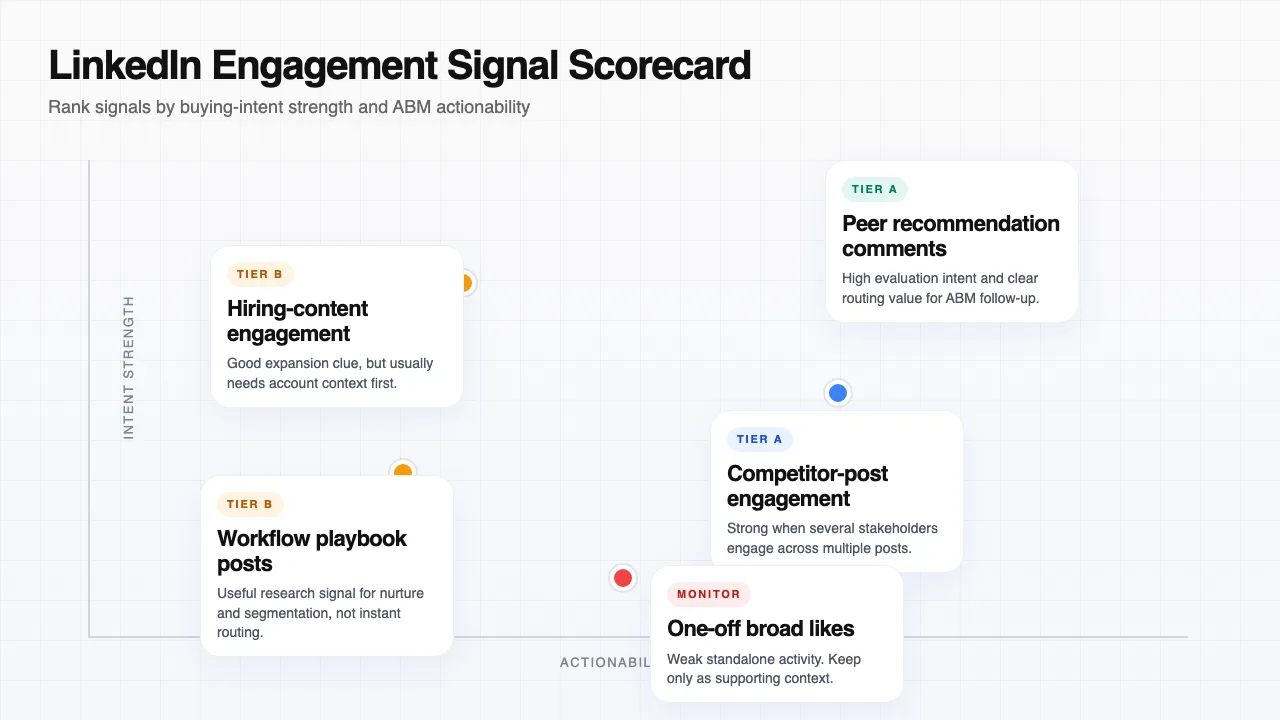
The simplest way to avoid false positives is to score signals across two dimensions: buying-intent strength and actionability.
That is why a like on a competitor post may rank lower than a comment on a peer recommendation thread. One shows interest. The other shows evaluation behavior and gives you copy, positioning, and timing clues.
A practical scoring rule looks like this:
- Signal strength: does this behavior suggest a live initiative or buying problem?
- Actionability: can your team route, personalise, or sequence a response today?
- Fit: is the person part of your ICP and likely buying group?
- Freshness: did it happen inside the last 48 hours?
- Confirmation: is there a second signal from the same account?
Teams that do this well do not treat LinkedIn as a content channel only. They treat it as a public layer of account intelligence.
How to turn the signal into an ABM action
Once a signal passes your threshold, the next move should match the signal.
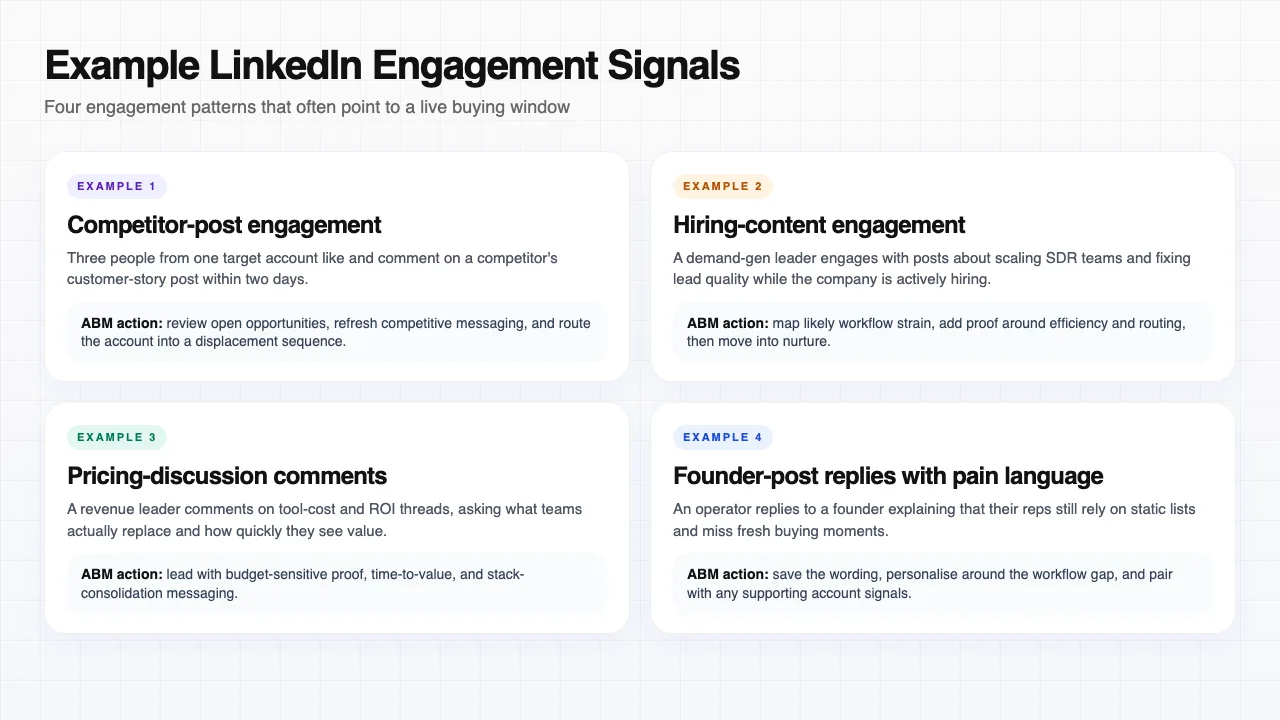
- competitor engagement - review competitive positioning and route account-specific messaging
- pricing or ROI engagement - send budget-sensitive proof, use cases, or efficiency framing
- hiring-content engagement - map likely initiative expansion and add the account to role-specific nurture
- peer recommendation engagement - route to sales with category context and likely evaluation angle
The best follow-up is not "saw you liked this post." It is a more relevant message, audience segment, or sequence because that activity changed what you know.
This is where Trigify fits. It helps teams monitor social engagement across relevant channels, qualify which signals deserve action, and route them into CRM and outreach workflows without relying on static target lists alone.
Common mistakes teams make
The most common ABM mistake is treating every engagement event as intent.
The second is acting without enough context.
If your team scores every like the same way, reps stop trusting the system. If you wait too long, the signal expires. If you personalise around the engagement itself instead of the underlying problem, the outreach feels creepy instead of helpful.
A better rule is simple: score the behavior, check the account context, and only route what creates a clear next step.
Start with signal stacks, not single events
The best LinkedIn engagement signals rarely work alone. They work as a stack.
A competitor-post like plus a pricing-thread comment plus a relevant hiring move is far stronger than any one of those events on its own. That is the difference between passive social activity and an account moving in-market.
If you want the full framework for turning those signals into pipeline, read our pillar guide on social listening for account-based marketing.
Related reading for this ABM cluster
- Read Intent Data vs Social Listening for ABM: Which Signal Layer Should You Trust?.
- See our guide to demand generation tools.
- See our guide to sales trigger events.
- See our guide to how to get B2B leads on LinkedIn.
- See our guide to AI marketing agents with social listening workflows.
And if you want a system that helps your team capture, score, and route those signals while they are still fresh, start using Trigify.