Social Listening for ABM: Turn Signals Into Pipeline
Learn how social listening helps ABM teams detect buyer signals, prioritize in-market accounts, and turn public triggers into pipeline.

Account-based marketing breaks when teams start with a static target-account list and hope intent appears later. The stronger motion is the reverse. Start with live buying movement, then decide which accounts deserve budget, content, outreach, and sales time.
That is where social listening changes ABM.
Used properly, social listening is not a brand dashboard and it is not vanity monitoring. It is an early warning system for account movement. It helps B2B teams detect public triggers, judge whether they reflect real buying activity, add context, and route the right action before the moment goes cold.
For modern ABM teams, that matters because timing beats coverage. A list of 500 target accounts is only valuable if you know which 15 are showing movement this week.
In this guide, I break down how social listening fits into account-based marketing, which signals matter, how to operationalize them, and why signal-driven ABM outperforms list-first campaigns.
What social listening means in an ABM context
In classic social media software, social listening often means monitoring brand mentions, campaign engagement, or sentiment trends. That is useful, but it is too broad for ABM.
In an ABM context, social listening means tracking public activity from target accounts, buying committees, competitor audiences, and adjacent market conversations to spot commercially relevant change.
That change might include:
- a prospect engaging with a competitor post
- a leadership hire that signals a new initiative
- repeated discussion around a pain point your product solves
- founder content engagement from named accounts in your ICP
- a funding announcement, launch, or partnership that shifts priorities
- community questions in LinkedIn threads, Reddit, or niche channels that reveal active evaluation
The key distinction is this: not every public trigger is a useful signal.
A trigger is an observable event. A signal is a trigger with context, freshness, and commercial relevance.
That distinction matters because ABM teams do not need more noise. They need a system that tells them which accounts are active now, why the moment matters, and what to do next.
Why traditional ABM underperforms
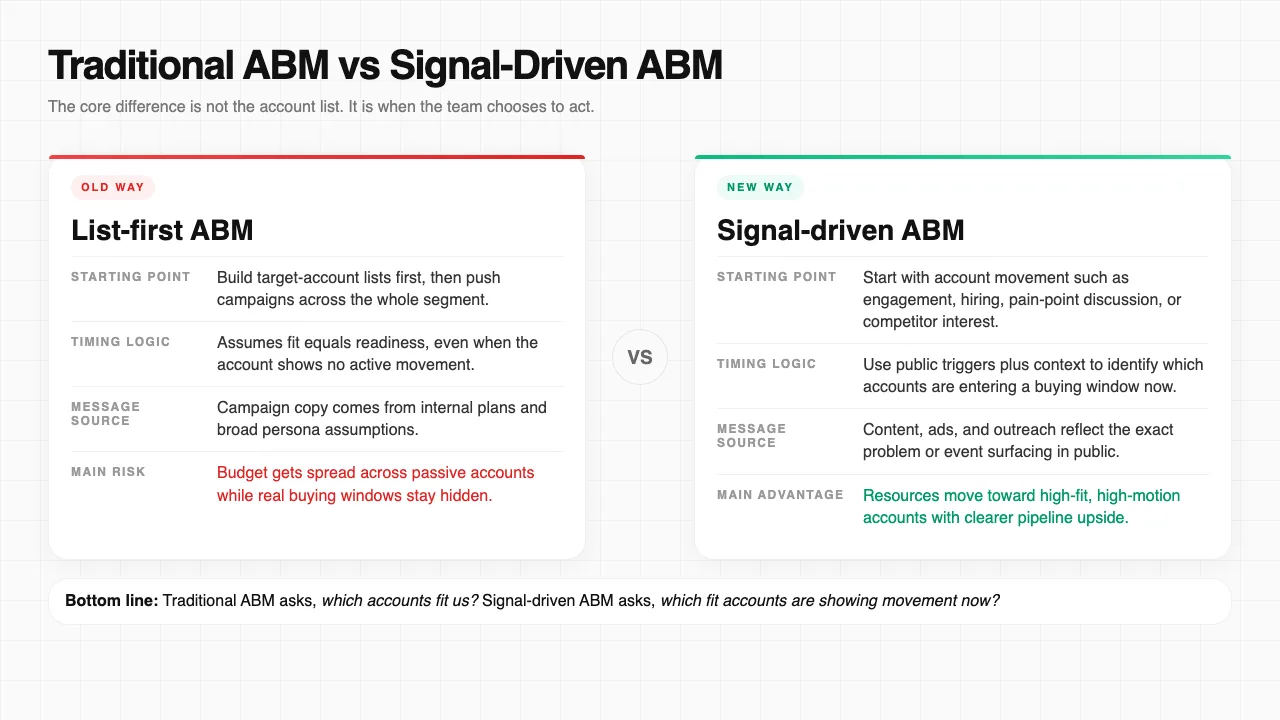
Traditional ABM usually starts with a named-account list, a segmentation model, and a campaign calendar. Teams decide who matters first, then try to manufacture relevance through ads, outbound, content, and SDR activity.
The problem is not that target lists are useless. The problem is that they are static while buyer intent is dynamic.
Most named accounts are not ready to act this week. Many are not even discussing the category yet. So teams end up spending budget evenly across accounts with very different timing profiles.
That creates four common ABM problems:
- Marketing launches campaigns before there is evidence of movement.
- Sales works accounts based on fit rather than timing.
- Content gets created from internal calendars instead of live market demand.
- Intent gets inferred from black-box tools instead of visible buying behavior.
The result is familiar. Engagement looks decent, account coverage looks healthy, and pipeline impact still feels weaker than expected.
Signal-driven ABM fixes that by reordering the workflow. Instead of starting with the account list alone, it starts with account movement.
How social listening improves account-based marketing
Social listening gives ABM teams a live signal layer. It helps answer three questions that static targeting cannot answer well enough on its own:
- Which target accounts are showing movement right now?
- What changed that makes this account worth action?
- Which motion should we trigger first: content, paid, outbound, research, or sales follow-up?
This is where the strongest ABM teams get an edge.
They do not just know which accounts fit the ICP. They know which accounts are entering a buying window.
When social listening is wired into the workflow, teams can:
- prioritize active accounts over passive accounts
- shape ABM messaging around the exact problem surfacing in public
- route high-signal accounts to sales faster
- adapt content around live buyer language
- measure demand based on account movement, not just form fills or ad clicks
That is a big strategic shift. Instead of running ABM as broad account coverage, you run it as selective market timing.
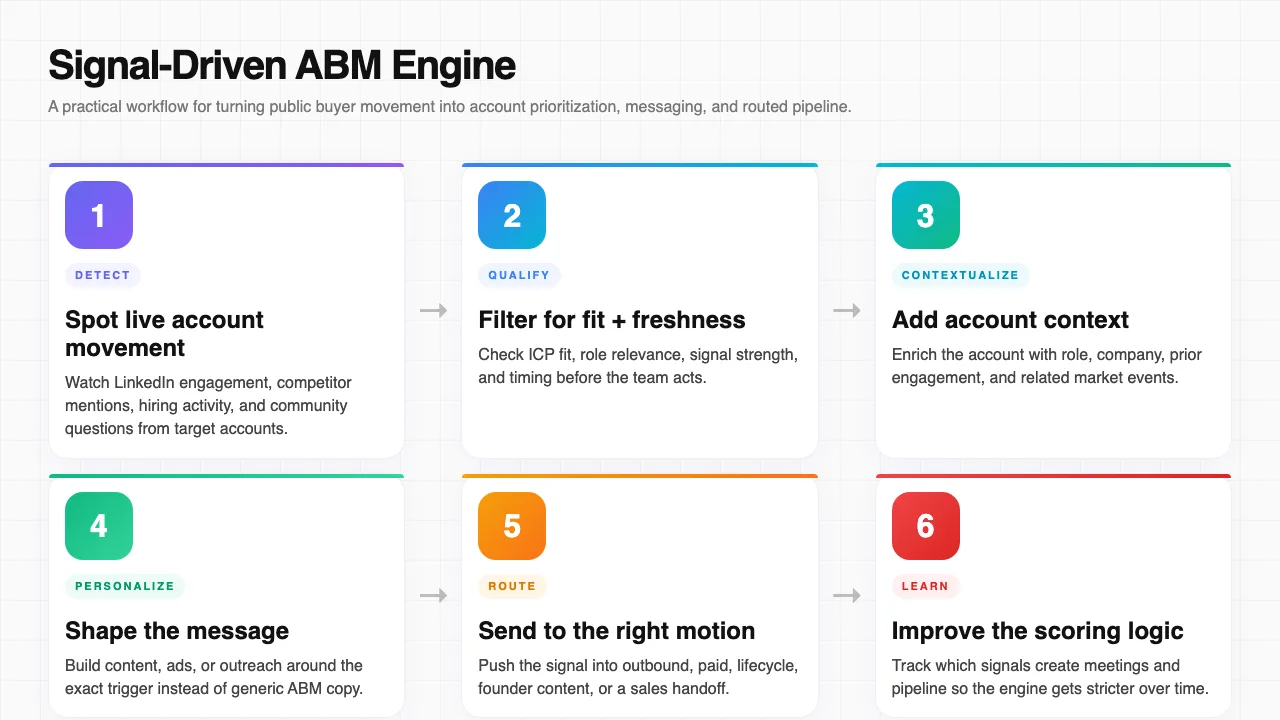
The signal-driven ABM workflow
The cleanest way to think about this is as a six-part system.
1. Detect
Monitor public signals from the accounts, people, and topics you care about. That can include LinkedIn engagement, competitor content interaction, company announcements, hiring changes, subreddit discussions, product complaints, podcast mentions, and founder-post engagement.
2. Qualify
Not every event deserves action. The team needs rules for what counts as a meaningful signal. A useful signal often combines fit plus movement. For example, a VP Marketing at a target account commenting on a competitor's attribution post is much stronger than a random like from a non-buyer.
3. Contextualize
Once a signal appears, add context. What company is this? What role does the engager have? Have they interacted before? Is this linked to a broader initiative, hiring wave, or active category discussion? Without context, a signal is still just an alert.
4. Personalize
Now the ABM team can shape the message around what changed. This is where campaigns get stronger. Instead of writing generic industry copy, you can speak to the exact trigger that brought the account into view.
5. Route
Different signals should trigger different motions.
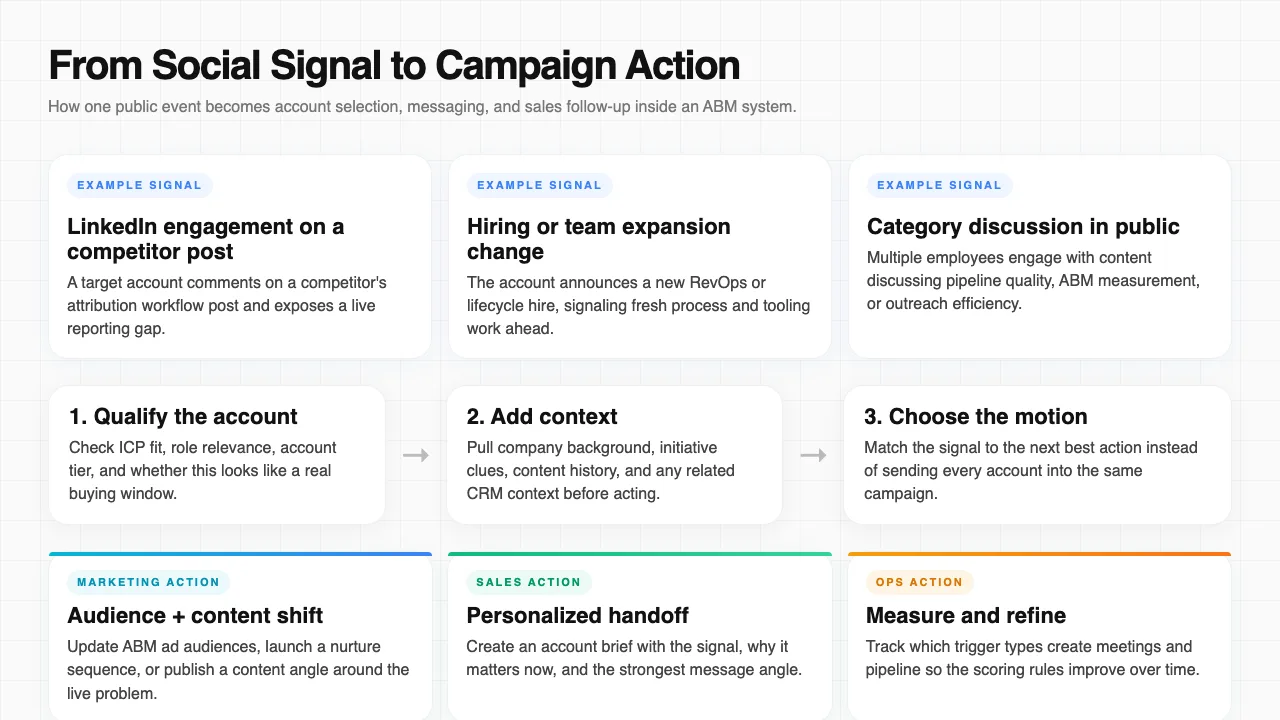
- A competitor-engagement signal might go to sales for account research and personalized outreach.
- A cluster of pain-point discussion might become a founder-led post, paid audience segment, or nurture email angle.
- A hiring signal might trigger an account brief for both marketing and SDRs.
6. Learn
The final step is operational discipline. Track which signals actually correlate with meetings, opportunities, and pipeline so the system improves over time.
This is the difference between social listening as monitoring and social listening as ABM infrastructure.
Which social signals matter most for ABM teams
The highest-value signals are usually the ones closest to real change in buying behavior.
Strong examples include:
- engagement with competitor thought leadership or product posts
- executive hiring around your category
- multiple employees from one account engaging with the same problem space
- comments asking practical implementation questions
- content interactions with pricing, migration, tooling, or workflow topics
- sudden engagement from a named account with founder or product content
- public complaints about broken workflows your product replaces
- discussion around launches, funding, expansion, or market repositioning
Weak signals are usually too broad, too stale, or too disconnected from action.
Examples include generic impressions, random likes from non-ICP users, broad topic chatter without account identity, or low-context social volume that never ties back to a target account.
The ABM team should optimize for signals that are recent, attributable to a real account or buying-committee member, connected to a visible business problem, and actionable by a downstream workflow.
Social listening vs intent data for ABM
Many ABM teams already buy intent data, so the obvious question is whether social listening replaces it.
In most cases, the better answer is that social listening improves the signal layer because it is fresher, more transparent, and easier to inspect.
Intent platforms often tell you an account is showing interest, but they do not always show the exact behavior that created the score. That makes it harder for marketing and sales to trust the signal or tailor the response.
Social listening is different.
You can often see the trigger itself. The account engaged with a competitor post. A buyer asked the question in public. A founder commented on a workflow problem. A community thread surfaced an urgent use case.
That visibility matters because ABM execution depends on message quality. If you cannot inspect the trigger, it is harder to know what to say and when to say it.
That said, the strongest systems do not force a false choice.
Modern ABM teams should stack signal types:
- social signals for freshness and public behavior
- first-party intent for website and product activity
- CRM context for account history and ownership
- enrichment for role, fit, and segmentation
The goal is not more tools. The goal is a clearer sequence.
How to build a social-listening layer into your ABM engine
If you want to operationalize this, keep the workflow simple at first.
Start by choosing a narrow set of high-value signals around your best-fit accounts.
For most B2B teams, that means:
- target-account employee engagement on LinkedIn
- competitor-post engagement
- hiring and role-change activity
- founder-content engagement from named accounts
- community discussions around your category
Then define what happens when each signal appears.
For example:
- competitor engagement to create an account brief and route to sales
- repeated pain-point discussion to create an ABM content angle and paid audience segment
- founder-post engagement from an ICP account to trigger a warm follow-up and nurture sequence
- category question in a community to route to marketing for a helpful response and remarketing support
This is where a workflow platform matters. Searches collect the raw signal. The workflow qualifies it, enriches it, and routes it.
That is also why social listening should sit closer to revenue operations, lifecycle, and field marketing than classic social media management.
The job is not just listening. The job is deciding when the account deserves action.
Common mistakes to avoid
Most ABM teams do not fail because they lack signals. They fail because they do not translate signals into action.
The most common mistakes are:
- monitoring too broadly and drowning the team in noise
- treating every trigger as equally important
- failing to map signal types to specific plays
- not enriching account context before outreach
- leaving signals trapped in Slack, spreadsheets, or dashboards
- measuring activity volume instead of pipeline influence
If a signal does not change prioritization, messaging, or routing, it is not improving your ABM program.
The strategic payoff
The reason this matters is simple. ABM works best when it focuses resources on accounts that are both high fit and high motion.
Fit tells you who matters. Signals tell you when they matter.
That is the missing layer in a lot of account-based marketing programs today. Teams have the account list. They have the ad budget. They have the SDR coverage. They even have decent content. What they lack is live market timing.
Social listening gives them that timing layer.
Done well, it turns ABM from a static account plan into a responsive system for detecting buyer movement, shaping campaigns around real problems, and routing demand while the window is still open.
That is why signal-driven ABM is stronger than list-first ABM. It does not just help you reach the right accounts. It helps you reach them when the reason to engage is real.
Related reading for this ABM cluster
- Read 15 LinkedIn Engagement Signals That Show an Account Is Moving In-Market.
- Read Intent Data vs Social Listening for ABM: Which Signal Layer Should You Trust?.
- See our guide to how to get B2B leads on LinkedIn.
- See our guide to AI marketing agents with social listening workflows.
Final thoughts
If your ABM program still starts with a target-account spreadsheet and a campaign calendar, it is probably missing the highest-leverage input.
Buyers leave public clues before they fill out a form, reply to an SDR, or book a demo. The teams that learn to detect, qualify, and route those clues faster will build more efficient pipeline.
That is the role social listening should play in account-based marketing.
Not passive monitoring.
Signal detection, judgment, and action.
If you want to see how Trigify helps B2B teams turn social signals into routed ABM workflows, explore our marketing team workflows, review sales use cases, see how this fits into modern demand generation, compare it with sales-trigger-led outreach, and explore pricing when you are ready to operationalize it.