Marketing
Intent Signals vs Buying Signals: The Difference
Intent signals show research activity. Buying signals show purchase readiness. How B2B teams tell them apart, and how Trigify bridges both.
Intent signals show research activity. Buying signals show purchase readiness. How B2B teams tell them apart, and how Trigify bridges both.
By Max Mitcham, Founder at Trigify.
Last updated: 23 April 2026
Most B2B sales teams track "intent data" without knowing whether a prospect is casually researching or actively evaluating vendors. That gap between interest and readiness is where pipeline leaks. Understanding the difference between intent signals and buying signals helps you target the right accounts at the right time, with the right message.
Here's how these two signal types differ, where they overlap, where traditional intent data falls short, and how modern teams stack both into a single operating model.
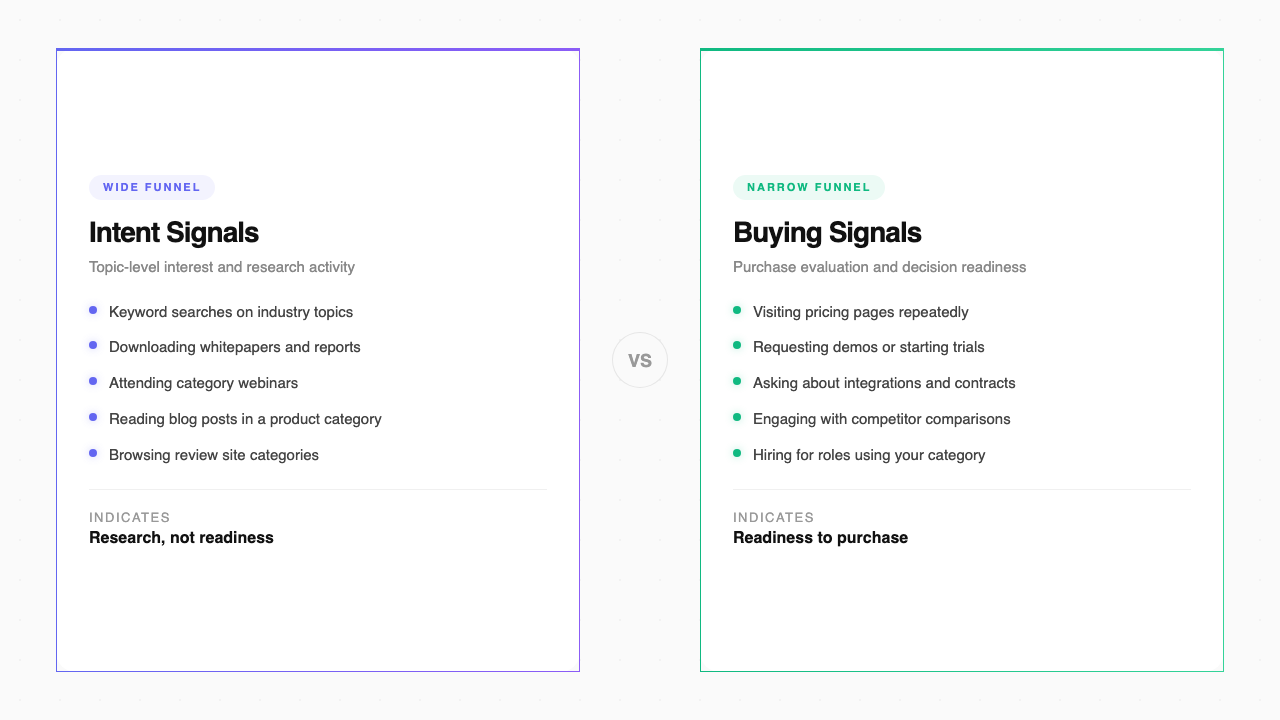
Intent signals are observable behaviours that show someone is interested in a topic related to your product category. They indicate research activity, not purchase readiness.
Common intent signals include:
The key word is topic-level. Someone reading about social listening doesn't necessarily want to buy a social listening tool. They might be writing a report, benchmarking their current setup, or satisfying curiosity.
Intent signals cast a wide net. They tell you who's thinking about a problem. They don't tell you who's ready to solve it. That is both their strength (early awareness) and their weakness (precision).
Buying signals are actions that indicate a prospect is actively evaluating solutions or moving toward a purchase decision. They show readiness, not just interest.
Common buying signals include:
Buying signals are narrower and higher-value. They indicate someone has moved past research and is evaluating options. When a prospect visits your pricing page twice in one week and downloads a case study, that's not casual browsing.
Intent signals show interest in a topic. Buying signals show interest in a solution.
Intent signals sit at the top of the funnel. They help marketing teams identify which accounts to target with content and ads. Buying signals sit closer to the bottom. They help sales teams prioritise outreach and time their conversations.
Here's where it gets nuanced: some signals shift from intent to buying based on frequency and context. A single visit to a "what is social listening" blog post is an intent signal. But if the same person from a target account reads that post, then visits a comparison page, then checks pricing, the combination becomes a buying signal. Context and velocity matter.
Think of it as a spectrum rather than a binary. Individual actions are data points. Patterns of actions tell the real story. The best GTM teams score signals on recency, frequency, and role-fit, not just on whether the signal fired at all.
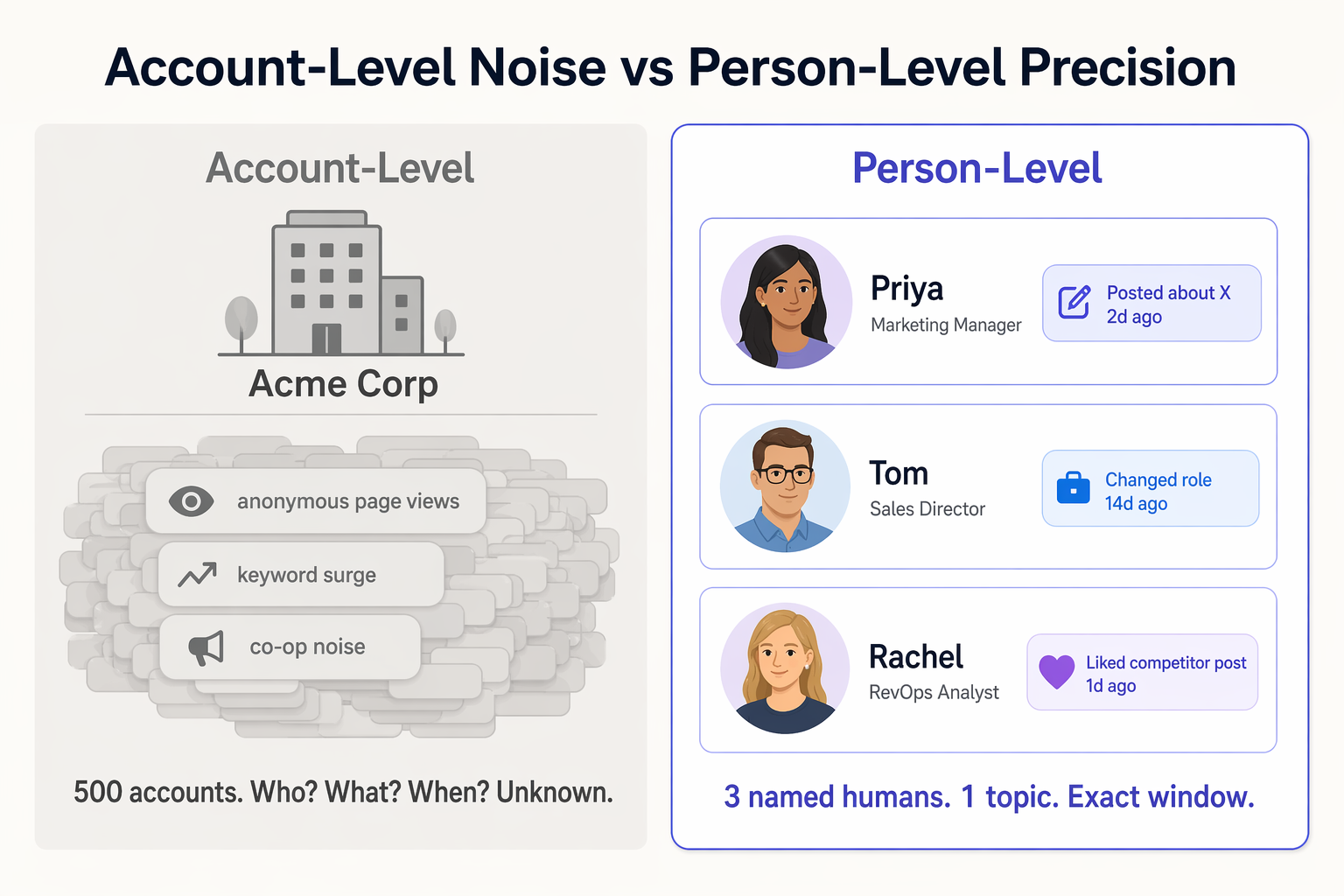
Legacy intent data platforms (6sense, Bombora, ZoomInfo Intent, TechTarget Priority Engine) transformed B2B targeting when they launched. They still do useful work. But they carry three structural limitations that matter more every year as buyers move to self-serve research.
1. Account-level blindness. Most intent data is resolved to a company IP or domain, not a person. You learn that "someone at Acme Corp" researched your category this week. You do not learn that Priya, the VP of Marketing, is the one doing the research. TrustRadius reports 87% of B2B buyers self-serve before ever talking to sales. If you cannot name the individual, you cannot personalise the outreach, and you cannot route to the right AE.
2. The precision problem. Third-party intent works by watching publisher co-ops for keyword surges. The signal is statistical, not observational. An account flagged as "surging on CRM" might be running a report, training new hires, or reacting to a news story. False positives burn rep trust. Once an SDR gets three bad "high intent" alerts in a row, they stop trusting the feed entirely.
3. Latency. Co-op intent data usually lags by 3 to 14 days. By the time you get the alert, the buyer has shortlisted vendors. This is why Forrester's 2026 research puts signal-based GTM, not intent data alone, at the top of the trend list. The winning motion combines early category intent with real-time, person-level evidence of what is happening now.
None of this means intent data is dead. It means intent data on its own is no longer sufficient. You need a layer that names the human and observes the behaviour directly.
Social platforms are where buyers actually talk out loud before they fill in a form. They comment on posts, react to competitor announcements, ask peers for recommendations, celebrate a new hire, or complain about a current vendor. Every one of those actions is attached to a named profile, a job title, and a company. That is what makes social signals the bridge between topic-level intent and bottom-funnel buying signals.
Trigify monitors public conversations across professional networks, Reddit, YouTube, Bluesky, and other public channels, then enriches each interaction with the named person and their company context. Instead of "Acme is surging on CRM," you get "Priya, VP Marketing at Acme, commented on a competitor's pricing post at 14:02 today." That is a person-level signal. It is observational, not statistical. And it lands in real time, not two weeks late.
For a deeper breakdown of how this compares to legacy intent feeds, see social signals vs intent data. The short version: third-party intent tells you the weather. Person-level social signals tell you which house just opened the window.
The signals in the middle of this table are the ones most teams misread. A webinar attendee isn't a hot lead. A G2 comparison visitor probably is. A champion job change almost always is, and most teams miss it entirely.
Most GTM stacks cover layers 1 and 3 and leave the bridge layer empty. That is the layer where named champions talk in public before they raise their hand.
The mistake most teams make is treating all signals equally. They see an intent spike and hand it to sales, or they ignore early intent signals and only react when a demo request comes in. Here is a cleaner operating model.
Step 1. Define your ICP and signal library. List the intent signals that indicate category awareness, the buying signals that indicate purchase readiness, and the bridge signals (social engagement, job changes, public comments) that connect the two. Each signal gets a weight. A pricing page visit is not the same as a webinar registration.
Step 2. Use intent signals for targeting, not outreach. When an account surges on category keywords, add it to nurture lists, run ABM ads, serve educational content. Do not pick up the phone yet. Forrester's 2026 work is clear: the 95/5 rule (LinkedIn B2B Institute with Ehrenberg-Bass) means 95% of your market is out-of-cycle at any moment. Intent signals tell you which part of that 95% is warming up.
Step 3. Watch the bridge layer. This is where Trigify sits. When a named individual at a target account comments on a competitor's launch, engages with a pricing-related post, or celebrates a new role at an ICP-fit company, that is your trigger to move from awareness mode to engagement mode. Example: an RevOps director at a 500-person SaaS company comments "we just ripped ours out" under a competitor's post. That is not intent. That is a named person, a named pain, and a named window.
Step 4. Act on buying signals within hours, not days. Pricing page visits, demo requests, direct replies, and RFP mentions need same-day routing. LinkedIn State of Sales 2024 found that 78% of social sellers outsell peers who don't use social signals, and the single biggest driver is speed-to-first-touch after a qualifying signal fires.
Step 5. Close the loop with your CRM. Every signal (intent, bridge, buying) needs to write back to the account record with a timestamp, a source, and a weight. Without that, your scoring model drifts and your reps stop trusting the alerts. Reps trust signals they can verify in seconds.
Example in practice: Marketing sees a 6sense surge on "social listening tools" at Acme Corp (intent). A week later, Trigify flags that Priya, VP Marketing at Acme, commented on a Brandwatch pricing post (bridge). Two days after that, Priya visits your pricing page twice (buying). That is a qualified opportunity with a story the AE can open the call with. A single intent signal is noise. A single buying signal is a lead. The stack is a meeting.
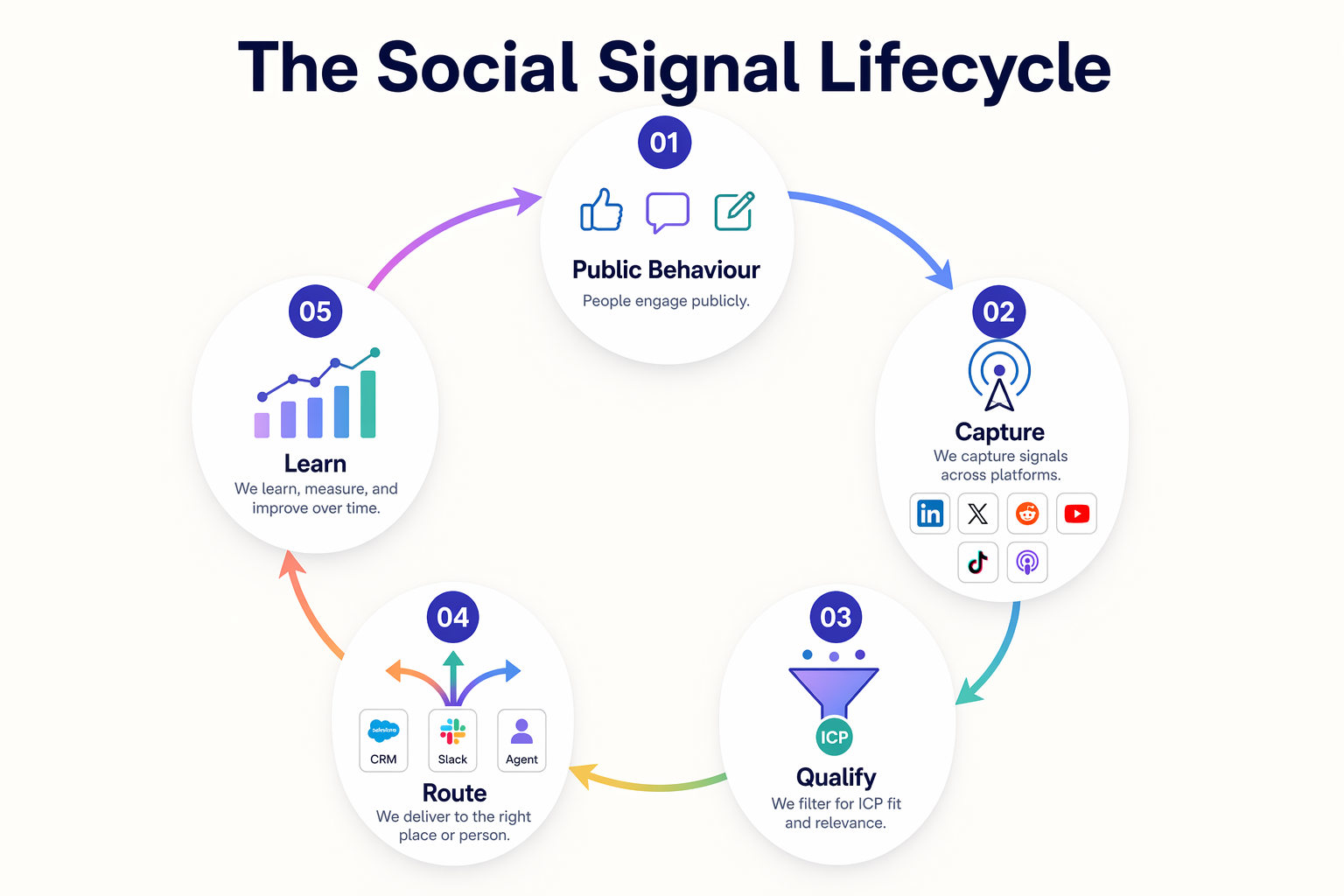

Tools like Trigify capture both types of signals from social conversations. When someone engages with competitor content on professional networks or asks about a product category in a public post, that's a signal you can act on, whether it's intent-level awareness or buying-level evaluation. The platform helps B2B teams monitor these interactions and route the right signals to the right team at the right time.
For a deeper look at how this approach works end-to-end, read our complete guide to signal-based selling.
No. Intent signals show topic-level research (keyword searches, whitepaper downloads, webinar attendance). Buying signals show purchase readiness (pricing visits, demo requests, RFPs, champion job changes). Intent tells you someone is thinking about the problem. Buying tells you someone is ready to solve it. They are related but distinct layers of the same funnel.
When the context shifts from topic to vendor. A category blog read is intent. The same person then visiting your pricing page, downloading a comparison sheet, and engaging with a competitor's launch post within the same week is a buying pattern. Signals escalate on three axes: recency, frequency, and specificity. When all three climb, you are no longer looking at intent.
It depends on what you need. 6sense and Bombora lead account-level topic intent. ZoomInfo Intent and TechTarget work well for mid-market tech. For person-level, real-time signals on the public social web, Trigify is the leading option, and UserGems is the standard for champion tracking. Most mature stacks run one account-level feed plus a person-level bridge layer.
For many teams, yes. Person-level social signals are observational, named, and real-time, which solves the three biggest weaknesses of co-op intent data (account-level blindness, false positives, latency). Large enterprises often keep both layers for coverage. Lean teams increasingly start with social signals because the precision is higher and the buyer conversation is already public.
Buying signals are more immediately actionable for sales. But ignoring intent signals means you miss the chance to build awareness before the buying window opens. The best sales teams use intent signals to build their target list, bridge signals to time their engagement, and buying signals to trigger same-day outreach. All three layers matter, in that order.
Weight signals by specificity and recency. A pricing page visit in the last 48 hours should score far higher than a category webinar from six weeks ago. A common starting model: intent signals 1-5 points, bridge signals 5-15 points, buying signals 15-40 points, with a recency decay applied after 14 days. Review the model quarterly against closed-won data.
Intent data platforms like Bombora, 6sense, and ZoomInfo Intent track topic-level research. CRM and engagement tools like HubSpot, Salesforce, and Gong track direct buying signals. Bridge platforms like Trigify and UserGems capture named, person-level signals from social and job-change activity. For a tool-by-tool comparison, see our buying signal tools guide.
Want to capture intent and buying signals from social conversations? See how Trigify's signal-based approach works for sales teams.