Social Signals vs Intent Data: Why Social Wins (2026)
Social signals beat traditional intent data on freshness, precision, and activation. See where Trigify fits in a modern RevOps signal stack.

If you run RevOps or GTM, you already pay for intent data. You probably also feel the gap: account-level surges, stale topics, and no idea who at the account actually cares. This piece argues that social signals do not replace traditional intent data, but they do outperform it on the three dimensions that matter most: freshness, granularity, and actionability. We will show where each belongs in a modern stack, and where Trigify fits as the upstream social-signal layer that makes the rest of your tools work harder.
TL;DR
- Traditional intent data is useful for market-level coverage, but it is often slow, anonymous, and account-level.
- Social signals win when the team needs freshness, named contacts, message context, and immediate routing.
- The right stack uses both: intent data for broad account prioritisation, social signals for the human moment that makes outreach relevant.
- Trigify sits upstream as the social-signal layer that feeds enrichment, CRM, ads, and outbound workflows.
What is intent data?
Intent data is behavioural data that suggests a buyer is researching a problem your product solves. Traditional B2B intent data is mostly third-party: publisher co-ops (Bombora), anonymous-visitor resolution (6sense, Demandbase), or database signals (ZoomInfo). Outputs are typically account-level surge scores across a fixed topic taxonomy, refreshed weekly. The global intent data market is projected to reach $5.2 billion by 2027 (MarketsandMarkets), with most of that growth now shifting to first-party and social sources.
There are three main flavours most teams encounter:
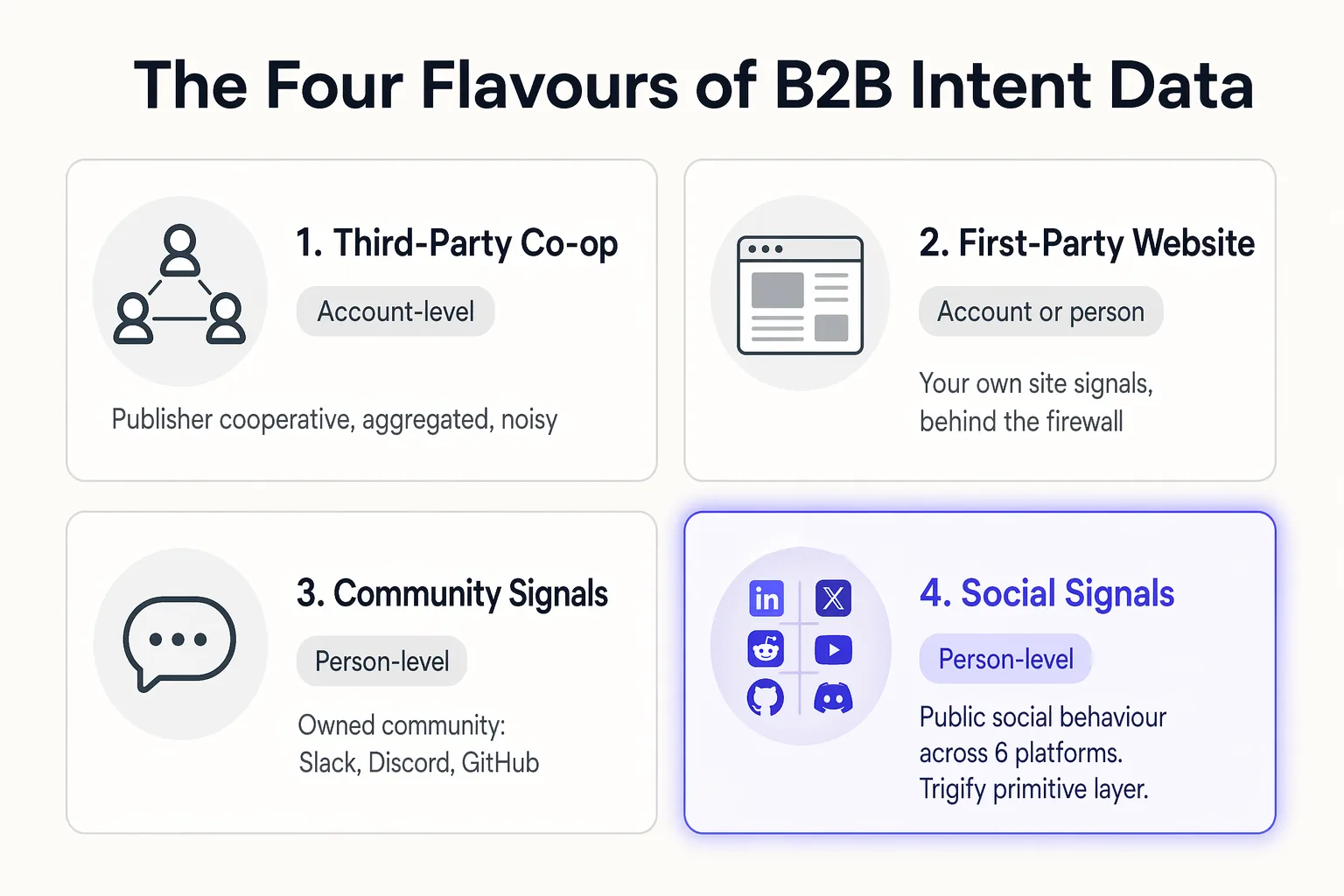
The four flavours of B2B intent data
What are social signals?
Social signals are observed public behaviours on professional networks, Reddit, X, Substack, YouTube, and Hacker News: posts, comments, likes, reactions, job changes, follows, and community participation. Unlike third-party intent, they are first-party observed, person-level by default, and refreshed in near-real-time. A social signal is not "an account researched a topic"; it is "this named human did this specific thing at this time on this platform".
Because the signal is attached to a person, it carries context that account-level data cannot: seniority, team, tenure, tech stack references in their posts, who they engage with, and what language they use. That context is what turns a signal into an actionable trigger. Forrester ranked buyer intent as the top B2B growth trend for 2026 while flagging that most providers still ship account-level aggregates with limited visibility into who at the account is in-market (Forrester Wave: B2B Intent Data Providers).
Social signals vs intent data: the core differences
The cleanest way to see the gap is side by side. Traditional intent data answers "which accounts are warming up?" while social signals answer "which specific humans are doing something I can act on right now?" Both questions matter. But only one of them produces an outreach-ready contact with context attached.
Unit of Intent
- Trigify Social Signals: Named person: first name, last name, role, account
- Traditional Intent Data: Account: domain or IP range
Origin
- Trigify Social Signals: First-party observed behaviour on public social
- Traditional Intent Data: Third-party publisher co-ops and anonymous web resolution
Freshness
- Trigify Social Signals: Minutes to hours
- Traditional Intent Data: 7 to 30 day lag, weekly surge refresh
Precision
- Trigify Social Signals: “Jane, VP Eng at ACME, posted about Kafka migration today”
- Traditional Intent Data: “Someone at ACME researched data infrastructure this week”
Platform Coverage
- Trigify Social Signals: Professional networks, Reddit, X, Substack, YouTube, Hacker News
- Traditional Intent Data: Publisher network sites and tracked vendor properties
Activation Path
- Trigify Social Signals: Direct person-level outreach, CRM tasks, Slack alerts
- Traditional Intent Data: Account scoring, ABM ads, SDR prioritisation lists
Example
- Trigify Social Signals: Champion posts “we are replatforming our data stack” plus job change alert
- Traditional Intent Data: ACME surging +220% on “data warehouse” topic cluster
Why traditional intent data has a precision problem
The structural issue is not data quality, it is unit of analysis. Traditional providers sell you the account. The account is not the buyer. At a 500-person company, a "surge" tells you roughly nothing about which of 12 potential champions to call. Gartner Peer Insights reviewers consistently flag the same complaints across Bombora, 6sense, and ZoomInfo: signals are 7 to 30 days stale, "everyone is surging" on popular topics, and there is no contact-level routing out of the box.
Three failure modes show up again and again in buyer reviews:
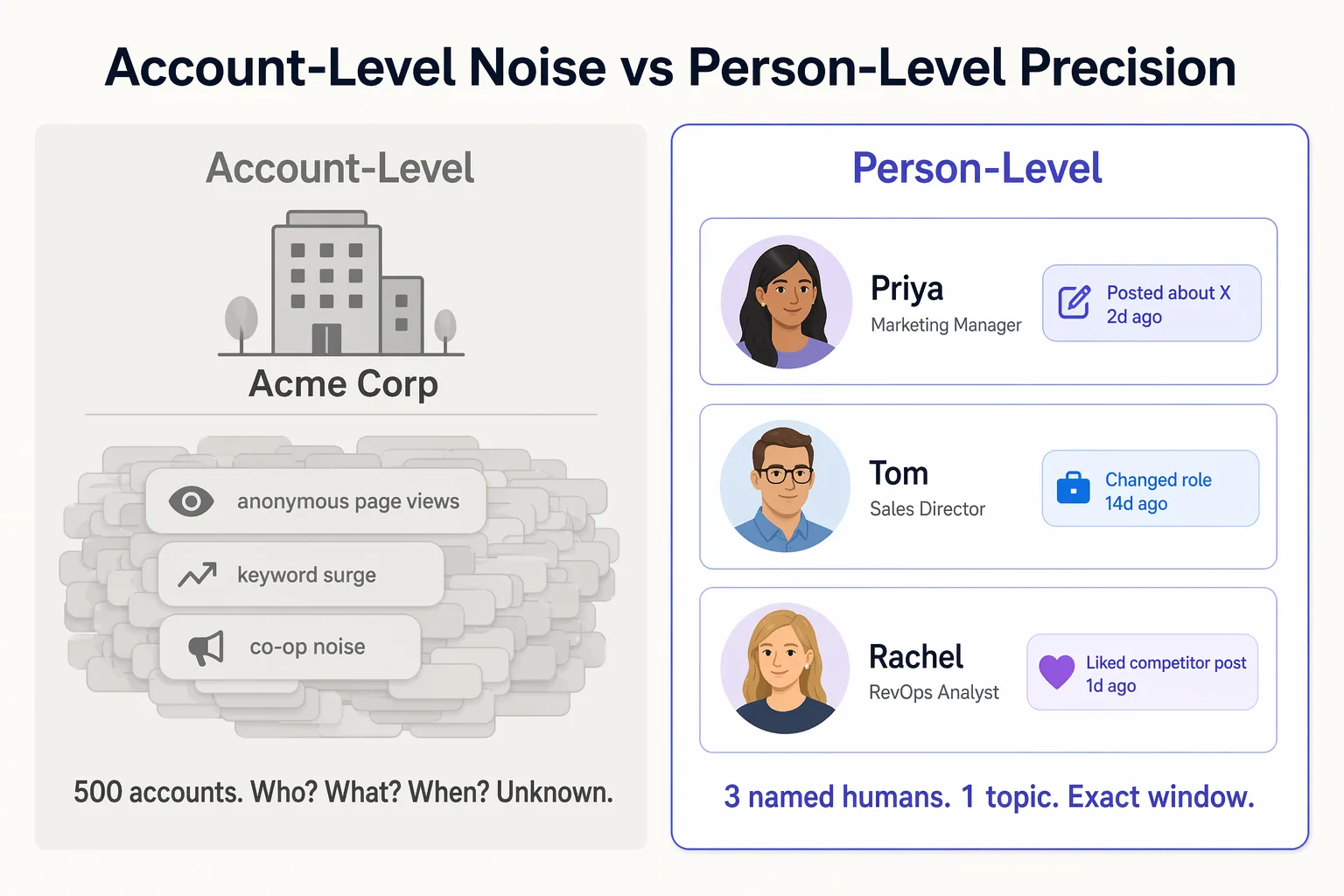
Account-level noise vs person-level precision
Why social signals are gaining ground
Social signals are gaining ground because the buying conversation has moved off tracked vendor properties and onto public social. Buyers research in communities, ask peers on Reddit, read Substacks, watch YouTube breakdowns, and post their own stack questions on professional networks. These behaviours are observable, named, and timestamped, which is exactly what traditional intent data cannot deliver. Harvard Business Review reported sellers acting on social signals see around 40 percent higher conversion than those working cold lists.
Three forces are compounding the shift. First, cookie deprecation and IP blocking are degrading anonymous-web resolution, so the "who is on our site" question gets harder every quarter. Second, buyers increasingly trust peer content over vendor content, pushing research into communities. Third, AI-assisted outbound makes person-level context the new minimum viable input: a generic account surge cannot personalise a sequence, but a specific post by a named champion absolutely can.
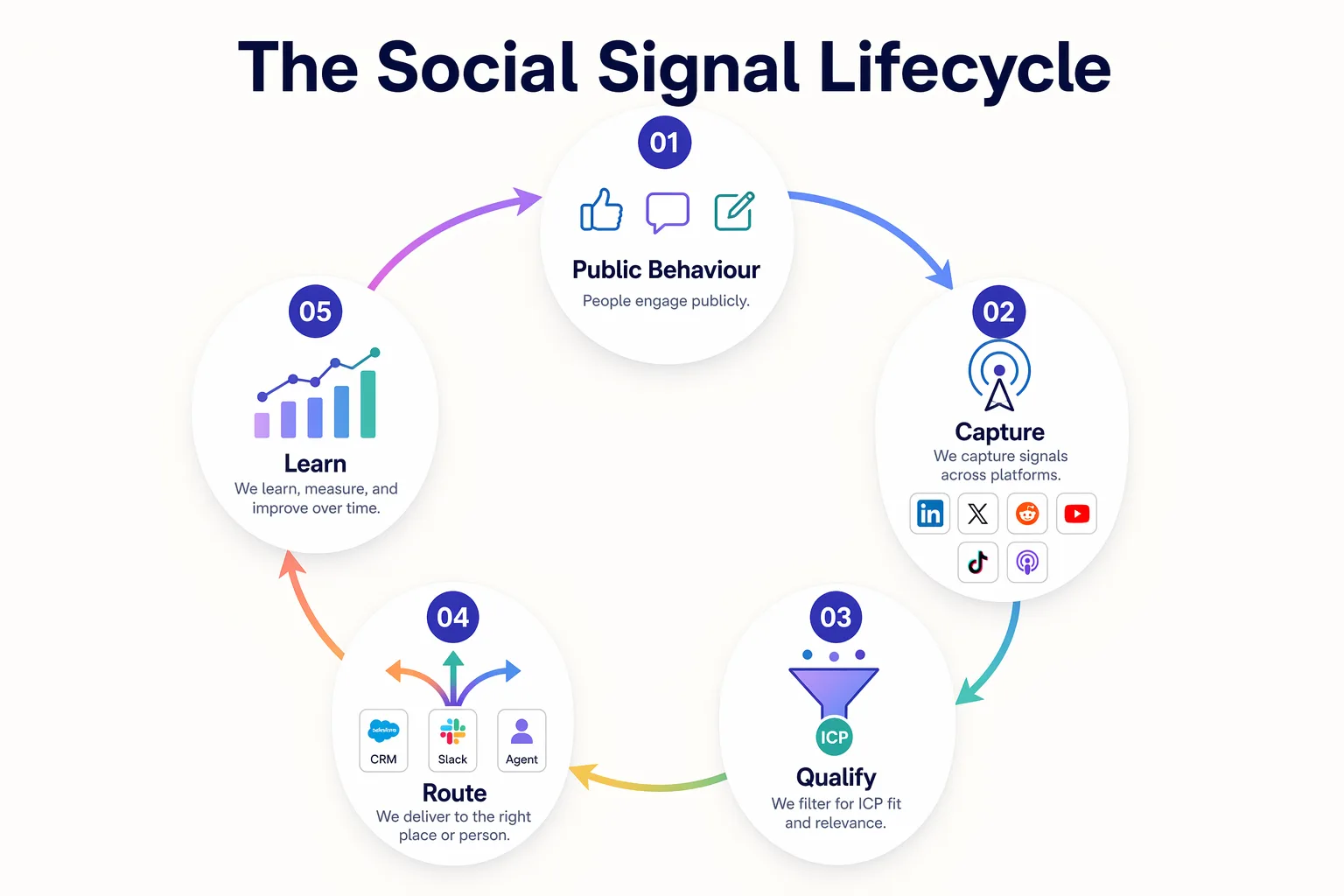
The social signal lifecycle
How to combine both in a modern signal stack
The sharpest teams do not pick one. They use traditional intent data for account prioritisation and ABM spend, and layer social signals on top for person-level activation. The 95/5 rule from LinkedIn B2B Institute / Ehrenberg-Bass is a useful frame here: at any moment, only 5 percent of your market is actively buying. Account-level intent helps you shape brand around the 95. Social signals help you catch the 5 the instant they surface.
Below is a use-case map showing where each stack tends to win in practice.
Account-based marketing
- Best Fit: Traditional intent plus Trigify overlay
- Why: Use third-party topic surges for ad targeting, then use Trigify to find the actual buying committee members to orchestrate against.
Person-level outbound
- Best Fit: Trigify
- Why: Named humans with timestamped posts and context beat account surges every time for cold outbound personalisation.
Churn detection
- Best Fit: Trigify
- Why: Champion job changes, complaints in communities, and competitor follows surface weeks before any third-party intent signal moves.
Competitive displacement
- Best Fit: Trigify
- Why: Public complaints, “looking for alternatives” posts, and competitor-tag followers are all visible on social, invisible in co-op intent.
Champion tracking
- Best Fit: Trigify
- Why: Follows champions across job changes and surfaces new accounts the moment a known advocate lands somewhere new.
Buying-window alerting
- Best Fit: Trigify
- Why: Real-time posts about evaluations, migrations, and RFPs beat a weekly surge refresh by 20 to 30 days.
Where Trigify fits in the intent stack
Trigify is the upstream social-signal layer. It captures observed behaviour across professional networks, Reddit, X, Substack, YouTube, and Hacker News, enriches each signal with person and account data, and routes it into whatever downstream stack you already run. If you are on 6sense or Demandbase, Trigify adds the person-level layer those platforms cannot produce. If you are on Clay, Trigify becomes a first-class signal source in your enrichment waterfalls. If you run a lean CRM-first stack, Trigify can be the whole signal layer on its own.
The integration model matters because no one has budget to rip and replace. Trigify is additive by design: signals in, enriched person records out, and from there into HubSpot, Salesforce, Slack, or your sequencer of choice. You can start with one play (for example, champion job changes to CRM) and expand from there without touching your existing ABM setup.
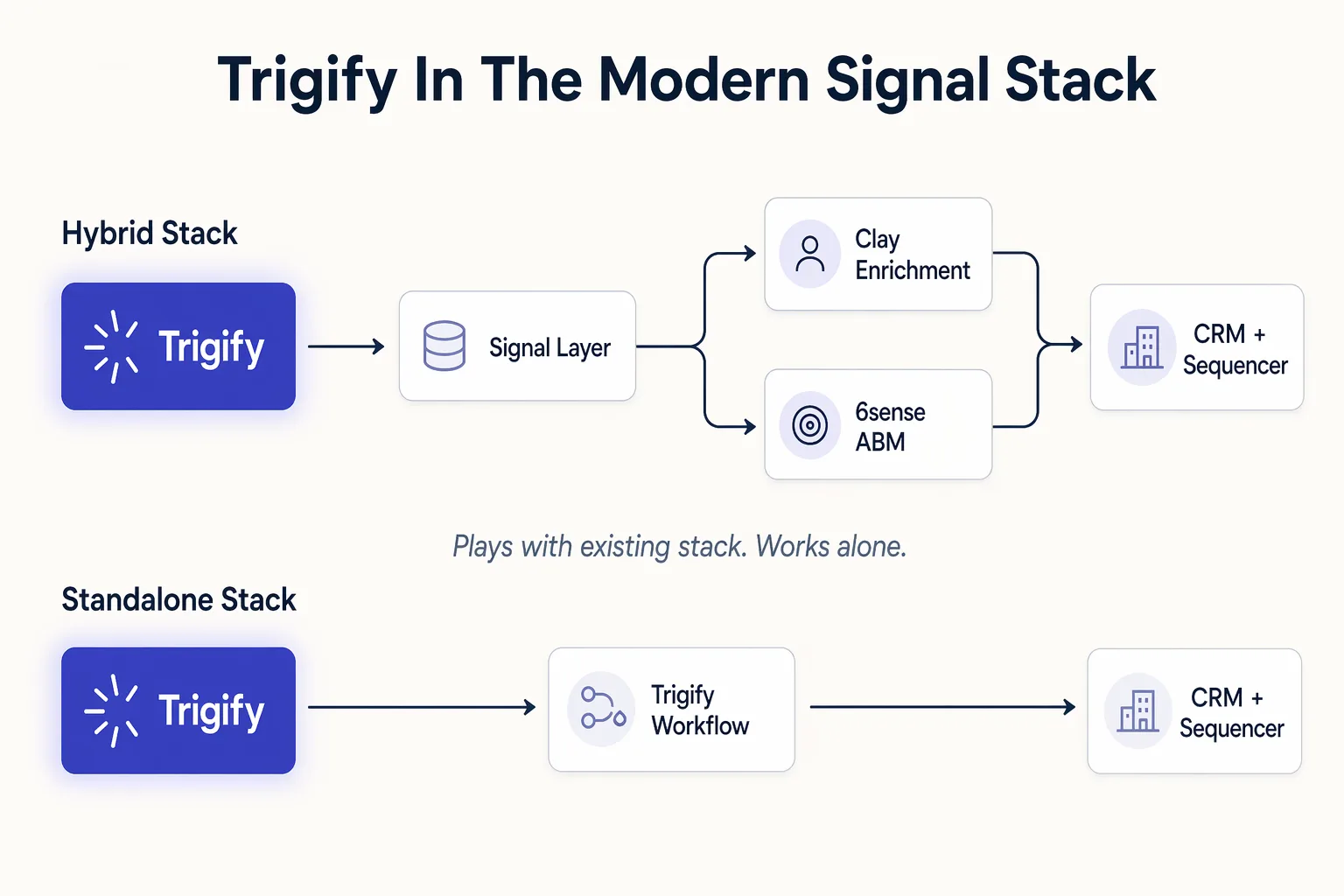
Trigify in the modern signal stack
FAQ: Social Signals vs Intent Data
What is intent data?
Intent data is behavioural data indicating a buyer is researching a problem your product solves. In B2B, it usually means third-party signals like Bombora Company Surge, 6sense anonymous-visitor resolution, or ZoomInfo Streaming Intent. Outputs are typically account-level surge scores against a fixed topic taxonomy, refreshed weekly, and designed to feed ABM and SDR prioritisation.
Is social signal data the same as first-party intent?
Not quite. First-party intent traditionally means behaviour on properties you own, like your website or product. Social signals are observed public behaviour on third-party platforms, but because they are tied to named individuals and unfiltered by vendor taxonomies, they behave more like first-party data in terms of precision and actionability. Trigify treats them as a distinct, higher-resolution category.
Why is person-level better than company-level?
Because the account does not buy, the human does. A 500-person company "surging" on a topic tells you nothing about which of a dozen potential champions to contact. A named VP posting about a migration today tells you exactly who to message, what to say, and when. Harvard Business Review pegs the conversion lift from acting on social signals at around 40 percent.
Do we still need traditional intent data providers?
If you run serious ABM or advertising programmes, probably yes. Third-party intent still shapes account prioritisation and ad targeting at scale. But for outbound personalisation, champion tracking, churn detection, and buying-window alerts, social signals consistently outperform. The question is not either-or, it is where each belongs in your stack.
How fresh is social signal data compared to Bombora?
Trigify surfaces posts, comments, and job changes within minutes to hours. Bombora and similar co-op providers ship weekly surges with a 7 to 30 day effective lag, as reported repeatedly in Gartner Peer Insights buyer reviews. For fast-moving buying windows such as migrations, replatforms, and competitive evaluations, that freshness gap is often the difference between a meeting and a missed deal.
What is the 95/5 rule and how does it apply?
The 95/5 rule from LinkedIn B2B Institute and Ehrenberg-Bass says only around 5 percent of your market is in-market at any moment. Account-level intent helps with the 95 percent via brand and demand shaping. Social signals are how you catch the 5 percent the instant they surface, by listening for the specific behaviours that only happen inside an active evaluation.
Can we pipe social signals into 6sense or ZoomInfo?
Yes. Trigify is designed as an upstream layer that feeds existing intent and ABM platforms. Enriched person-level signals can flow into 6sense, Demandbase, or ZoomInfo via CRM or reverse-ETL, adding the who and when those platforms otherwise infer from account-level aggregates. You keep your ABM investment and add a sharper trigger layer on top.
How do we start without ripping out our current stack?
Pick one narrow play and add Trigify as a signal source. Champion job changes into CRM is the highest-leverage starting point, because job changes correlate with a three times conversion lift within 90 days (UserGems and SalesLoft). From there, expand into competitor-complaint monitoring, hiring-signal alerts, and community-question detection without touching the rest of your ABM setup.