Social Media Signals: The Complete GTM Guide (2026)
The operator guide to social media signals: full signal library, the lens framework, person-level intent, and how Trigify turns posts into pipeline.

TL;DR
- Social media signals are person and account behaviours that show timing, interest, influence, or risk before they appear in your CRM.
- The useful move is not collecting every mention. It is applying the right lens, then routing the signal to sales, marketing, or RevOps with context.
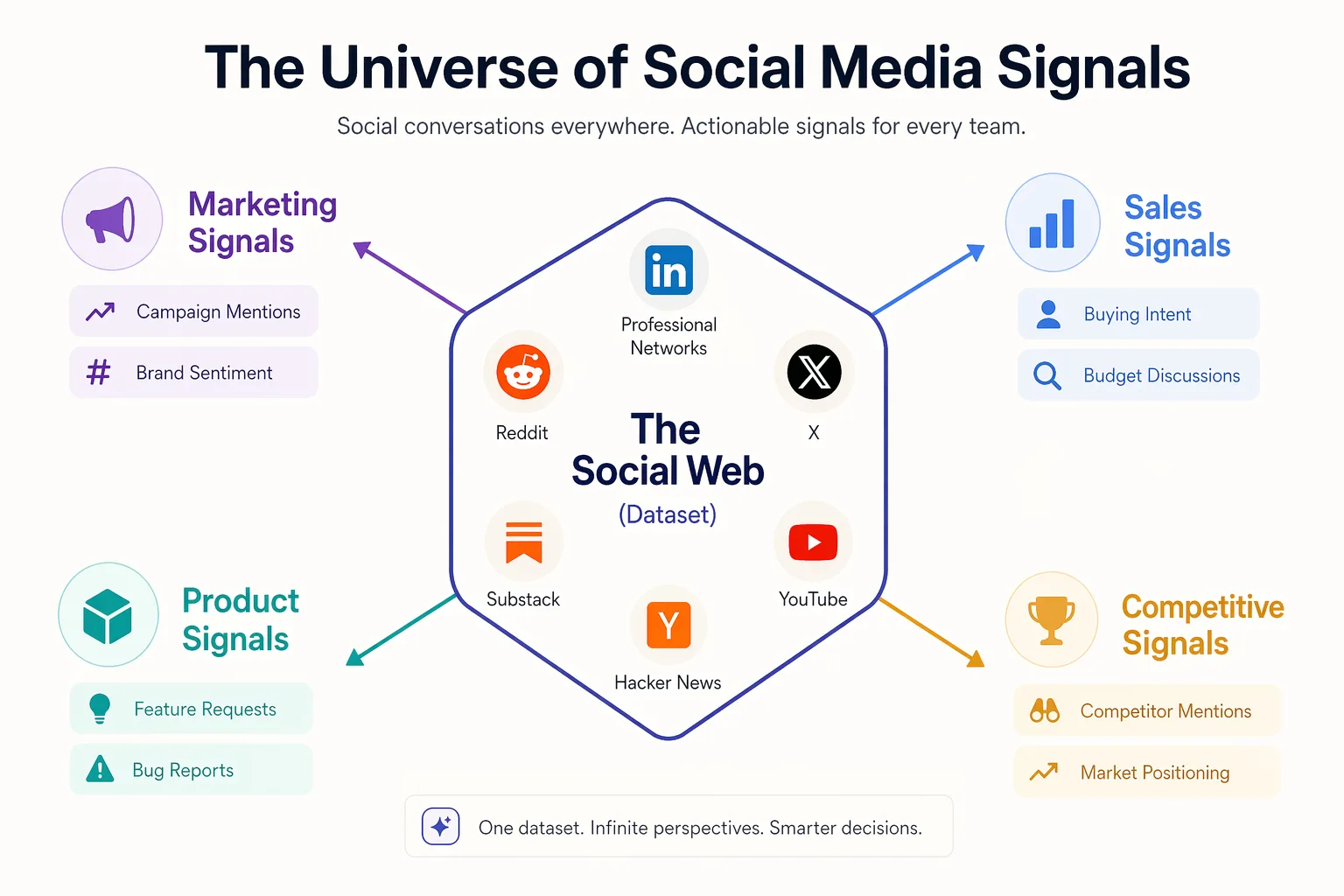
- Trigify captures signals across professional networks, Reddit, X, Substack, YouTube, and Hacker News, then turns them into workflow triggers.
- Use this guide as the parent map for marketing, sales, GTM engineering, and intent-data comparison chapters.
The Universe of Social Media Signals
Key stats for social media signals
- #1 B2B sales trend for 2026: signal-based GTM (Forrester, Predictions 2026).
- $5.2B market by 2027 at roughly 25% CAGR (MarketsandMarkets, Intent Data Market Report).
- 78% of social sellers outsell peers who don't sell through social surfaces (LinkedIn State of Sales 2024).
- 87% of B2B buyers want to self-serve part or all of the buying journey, researching on public social surfaces before any sales contact (TrustRadius, B2B Buying Disconnect Report).
What are social media signals?
Social media signals are observable behaviours on public social platforms (comments, posts, follows, reshares, hires, job changes, mentions) that indicate a person or account is moving toward a commercial outcome: buying, churning, hiring, entering a market, or becoming influential. They are the raw data; the analytical lens turns them into a GTM action.
Unlike third-party cookie-based intent, social signals are attributable to a named person or verifiable account. They also live on the open web, which means buyers research there deliberately. According to TrustRadius, 87% of B2B buyers want to self-serve part or all of their buying journey before ever speaking to a rep, and most of that research happens across peer communities, review sites, and social content. If your team is not listening on those surfaces, you are missing the live part of the funnel.
Trigify captures these signals across six public surfaces: professional networks, Reddit, X, Substack, YouTube, and Hacker News. Each platform produces different evidence of intent. Professional networks show role, company context, and open engagement. Reddit and Hacker News show unfiltered workflow pain. X shows real-time opinion and competitor reaction. Substack and YouTube show long-form belief and strategic direction.
Why social signals matter for GTM in 2026
Social signals matter because cold lists no longer convert and buyers no longer wait to be sold to. Forrester's Predictions 2026 named signal-based GTM the #1 B2B sales trend of the year, and McKinsey reports that B2B companies using behavioural data to prioritise accounts grow approximately 2x faster than peers. Signal-based outbound drives roughly 40% higher conversion than cold, list-based outbound according to Harvard Business Review sales research.
Three shifts make 2026 the inflection point. First, buyer self-service is now the default: 87% of B2B buyers want to self-serve part or all of the journey (TrustRadius). Second, outbound noise has exploded, so response rates to undifferentiated cold sequences have collapsed. Third, AI agents are now the ones reading signals, which means structured, high-quality triggers beat volume plays.
The commercial impact is measurable. LinkedIn State of Sales 2024 found that 78% of social sellers outsell peers who don't sell through social surfaces. UserGems' analysis of job-change signals shows that reaching a champion within 90 days of their move produces roughly 3x the conversion rate of cold prospecting into the same account. These are not vanity lifts. They are the difference between a pipeline motion that works and one that slowly dies.
Person signals vs account signals: what's the difference?
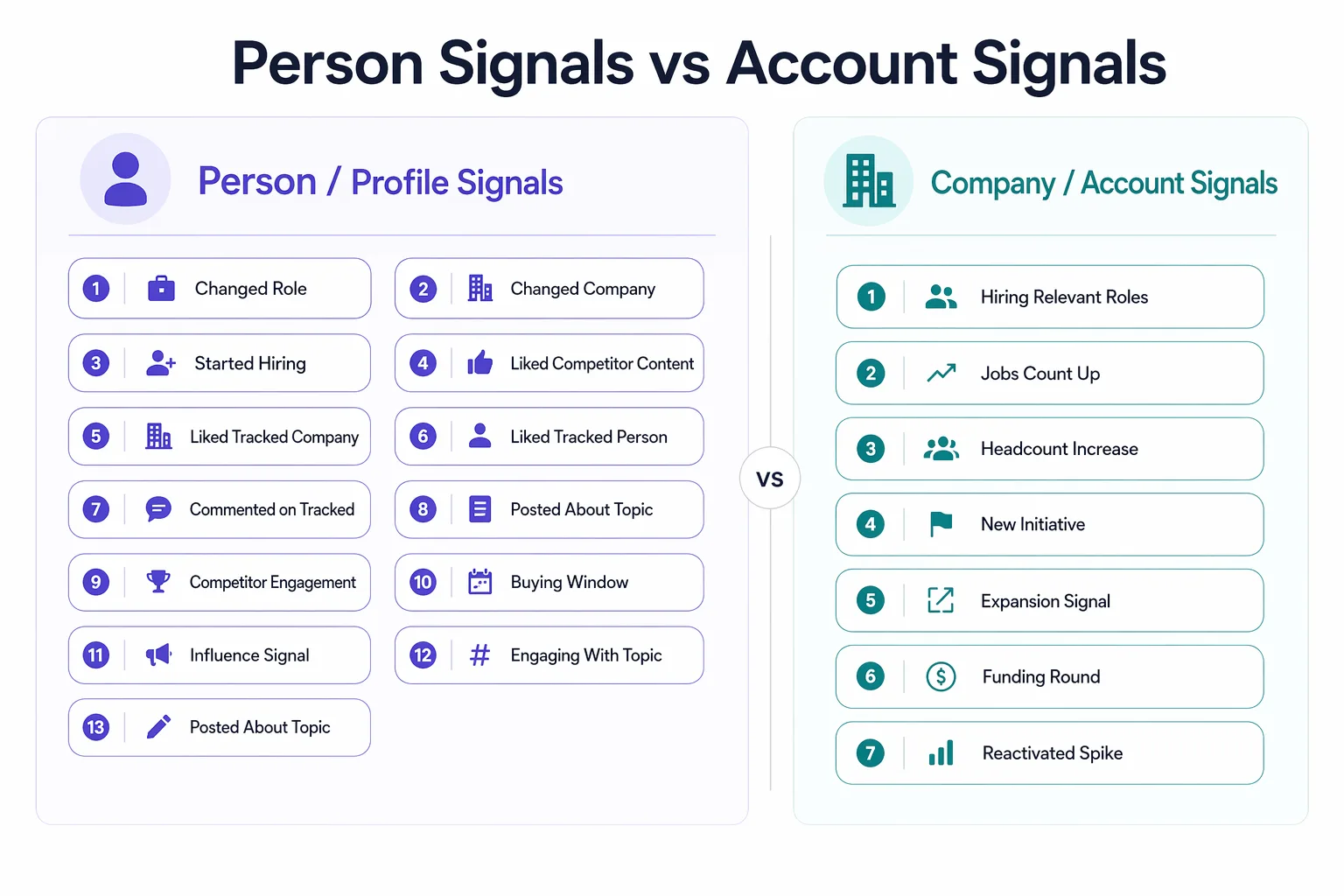
Person signals track individual behaviour (a specific buyer commenting, posting, engaging, or changing jobs), while account signals track company-level behaviour (hiring surges, funding, leadership changes, competitor mentions). Person signals answer "who is in-market right now?" Account signals answer "which companies are entering a commercial moment?" The best motions use both, stacked together.
Person Signals vs Account Signals
Person signals
- Engagement signals: comments, reactions, reshares on your content or a competitor's.
- Authorship signals: posts a prospect writes about the problem your product solves.
- Follow signals: who a target buyer starts following (often a peer, a competitor, or a category leader).
- Job change signals: a champion leaving for a new role. UserGems data shows these convert at 3x cold outbound within 90 days.
- Community signals: Reddit comments, Hacker News threads, niche Slack or Discord mentions.
- Long-form consumption signals: Substack subscriptions, YouTube channel follows that indicate a specific belief or workflow.
Account signals
- Hiring signals: role postings that imply a new initiative, tool choice, or capability gap.
- Leadership change signals: a new VP, Head of, or C-level hire often triggers a tooling review within 60 days.
- Funding and expansion signals: new rounds, new offices, new markets.
- Competitor mention signals: a target account publicly comparing, complaining about, or leaving a competitor.
- Content shift signals: a brand account changing narrative (pricing page, rebrand, product launch).
Stacked signals beat single signals. A lone comment is noise. A comment + a related hire + a funding round + a new VP = a commercial moment. This stacked logic is the emerging operator standard, and it is what separates a working signal motion from CRM pollution.
How does one post become four different signals?
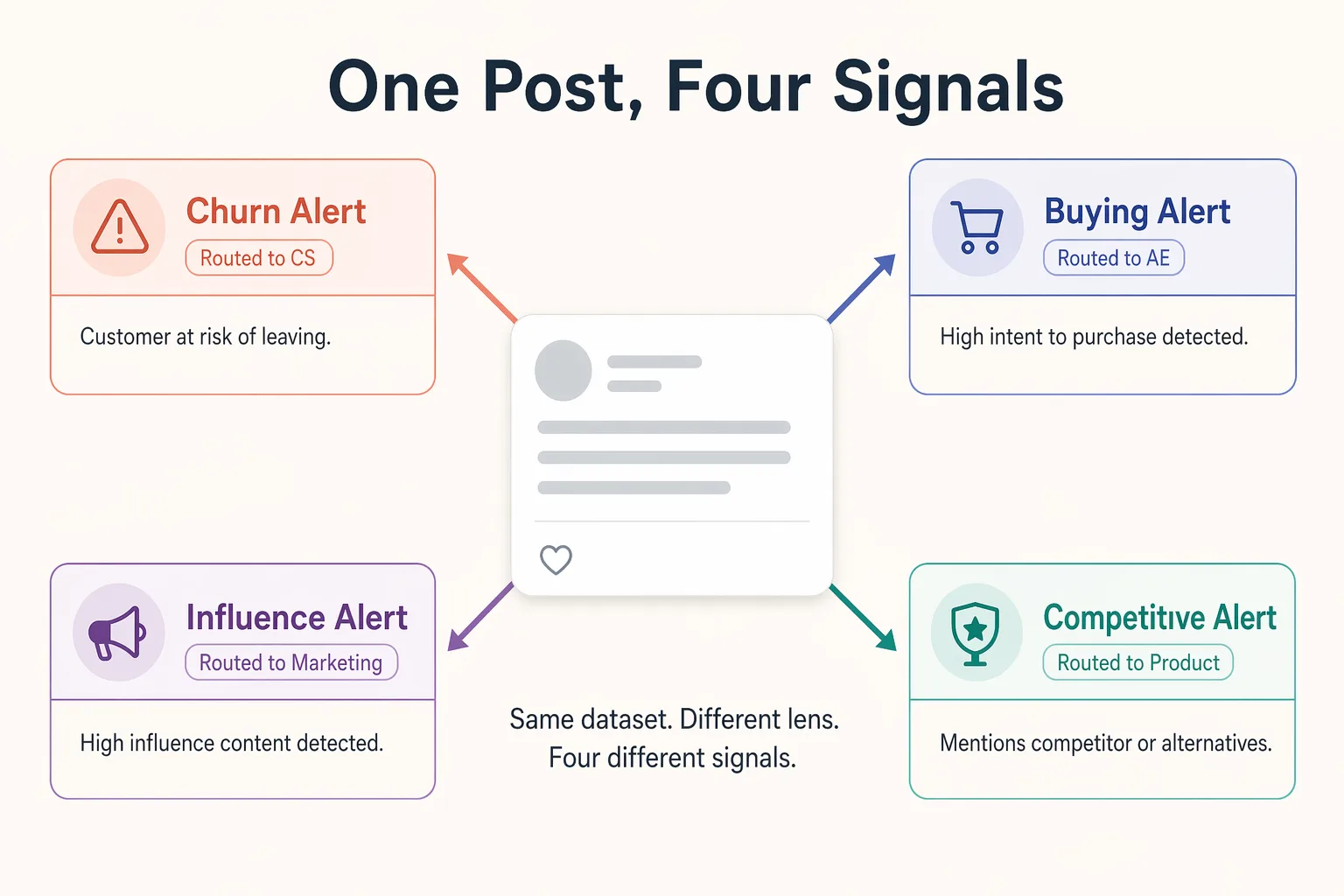
A single social media post can produce four completely different signals depending on the analytical lens applied: a churn lens (who's complaining about a competitor), a buying lens (who's researching a category), an in-market lens (who's actively evaluating), and an influence lens (whose opinion moves the category). The post is the same. The GTM meaning is not.
One Post, Four Signals
Consider a VP of RevOps posting "our CRM has become a graveyard for unqualified leads." Read through a churn lens, it is a churn risk for whichever CRM they use. Read through a buying lens, it is a prospect for a signal-based outbound tool. Read through an in-market lens, it is a trigger to sequence within 48 hours. Read through an influence lens, it is a voice worth engaging with publicly to build category presence.
The lens you apply depends on what your GTM team is actually trying to accomplish this quarter. That is why signal capture is necessary but not sufficient. The interpretation layer is what turns data into revenue.
Social signals vs intent data: what's the difference?
Intent data is typically aggregated, third-party, account-level, and opaque. Social signals are public, person-level, transparent, and attributable. Intent data tells you "a company in your ICP is researching your category." Social signals tell you "this specific person at this account just commented about this specific problem." Both are useful. Social signals are more actionable.
Traditional intent data (Bombora, 6sense, ZoomInfo) comes from cooperative networks of publisher sites, with account-level surges scored by a black-box model. The operator complaint is consistent: you cannot see why a score is high, and you cannot reach the individual who triggered the surge. Social signals invert this. The trigger is transparent (a post, a comment, a follow), the actor is identified (a named person at a named company), and the contact path is immediate.
For a deeper comparison, see our dedicated guide on social signals vs intent data and our breakdown of first-party vs third-party intent data. If you want the broader category context, the 2026 B2B intent signals guide covers the full landscape.
How do GTM teams use social signals?
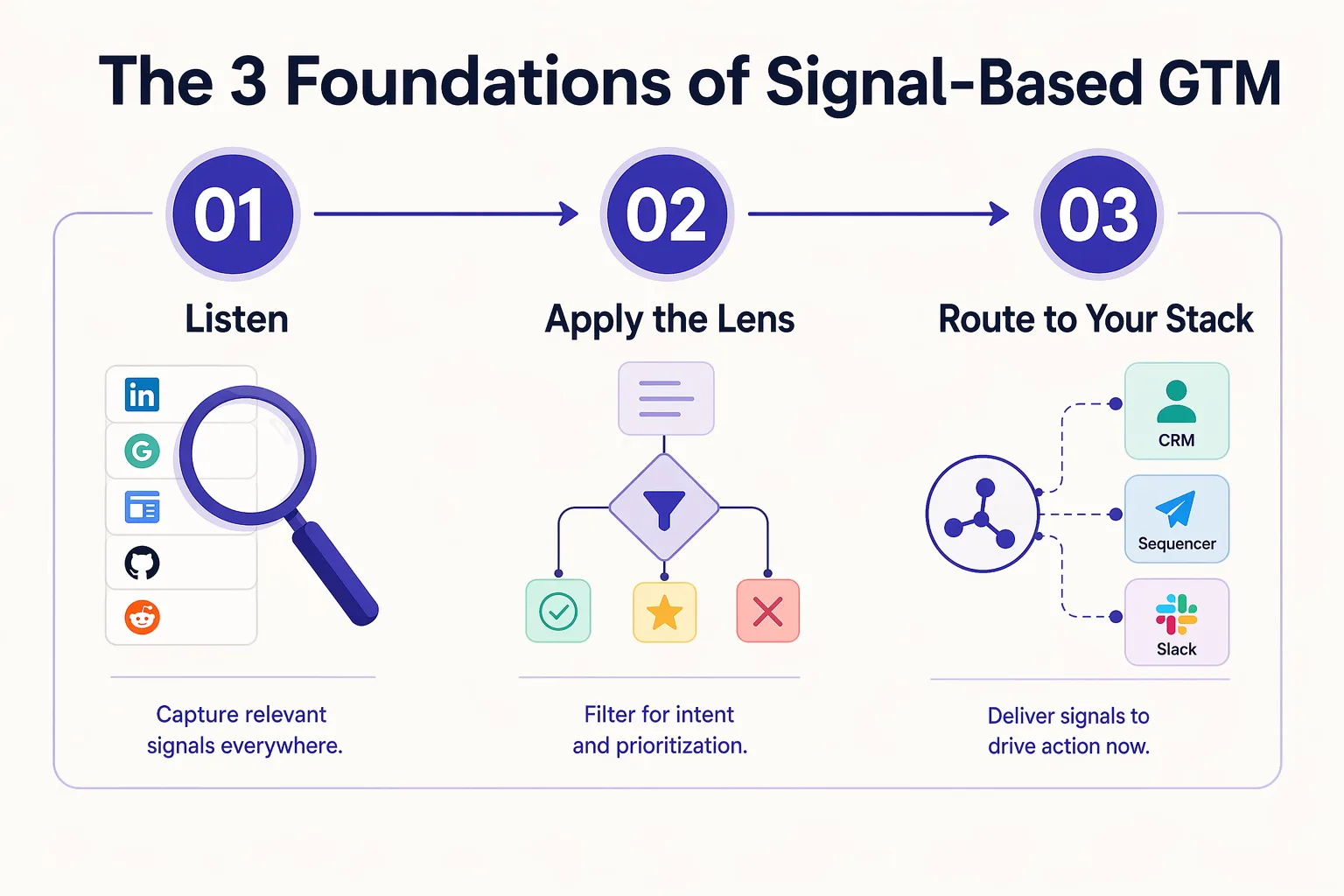
GTM teams use social signals in three coordinated motions: marketing teams use them for audience targeting, content triggers, and thought-leadership distribution; sales teams use them for prioritisation, personalised outbound, and timing; and GTM engineers use them as the trigger layer in automated plays that route through Clay, HubSpot, Salesforce, and sequencers.
The 3 Foundations of Signal-Based GTM
Marketing: triggered content and category presence
Marketing teams use social signals to detect who in their ICP is publicly engaging with the category, then run triggered content plays (comment, reshare, DM, retarget) to build presence before sales ever reaches out. The LinkedIn B2B Institute's 95/5 rule applies here: only 5% of your market is in-market at any given time, so the other 95% is where mental availability is built. Social signals tell you which 5% is live and which 95% is paying attention. For the full playbook, see Social Media Signals for Marketing.
Sales: prioritisation and personalised outbound
Sales teams use social signals to prioritise their book of business and sequence outbound around real events (a comment, a hire, a job change). LinkedIn State of Sales 2024 found 78% of social sellers outsell non-social peers, and UserGems' job-change data shows 3x conversion within 90 days of a champion move. For the full playbook, see Social Media Signals for Sales and our deeper take on signal-based selling in B2B.
GTM engineering: signals as the trigger layer
GTM engineers wire social signals into automated workflows: capture the trigger, qualify it against ICP rules, enrich with Clay or Apollo, route to the right play (outbound sequence, paid retargeting, SDR task, CS alert). This is the fastest-growing use of signals in 2026. See the GTM engineer's social signals playbook for wiring patterns, and Introducing the Trigify CLI for the terminal-native workflow.
Which social signal platforms matter?
Six public platforms produce the majority of commercially useful social signals for B2B: professional networks (identity and role context), Reddit (unfiltered workflow pain), X (real-time opinion and competitor reaction), Substack (long-form belief and strategic direction), YouTube (deep workflow demonstration), and Hacker News (technical decision signals). Trigify covers all six in one capture layer.
Most competitor guides treat "social" as a single bucket and quietly mean professional networks only. The operator reality is that different platforms answer different questions. Reddit tells you what a buyer hates about your competitor. X tells you when a category leader shifts opinion. Substack tells you what a buyer believes about the future of the space. YouTube tells you what workflow they actually use. Hacker News tells you when a technical decision is being made. Professional networks tell you who the person is and how to reach them.
The identity loop matters here. Professional networks are the only surface where the same person who generates a signal can be identified, enriched, and contacted in a single loop. That is why any serious social signal motion uses professional networks as the identity anchor and the other five platforms as context.
Trigify vs the signal stack: how does it compare?
Trigify is the capture and interpretation layer for social-native signals across the public web. Competitors in the adjacent space focus on different layers: 6sense and ZoomInfo on third-party intent, Common Room on community signals, Clay on enrichment and orchestration, UserGems on job-change signals. Trigify is the only tool that captures social signals across all six public platforms with transparent, self-defined triggers.
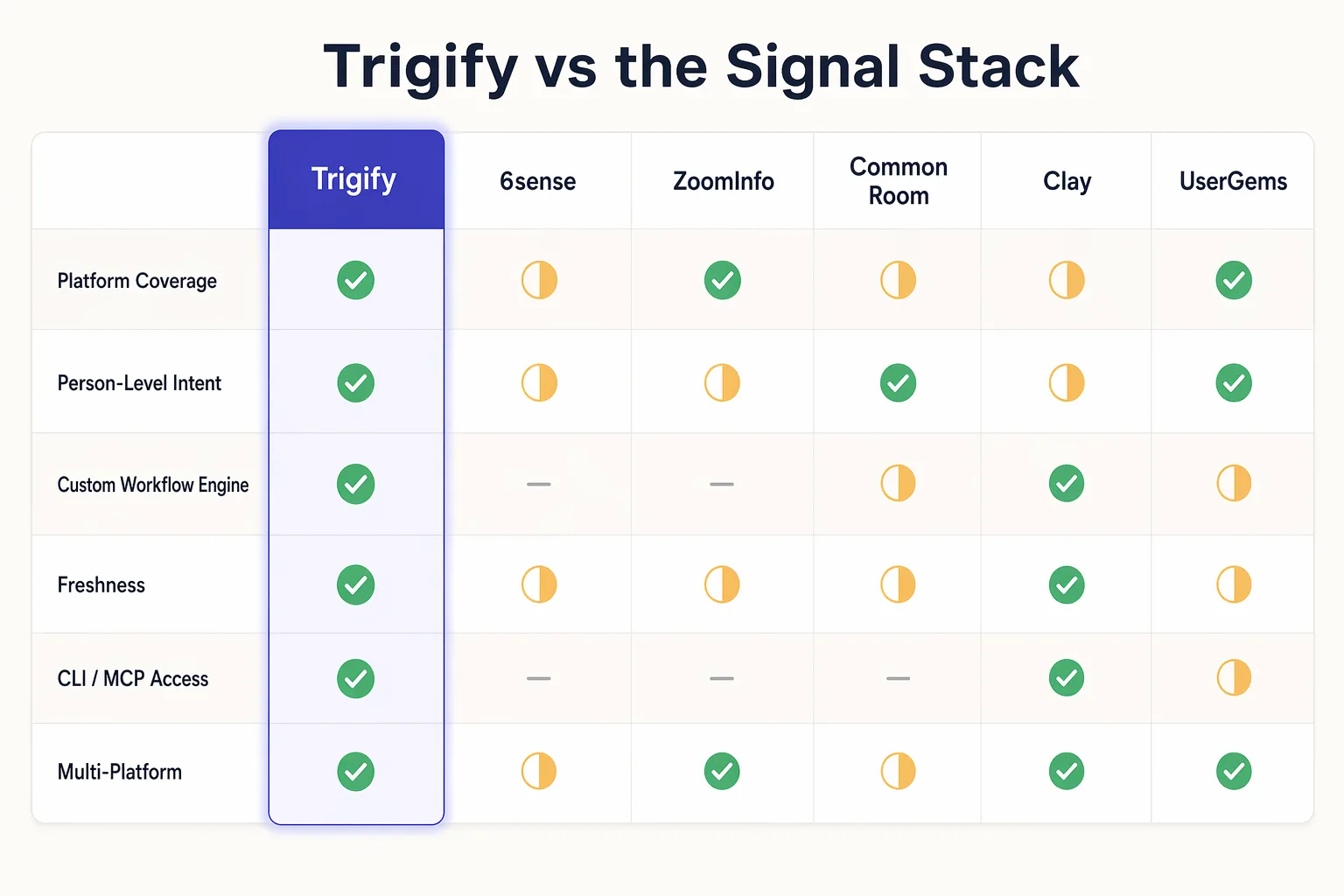
Trigify vs the Signal Stack
Trigify
- Primary layer: Signal capture + interpretation
- Signal source: Professional networks, Reddit, X, Substack, YouTube, Hacker News
- Transparent triggers?: Yes (self-defined)
- Multi-platform social?: Yes (six platforms)
6sense
- Primary layer: Third-party intent
- Signal source: Publisher cooperative
- Transparent triggers?: No (black-box score)
- Multi-platform social?: No
ZoomInfo
- Primary layer: Contact data + intent
- Signal source: Publisher cooperative + firmographic
- Transparent triggers?: Partial
- Multi-platform social?: No
Common Room
- Primary layer: Community signals
- Signal source: Slack, Discord, community tools
- Transparent triggers?: Yes
- Multi-platform social?: Partial
Clay
- Primary layer: Enrichment + orchestration
- Signal source: Aggregates other sources
- Transparent triggers?: Yes
- Multi-platform social?: No (no native capture)
UserGems
- Primary layer: Job-change signals
- Signal source: Professional network job changes
- Transparent triggers?: Yes
- Multi-platform social?: No (single signal type)
Trigify is designed to sit in front of Clay, HubSpot, Salesforce, and Apollo, not replace them. You own the triggers (which signals matter for your motion). We capture them cleanly, qualify them against your ICP, and route them into the tool where your team already works.
How do you build a social signal workflow?
A working social signal workflow has six steps: define the trigger, capture across platforms, qualify against ICP, enrich with contact and context, route to the right play, and measure conversion. You can build the first version in about an hour if the trigger is clearly defined, and iterate from there.
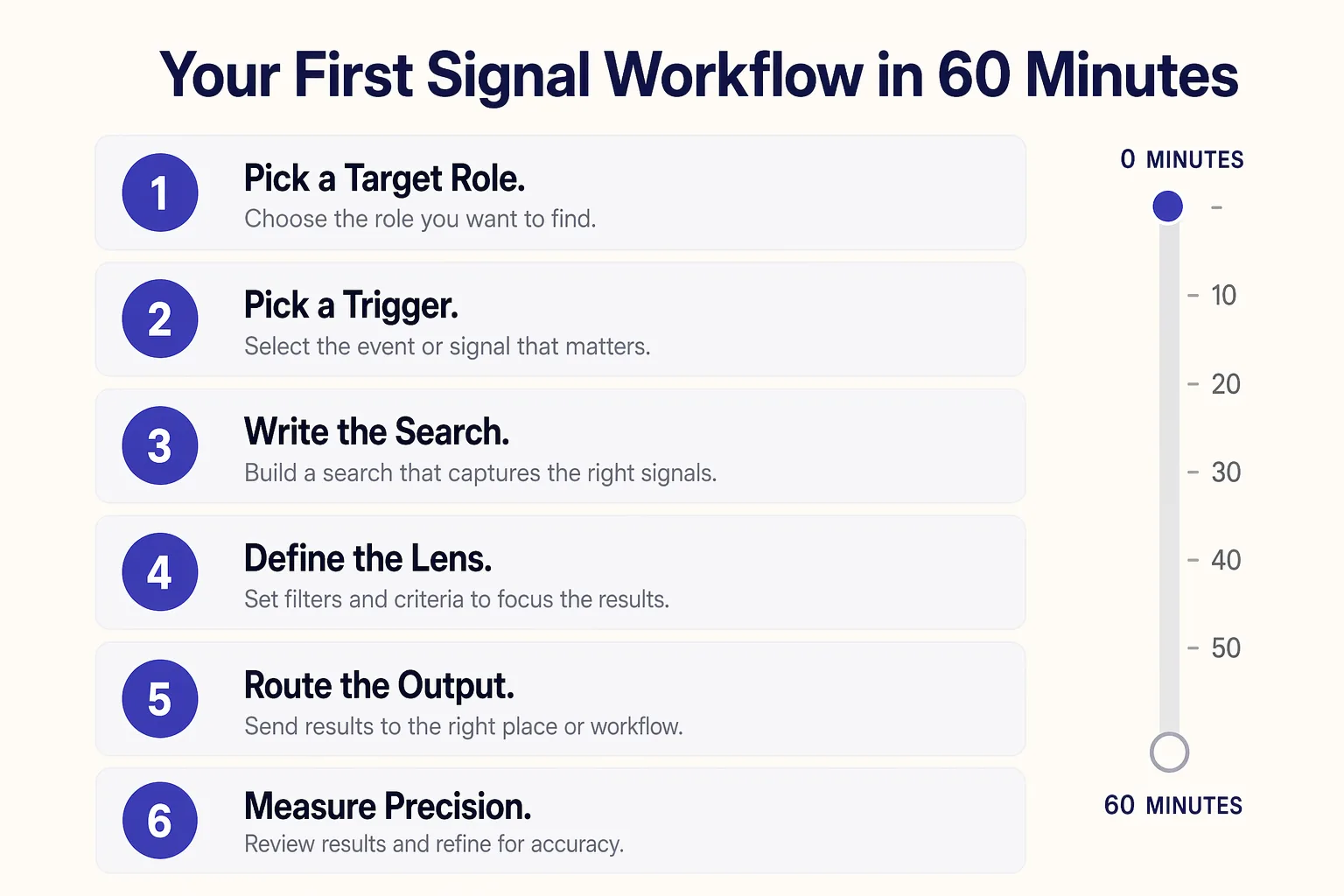
Your First Signal Workflow in 60 Minutes
- Define the trigger. Pick one specific behaviour that indicates a commercial moment. Example: "VP or Head of RevOps posts about CRM data quality." Vague triggers produce CRM pollution.
- Capture across platforms. Point Trigify at the relevant surfaces. For this example: professional networks (primary) plus Reddit r/revops (context).
- Qualify against ICP. Filter by company size, industry, geography, tech stack. Discard signals that match the trigger but not the profile.
- Enrich with contact and context. Send qualified signals to Clay or Apollo for email, phone, tech stack, funding, and recent news.
- Route to the right play. Sequence in HubSpot or Salesloft, paid retargeting on professional networks, SDR task for high-priority stacked signals.
- Measure conversion. Track signal-to-meeting rate, signal decay time, and stacked-signal lift vs single-signal baseline.
Most teams iterate by tightening the qualification filter in week two and adding stacked signals in week three. By week four, you have a working motion with measurable conversion lift.
FAQ: Social media signals for GTM
What is a GTM engineer?
A GTM engineer is the operator who wires signal capture, enrichment, routing, and execution into an automated revenue workflow. They sit between marketing, sales, and RevOps, and they treat the GTM stack as a system to be engineered rather than a set of SaaS licences. For the full playbook, see the GTM engineer's social signals playbook.
What are composite signals?
Composite signals (also called stacked signals) are combinations of two or more individual triggers that together indicate a commercial moment. Example: a comment about a competitor plus a new VP hire plus a funding round. Individually these are noise; stacked, they are a high-conviction buying signal. Stacking is the single biggest lever for reducing CRM pollution in a signal motion.
How do you measure social signal conversion?
The core metrics are signal-to-meeting rate (percentage of qualified signals that become booked meetings), signal decay time (how quickly a signal loses value after capture), and stacked-signal lift (conversion delta between stacked and single signals). According to Harvard Business Review sales research, signal-based outbound drives roughly 40% higher conversion than cold, list-based outbound when measured cleanly.
Which platforms work best for B2B social signals?
Professional networks are the identity anchor for B2B because they link signal, person, company, and contact path in one surface. Reddit and Hacker News add unfiltered workflow pain. X adds real-time opinion. Substack and YouTube add long-form belief and workflow depth. Trigify captures all six so you don't have to pick one.
How is person-level intent different from company-level?
Person-level intent identifies a specific individual taking a specific action ("this VP commented on this post"). Company-level intent aggregates behaviour across a firm ("this account's content consumption surged"). Person-level is more actionable because you can reach a named individual. Company-level is better for total addressable market mapping. Mature motions use both, with person-level driving outbound and company-level driving territory design.
What is the 95/5 rule?
The 95/5 rule, popularised by the LinkedIn B2B Institute and Ehrenberg-Bass research, states that only 5% of your market is in-market to buy at any given time. The other 95% is building future mental availability. Social signals help you identify the live 5% for outbound and the engaged 95% for brand and content plays, so your effort matches the buyer's actual stage.
Can AI agents act on social signals?
Yes, and increasingly they do. AI agents can read a structured signal feed, classify it against ICP rules, draft a personalised outbound message, and route it into a sequencer with no human intervention. This only works when signals are clean, transparent, and well-defined upstream. Black-box account-level scores do not give agents enough context to act.
What is the fastest way to start with social signals?
Define one clear trigger ("champion job change into a target account"), capture it in Trigify across professional networks, qualify against your ICP, enrich with Clay, and route to a five-touch outbound sequence. You can have this running in under an hour and a measurable conversion read within two weeks. For the step-by-step, see the six-step workflow above.
- If you want the marketing-specific playbook, see Social Media Signals for Marketing.
- If you want the sales-specific playbook, see Social Media Signals for Sales.
- If you want the GTM engineer wiring patterns, see GTM Engineer's Social Signals Playbook.
- If you want the category comparison, see Social Signals vs Intent Data.
- If you want the broader landscape, see B2B Intent Signals in 2026 and First-party vs Third-party Intent Data.
- If you want the operator's take on signal-based selling, see Signal-based Selling in B2B.
- If you want the terminal-native workflow, see Introducing the Trigify CLI.