Social Media Signals for Sales: Person-Level Intent
How B2B SaaS sales teams turn person-level social signals into pipeline. 13 Trigify signals, vendor comparison, and a five-step operating loop.

This is the sales chapter of our pillar guide, Social Media Signals for GTM: The Complete Guide. It is written for RevOps leaders, sales managers, AEs, and BDRs at 50 to 500 person B2B SaaS who are done paying for account-level intent that their reps cannot actually use on a Monday morning.
TL;DR
- Sales signals from social media are named actions by real people, not vague account-level surges.
- Person-level intent tells reps who acted, what they did, when it happened, and why the outreach should exist.
- The best sales workflow filters first, enriches second, and only routes prospects when the signal is worth a rep’s time.
- Use social signals for job changes, competitor engagement, topic interest, buying-window behaviour, and champion movement.
What are sales signals from social media?
A sales signal from social media is a named, timestamped behaviour by an identifiable person on a public platform that suggests they are closer to a buying decision. Examples: a VP of Data commenting on a post about your category, a head of RevOps starting a new role, or a champion liking a competitor's launch post.
Social sales signals differ from traditional intent data in three ways. They are person-level, not account-level. They are public and observable, not inferred from IP logs. And they are fresh, arriving the day the behaviour happens rather than in a weekly CSV. Forrester ranks buyer intent the #1 growth-driving trend in B2B, but notes most intent data providers still operate at the account layer (Forrester B2B Summit 2024), which is precisely the gap social signals fill.
Why sales teams need person-level signals
Sales teams need person-level signals because every outbound cadence is written to a human, not an IP address. Knowing that "someone at Acme" is researching integrations is not actionable for an AE. Knowing that the new Director of Platform posted about their migration pain two days ago is. That precision is the whole unlock.
The LinkedIn State of Sales Report 2024 found that 78 percent of social sellers outsell peers who do not use social, and top performers are 2.3x more likely to research prospects on social before outreach (LinkedIn State of Sales 2024). Meanwhile, the intent data market is projected to hit $5.2B by 2027 at a 25 percent CAGR (MarketsandMarkets), yet the complaint we hear on every Fireflies call is identical: "the list is right, the person is wrong." Person-level social behaviour fixes that.
There is a reply-rate dimension too. The Ehrenberg-Bass 95/5 rule (LinkedIn B2B Institute) reminds us that only 5 percent of buyers are in-market at any given moment. Spraying the other 95 percent degrades your domain reputation and burns your ICP. Signals let you focus the cadence on the five.
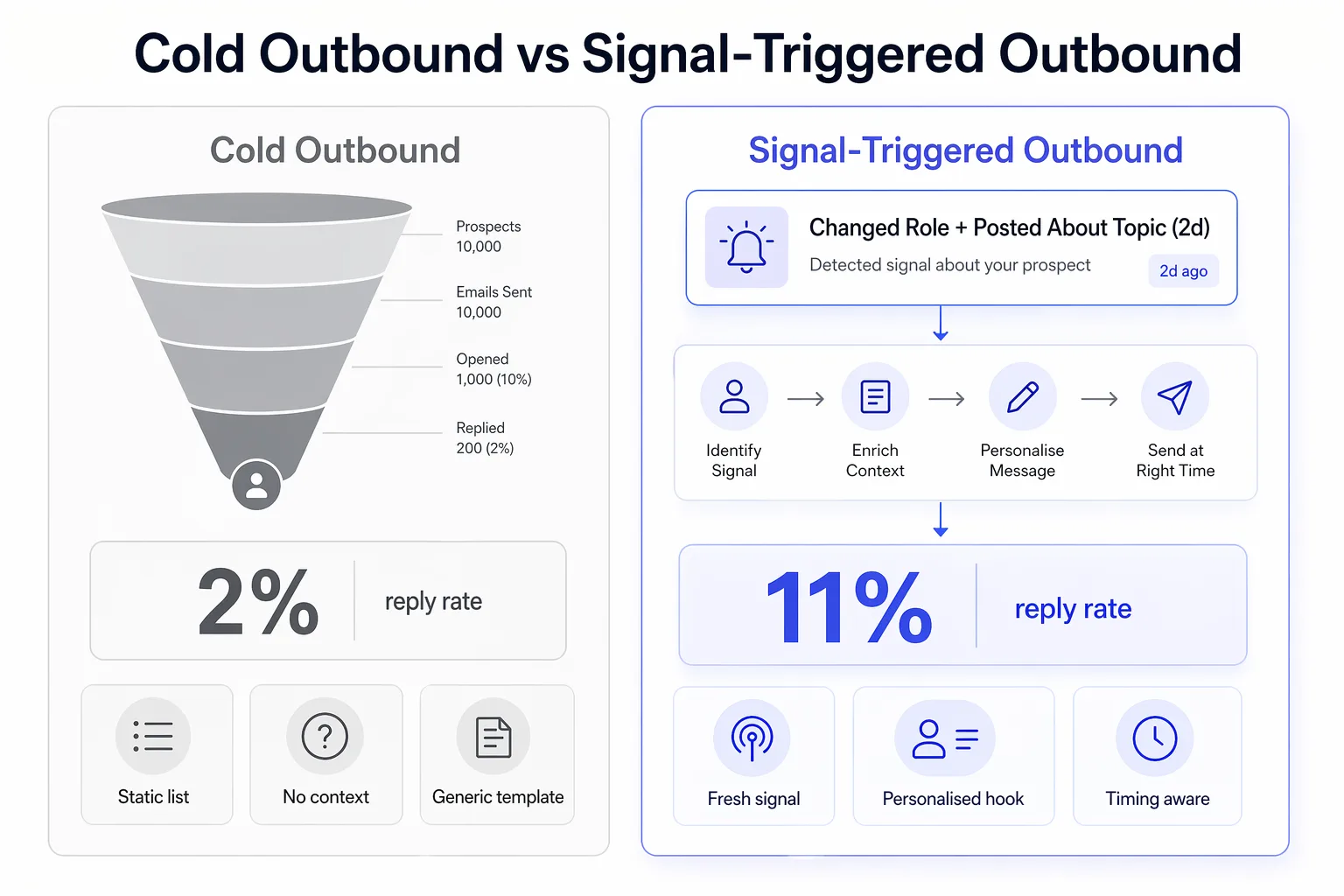
Cold Outbound vs Signal-Triggered Outbound
Which sales signals actually convert?
The signals that convert are the ones that combine a named person, an in-ICP account, and a time-bound behaviour inside a visible buying window. Job changes, competitor engagement, hiring announcements for adjacent roles, and repeated topic engagement over 14 days consistently outperform single-touch triggers. Single-signal triggers alert. Composite signals convert.
The ranked shortlist for B2B SaaS outbound, based on operator benchmarks and what we see across Trigify customers:
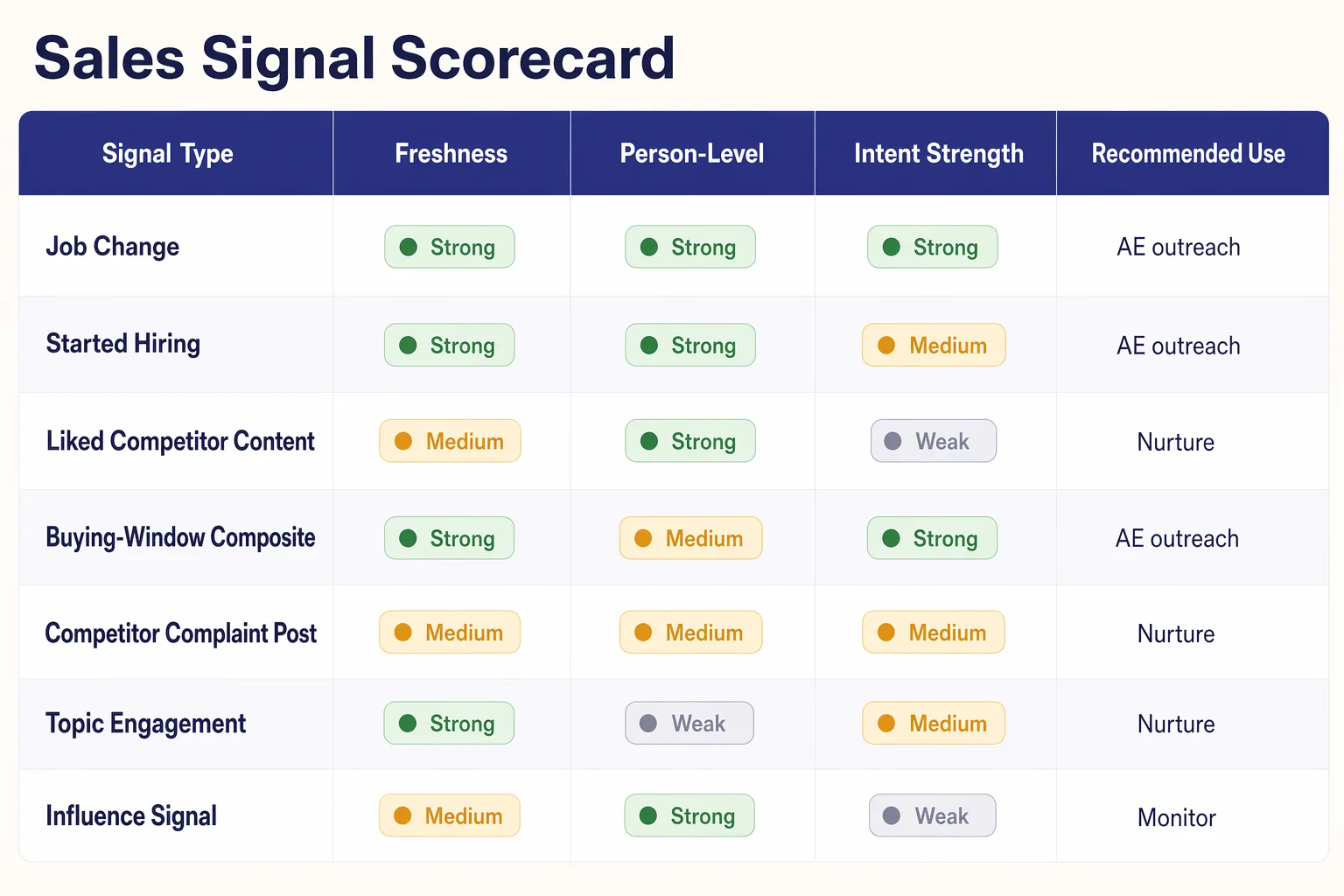
Sales Signal Scorecard
Company-level vs person-level intent: what's the difference?
Company-level intent tells you an account is researching a category. Person-level intent tells you which named individual at that account, on what topic, and when. Company-level is a heatmap. Person-level is a named contact with a timestamp. Both have a place in a stack, but only one of them can be handed to an AE on Monday without enrichment gymnastics.
Here is the honest comparison of where each major vendor plays, with Trigify first because it is the only pure-play person-level social-intent primitive in this list.
Trigify
- Signal Granularity: Person, post, author, topic
- Signal Types: 13 person-level social behaviours (likes, comments, posts, job changes, hiring)
- Person-Level Intent: Yes, native
- CRM Workflow: Direct to HubSpot, Salesforce, Clay, Outreach, Smartlead via CLI, API, MCP
- Platforms Covered: Professional networks, Reddit, X, Substack, YouTube, Hacker News
6sense
- Signal Granularity: Account
- Signal Types: IP-based research, anonymous site visits, keyword surge
- Person-Level Intent: Inferred via personas
- CRM Workflow: Platform-native orchestration; heavy implementation
- Platforms Covered: Third-party intent network, web
ZoomInfo
- Signal Granularity: Account plus firmographic contact
- Signal Types: Intent topics, scoops, funding, hiring
- Person-Level Intent: Limited
- CRM Workflow: Native Engage sequencer, CRM sync
- Platforms Covered: News, web, third-party intent, Bombora
Apollo
- Signal Granularity: Firmographic and technographic
- Signal Types: Hiring, funding, tech install, job postings
- Person-Level Intent: Weak, database-first
- CRM Workflow: Native sequencer, CRM sync
- Platforms Covered: Web crawl, company databases
UserGems
- Signal Granularity: Person (champion-focused)
- Signal Types: Job changes across your CRM
- Person-Level Intent: Yes, narrow
- CRM Workflow: CRM sync, sequencer enrolment
- Platforms Covered: Professional network job data
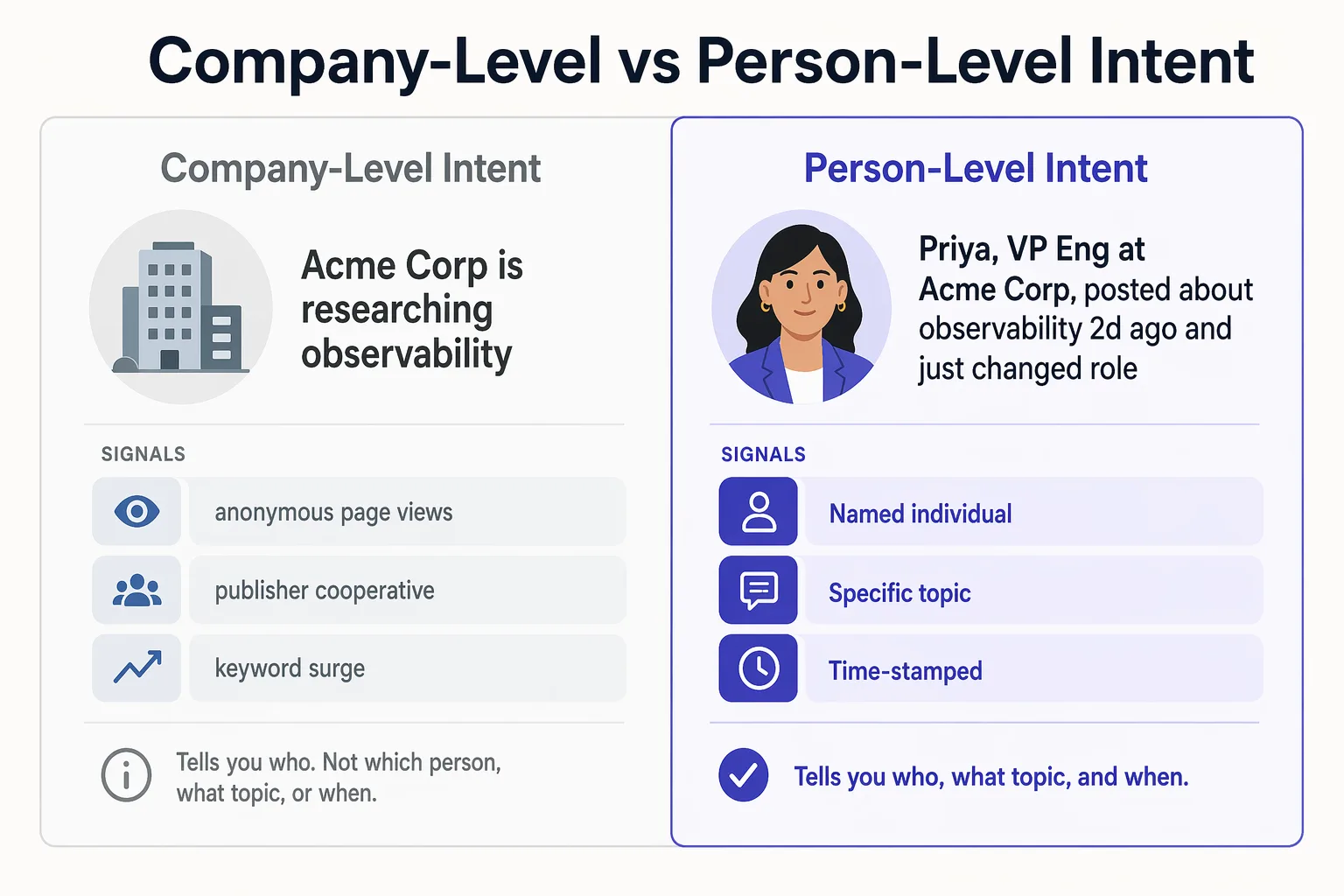
Company-Level vs Person-Level Intent
How to turn social signals into pipeline
Turning social signals into pipeline is a five-step loop: define the trigger, detect the signal, qualify it, route it, and measure it. The teams that win treat every signal as a small product with an owner, a conversion target, and a kill switch if it underperforms. The teams that lose buy a data feed and hope.
For the GTM engineering flavour of this same loop with code samples, see The GTM Engineer Playbook: Turning Social Signals Into Pipeline.
Which platforms deliver the best sales signals?
The best platform for a sales signal is the one your buyer actually uses in public. For most B2B SaaS, that means professional networks first for job change and consideration behaviour, Reddit and Hacker News for technical evaluation threads, X for executive commentary, Substack for newsletter-led consideration, and YouTube for demo-time research. Trigify covers all six so you can stop choosing.
- Professional networks. Richest source of job changes, role moves, and buying-committee formation.
- Reddit. Unfiltered pain posts and vendor comparisons in subreddits like r/devops, r/sales, r/saas.
- X. Executive and operator commentary. Useful for influence signals and competitor launches.
- Substack. Where consideration-stage research now lives. Subscriber comments and stacks are goldmine data.
- YouTube. Product demos, review videos, and comment threads that show active evaluation.
- Hacker News. Technical buyer sentiment and early-stage discovery.
Signal Library: the 13 person-level signals Trigify detects
These are the primitives. Compose them into buying-window workflows or fire them standalone; each one maps to a rep play and a CRM field.
Changed Role
Example: Head of RevOps moves to a new seniority inside the same company. Buying window opens for tooling decisions.
Changed Company
Example: A former customer champion starts at a net-new logo. Outreach within 90 days converts at 3x (UserGems benchmark).
Started Hiring
Example: Tier-1 account opens three platform reqs. Signals buying-committee formation and budget.
Liked Competitor Content
Example: Director of Data likes a competitor's launch post. Active consideration signal for a displacement play.
Liked Tracked Company Content
Example: Prospect likes a post from a company in your partner ecosystem. Warms up co-sell motions.
Liked Tracked Person Content
Example: Prospect likes a post from a named industry voice you follow. Influence-mapped outreach.
Commented on Tracked Content
Example: Prospect comments on a tracked post with a specific objection. Reply becomes the opener.
Posted About Tracked Topic
Example: VP Engineering writes a post about observability migration pain. Warmest possible inbound without a form fill.
Competitor Engagement
Example: Repeated likes and comments across multiple competitor authors in 14 days. Active evaluation.
Buying-Window Signal
Example: Composite fire when job change plus topic engagement plus ICP fit all hit inside 30 days.
Influence Signal
Example: Prospect engages repeatedly with a handful of industry voices. Map them and pitch through influence.
Engaging With Topic
Example: Prospect interacts with three posts on "vector databases" in a week. Topic score surges, AE gets alerted.
Posted About Topic
Example: Prospect publishes original content on a tracked category. Reference the post in the opener and book the meeting.
How Trigify fits your sales stack
Trigify is the detection primitive at the front of your sales stack. It watches six public platforms for the 13 person-level signals, qualifies them with a workflow engine, and writes named, timestamped events straight into your CRM, Clay, and your sequencer. You keep HubSpot or Salesforce. You keep Outreach, Apollo, or Smartlead. Trigify makes them smarter.
The common architecture on our customer base:
- Detect. Trigify workflows watch tier-1 accounts and tracked topics across professional networks, Reddit, X, Substack, YouTube, and Hacker News.
- Qualify. LLM classifiers and workflow filters strip noise before anything reaches a rep.
- Route. Webhooks push to HubSpot or Salesforce with
signal_source,workflow_id, andsignal_timestamp. Slack cards post to the account AE. - Sequence. Smartlead, Outreach, or Apollo enrols the contact with the specific post or role-change referenced as the opener.
- Measure. Per-workflow conversion tracked in HubSpot reports or dashboards. Kill what underperforms, scale what works.
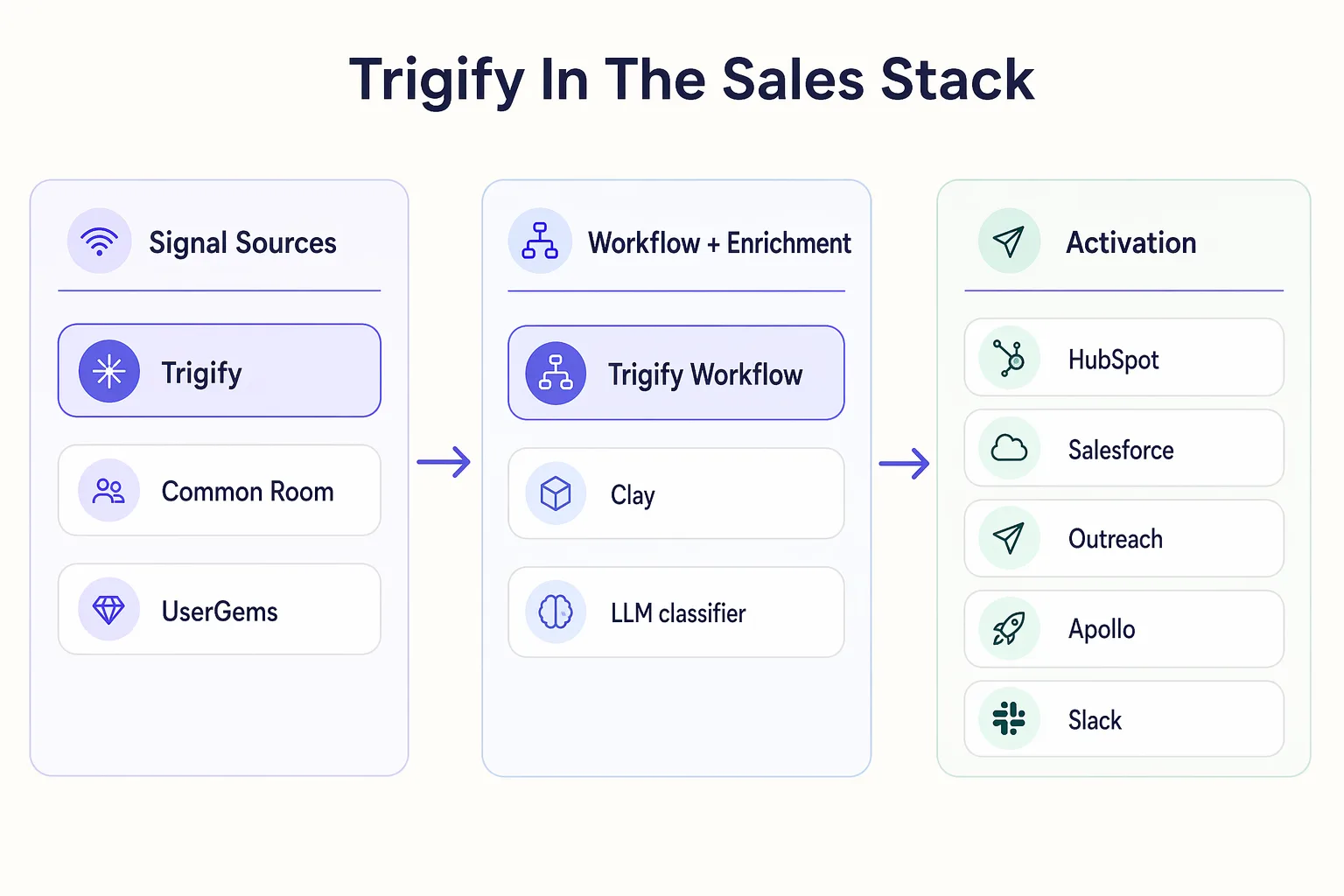
Trigify In The Sales Stack
If you want to see the CLI and API surface, read Introducing the Trigify CLI. If you want to understand where social signals sit relative to classic intent data, read Social Signals vs Intent Data.
FAQ: Social Media Signals for Sales
What counts as a sales signal?
A sales signal is any observable event that suggests a specific person or account is closer to a buying decision. The strongest signals are named, timestamped, and in-ICP: a job change, a public post about a category pain, a competitor engagement, or a hiring spike. Weak signals like generic surge scores are too lossy to drive a cadence without heavy enrichment on top.
How is a social signal different from a buying signal?
Every social signal can be a buying signal, but not every buying signal is social. Classic buying signals include funding rounds, tech installs, and press releases, which come from news and databases. Social signals come from behaviour on public platforms: likes, comments, posts, job changes. Social signals tend to be person-level and faster, which is why they slot naturally in front of traditional intent data.
Why does person-level intent matter more than company-level?
Because every cadence is written to a human. Company-level intent tells you "someone at Acme is researching." A rep still has to guess who, what, and when. Person-level intent tells you the Director of Platform posted about the problem two days ago. That precision shortens discovery, raises reply rates, and makes attribution possible. It is the difference between a heatmap and a named contact.
Are job changes really that predictive?
Yes. UserGems and SalesLoft have both published benchmarks showing 3x higher conversion on job-change signals within 90 days of a move compared to cold accounts. New leaders bring budget, urgency, and a bias toward reevaluating the stack. Pair the job change with topic engagement or a hiring spike and you are looking at one of the highest-converting plays in B2B SaaS outbound.
Can we use social signals for cold outbound?
Social signals make cold outbound less cold. You still need a compliant cadence and clean infrastructure, but the opener is now a reference to a specific behaviour on a public platform. That single shift reduces "why are you emailing me" replies and lifts connect rates. The LinkedIn State of Sales 2024 data showing 78 percent of social sellers outsell peers is consistent with what we see.
How do we filter noise?
Treat every workflow as a product with a qualification layer. Filter for ICP fit, role seniority, platform intent strength, and composite logic (two signals must fire inside a window, not one). Trigify's workflow engine runs classifiers before signals leave the detection layer, so only qualified events write to CRM. Kill any workflow that underperforms your cold baseline for two consecutive months.
How fast can we see pipeline impact?
Most teams see reply-rate lift inside two weeks because the first workflows fire against existing tier-1 accounts. Pipeline impact follows the sales cycle: for a 45 day cycle you are looking at meaningful closed pipeline attribution around week 8 to 10. The fastest wins come from job-change workflows layered on CRM champions (UserGems style) because the audience is pre-qualified.
Does Trigify replace our intent data provider?
No, it sits in front of it. Classic intent data is strong for account-level buying stage. Trigify adds the person, the behaviour, and the timestamp on top so your AEs have something human to open with. Most of our customers keep their existing intent provider for TAM prioritisation and use Trigify for the day-to-day signals their reps actually run cadences on.