Social Media Signals for Marketing Teams | Trigify
How B2B SaaS marketing teams turn named, person-level social signals into pipeline. Framework, stack fit, and the 95/5 rule explained.

TL;DR
- Social media signals help marketing teams see which people and accounts are warming up before they fill out a form.
- The job is to convert messy public behaviour into clean segments for ads, nurture, content, and sales handoff.
- Strong marketing signal motions separate brand monitoring from routable demand signals. Sentiment reports are not enough.
- Trigify gives marketing teams named, timestamped signals across public channels, then routes them into campaigns and workflows.
This guide is part of our broader social media signals GTM guide. It focuses on the marketing lens: how Heads of Marketing, Growth leaders, and Demand Gen teams at 50-500 person B2B SaaS companies can turn public social behaviour into pipeline.
What are social media signals for marketing?
Social media signals for marketing are named, person-level behaviours on public social platforms that indicate buying, brand, or category interest. Unlike aggregate listening metrics (share of voice, sentiment scores), signals identify the individual human behind a comment, follow, or reaction, and hand marketing a routable record for campaigns, ads, and sequences.
The shift matters because brand budgets have been defended for years on awareness proxies. Signals convert awareness into attributable pipeline. According to Forrester, signal-based GTM is the #1 B2B trend for 2026, precisely because it gives marketing a unit of work (a named signal) that connects to revenue the way an MQL never did.
Why marketing teams are adopting social signals
Marketing teams are adopting social signals because first-party web data and third-party intent data both have blind spots. Web analytics only sees visitors on your domain. Company-level intent flags accounts without telling you which human on that account is warming. Social signals fill the gap with named, public, real-time behaviour from the people buying committees are actually made of.
The category is growing fast. MarketsandMarkets forecasts the intent data market will hit $5.2B by 2027 at a 25% CAGR, with signal-based platforms taking the largest slice. TrustRadius found that 87% of B2B buyers now self-serve before talking to a vendor, which means most of the buying journey is happening in public feeds and community threads, not on your pricing page.
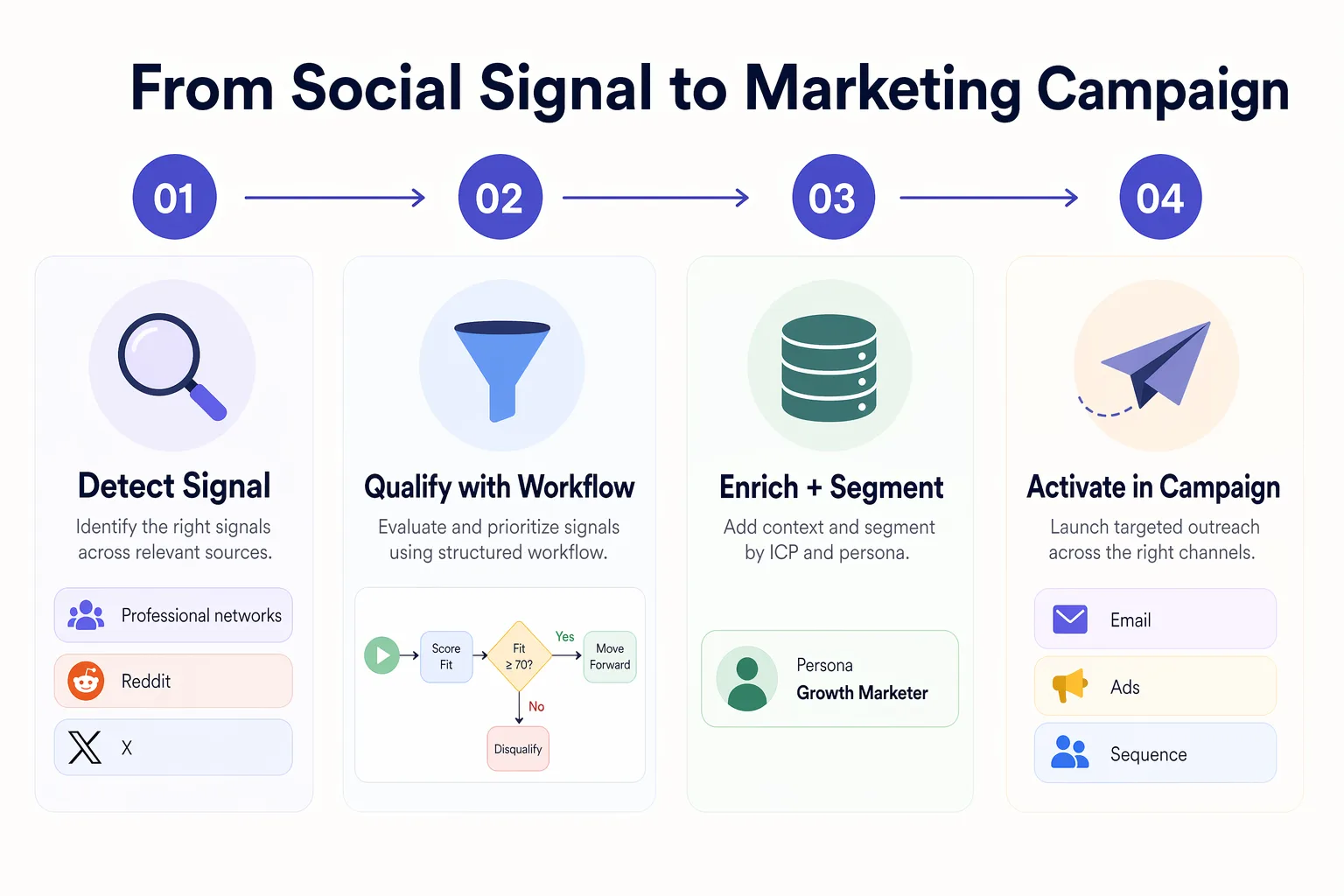
From Social Signal to Marketing Campaign
Which social signals matter for marketing?
Five signal families matter most for a marketing team: brand affinity, competitor engagement, topic monitoring, content engagement, and influence signals. Each maps to a distinct campaign action, which is the difference between an interesting dashboard and a pipeline lever. A signal that cannot be actioned inside a campaign does not belong in a marketing stack.
- Brand affinity: prospects repeatedly engaging with your executives, customers, or brand posts. Feeds advocacy lists, ABM tier-ups, and case-study recruiting.
- Competitor engagement: prospects liking, commenting, or following competitor content. Feeds displacement campaigns and paid retargeting seed lists.
- Topic monitoring: people posting or engaging with a problem, category, or keyword you own. Feeds content distribution, community DMs, and SDR alerting.
- Content engagement: who engaged with your last post, your thought leader, or a partner. Feeds warm outbound handoff, newsletter enrichment, and retargeting audiences.
- Influence signals: accounts whose posts trigger follow-on engagement from your ICP. Feeds influencer and partner program sourcing.
The Edelman Trust Barometer consistently finds peer voices and subject-matter experts out-rank corporate channels for trust, which is why engagement with a person's post is a higher-quality marketing signal than engagement with a company page.
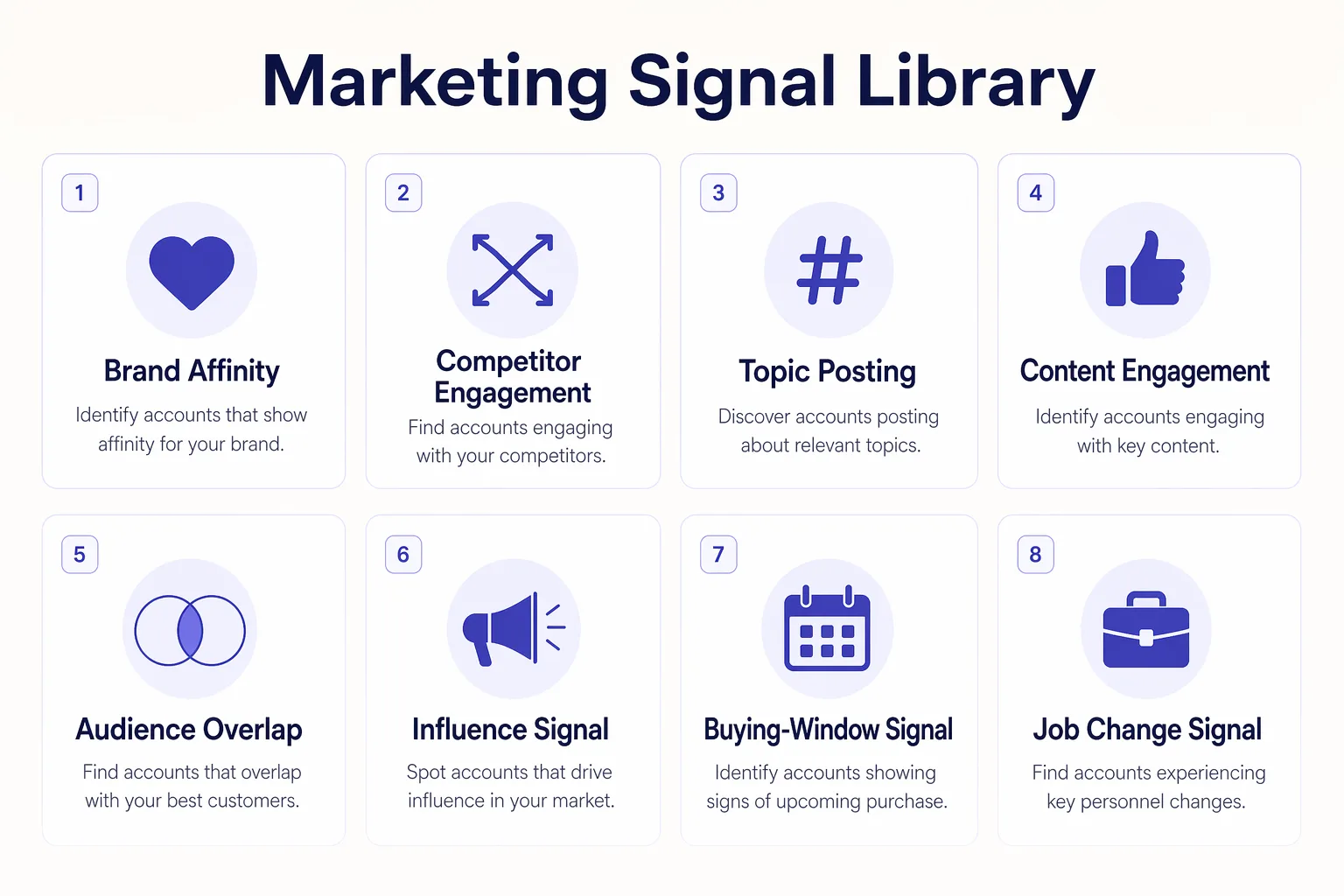
Marketing Signal Library
Social listening vs social signals: what's the difference?
Social listening reports on aggregate audiences (share of voice, sentiment, trending topics). Social signals identify individual humans in the feed and hand marketing a routable record. Listening answers "what is the market saying"; signals answer "which named prospect just moved, and what should we do about them in the next hour".
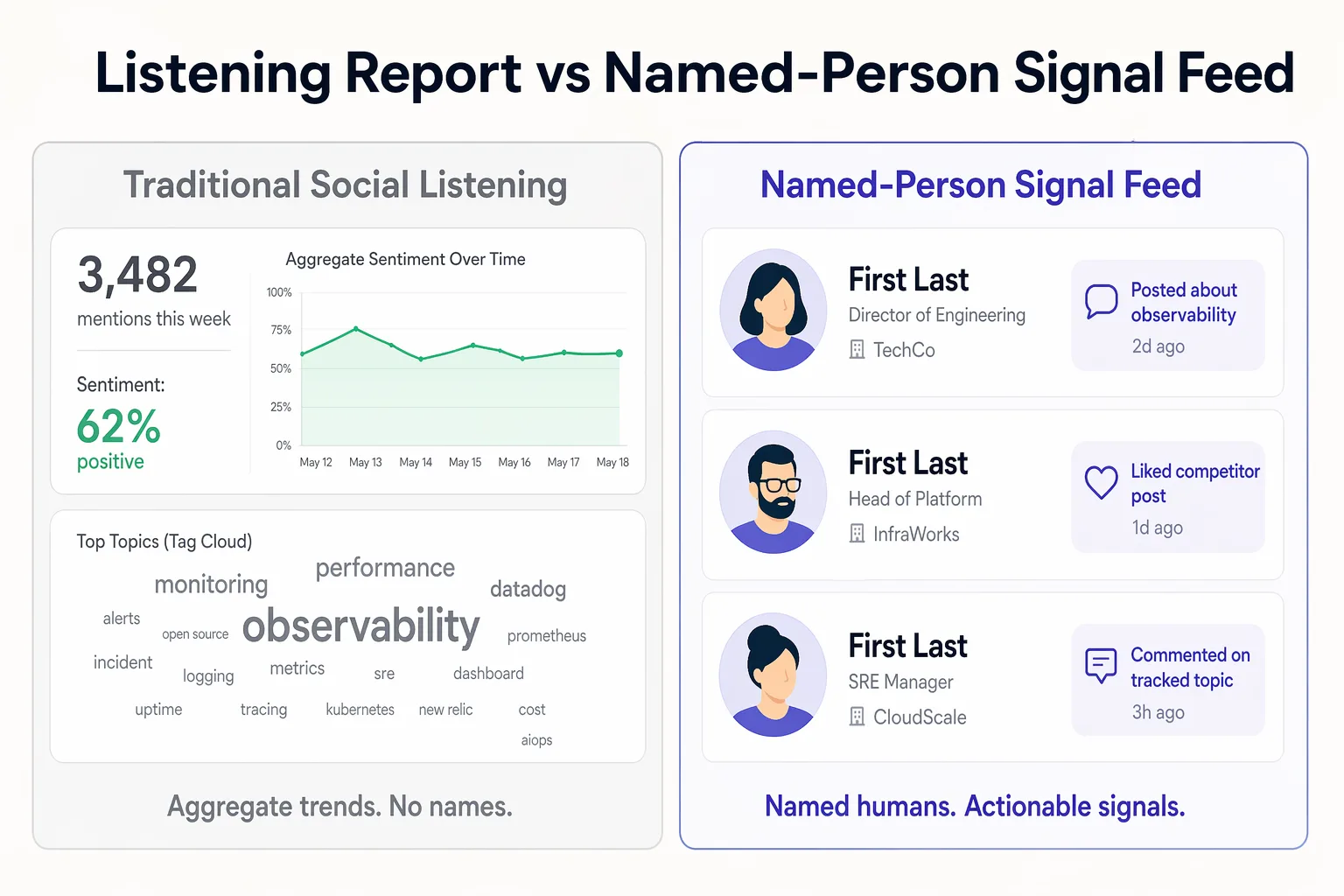
Listening Report vs Named-Person Signal Feed
How to build a marketing signal workflow
A marketing signal workflow has four repeatable steps: define the signal (what behaviour, on which platform, from which ICP), capture it continuously, enrich and score it, then route it to the activation surface (ads, CRM, sequences, or a Slack alert). Done right, the workflow feels less like a listening tool and more like an always-on demand engine.
- Define: write the signal in one sentence. Example: "VP Marketing at 50-500 person B2B SaaS comments on a post about dark social attribution."
- Capture: wire a tool that watches public feeds across professional networks, Reddit, X, Substack, YouTube, and Hacker News.
- Enrich: attach firmographic and tech-stack data, then score against your ICP.
- Route: push to CRM for sales, to an ad audience for retargeting, or to a Slack channel for human review.
LinkedIn State of Sales 2024 found that 78% of social sellers outsell peers who do not use social. The same dynamic applies to marketing teams: the ones turning social behaviour into routed signals ship measurably more pipeline than the ones reporting on sentiment.
Which platforms produce marketing signals?
The highest-yield platforms for B2B marketing signals are professional networks, Reddit, X, Substack, YouTube, and Hacker News. Each surfaces a different flavour of intent: professional networks expose role and company context, Reddit and Hacker News surface unfiltered problem language, Substack and YouTube show who is paying attention to category creators, and X shows real-time reaction to announcements and competitor moves.
A rule of thumb: if your ICP spends working hours there, it is a signal surface. UserGems research on job-change signals found prospects are 3x more likely to convert within 90 days of a role change, and most role changes are announced publicly on professional networks before they land in any database.
Trigify vs other tools: a marketing comparison
The table below compares Trigify against four tools marketing teams commonly evaluate when they start looking at social signals.
Trigify
- Primary Use: Signal-based GTM for marketing and sales
- Signal Granularity: Person-level, real-time
- Named Individuals: Yes, every signal resolves to a named human
- CRM Workflow: Native routing to CRM, ads, Slack, sequences
- Platforms Covered: Professional networks, Reddit, X, Substack, YouTube, Hacker News
Sprout Social
- Primary Use: Social publishing and listening
- Signal Granularity: Aggregate audience metrics
- Named Individuals: Limited, mostly brand-reply focused
- CRM Workflow: Reporting, not routing
- Platforms Covered: Major public networks
Hootsuite
- Primary Use: Social scheduling and monitoring
- Signal Granularity: Aggregate mentions and streams
- Named Individuals: No, streams not routable records
- CRM Workflow: Basic integrations, manual handoff
- Platforms Covered: Major public networks
Brandwatch
- Primary Use: Enterprise brand intelligence
- Signal Granularity: Aggregate, analyst-grade
- Named Individuals: No, built for brand not demand
- CRM Workflow: BI export, not workflow
- Platforms Covered: Broad web and social
Meltwater
- Primary Use: Media monitoring and PR
- Signal Granularity: Aggregate mentions, news-heavy
- Named Individuals: Rare, PR-contact focused
- CRM Workflow: Reports, not CRM-native
- Platforms Covered: News and public social
How Trigify fits your marketing stack
Trigify slots between your listening/monitoring layer and your activation layer. It takes what Sprout or Brandwatch would show you as an aggregate, resolves it to named humans, enriches and scores, then pushes to the tools you already pay for: HubSpot or Salesforce for nurture, paid platforms for retargeting, Slack for alerting, Clay for further enrichment, and your outbound sequencer for the warm handoff.
For most 50-500 person B2B SaaS marketing teams, that means you do not rip and replace. You keep the listening tool for brand reporting and add Trigify as the person-level signal engine that actually produces pipeline. Our CLI makes the workflow programmable for Growth and RevOps teams.
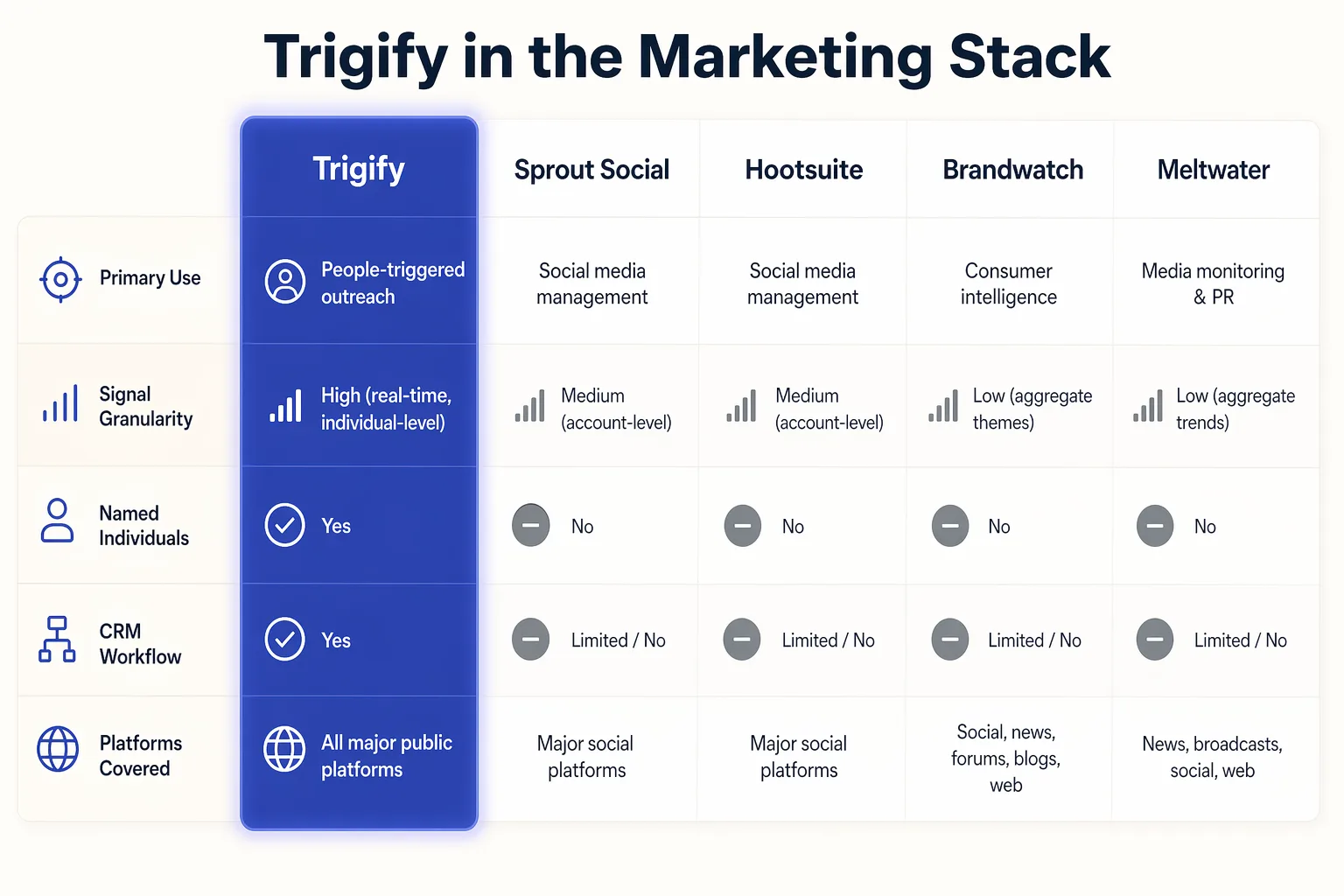
Trigify in the Marketing Stack
FAQ: Social Media Signals for Marketing
What is a social media signal for marketing?
A social media signal for marketing is a named, person-level behaviour on a public social platform (a post, comment, follow, or reaction) that indicates category, competitor, or brand interest. Unlike aggregate listening metrics, it hands marketing a specific human record that can be routed to a CRM, ad audience, nurture sequence, or Slack alert.
How is this different from social listening?
Social listening reports on aggregate audiences: share of voice, sentiment, trending topics. Social signals identify individuals and produce routable records. Listening belongs in a brand dashboard. Signals belong in a pipeline workflow. Most marketing teams keep both: listening for reporting, signals for activation, with clear ownership so neither replaces the other.
Which channels matter most for B2B marketing signals?
For 50-500 person B2B SaaS, the highest-yield channels are professional networks, Reddit, X, Substack, YouTube, and Hacker News. Each surfaces a different behaviour type: role context, unfiltered problem language, real-time reactions, creator attention, and technical evaluation. Coverage across all six is more useful than depth in one.
How do marketing signals connect to demand gen?
Signals become demand-gen fuel when they route directly into paid retargeting audiences, nurture tracks, and warm outbound. A competitor-engagement signal feeds a displacement ad set. A topic-monitoring signal feeds a content drip. A brand-affinity signal feeds advocacy and case-study recruiting. Every signal should map to a campaign action before you turn it on.
Can Trigify replace our listening tool?
Trigify is not a brand-reporting tool. If you need share-of-voice reports for executives, keep your listening platform. Trigify replaces the manual, low-signal workflows around that tool: sifting feeds for named prospects, copy-pasting into sheets, pushing into CRM. Many teams keep listening for brand work and add Trigify as the activation engine.
What's the 95/5 rule and why does it matter for marketing?
The 95/5 rule, from the LinkedIn B2B Institute and Ehrenberg-Bass Institute, is the finding that roughly 95% of B2B buyers are out-of-market at any given moment, leaving only 5% actively buying. Social signals catch the earliest observable shifts from the 95 to the 5, giving marketing a head start on the in-market window.
How do we measure if signals are working?
Measure signals on three axes: volume (signals captured per week by type), quality (ICP match rate and score distribution), and conversion (signal-sourced meetings, pipeline, and closed revenue). HBR research suggests marketing programs that shift from broad targeting to signal-driven activation see around a 40% lift in conversion (verify the specific source before citing externally).
What's the fastest way to start?
Pick one signal, one platform, one campaign. Example: capture every prospect at a named competitor who comments on that competitor's executives, push to a retargeting audience, run a displacement ad for 30 days. That single loop proves the model. From there, expand signal families, then platforms, then activation surfaces. Resist the urge to boil the ocean.
- If you want the broader strategy, start with our Social Media Signals GTM Guide.
- For the sales-side playbook, read Social Media Signals for Sales Teams.
- For the technical build, see the GTM Engineer Social Signals Playbook.
- To compare against traditional intent data, read Social Signals vs Intent Data.
- For the wider intent landscape in 2026, see B2B Intent Signals 2026.
- For the data-sourcing angle, read First-Party vs Third-Party Intent Data.