Sales
Social Selling in B2B: The Practical Guide
Social selling is signal-driven, not content-driven. Practical workflows, tools, and a 5-day starter sprint for B2B teams.
Social selling is signal-driven, not content-driven. Practical workflows, tools, and a 5-day starter sprint for B2B teams.
By Max Mitcham, Founder at Trigify.
Last updated: 23 April 2026
Social selling in B2B is the practice of using social data as a live sales intelligence layer. You monitor professional networks and adjacent communities for buying signals, qualify which prospects are actually evaluating, and engage them with relevant context before they hit an inbound form or a competitor's demo. It is proactive, signal-driven, and tied to pipeline outcomes rather than impressions.
Most "social selling" advice still boils down to posting on a professional feed and hoping someone notices. That is not social selling. That is content marketing with a prayer. According to LinkedIn's State of Sales 2024 report, 78% of social sellers outsell peers who don't use social, and reps who combine content with active signal-based engagement generate significantly more pipeline than those relying on cold outreach alone.
This guide covers how modern B2B teams actually do social selling in 2026, from identifying the right signals to building a repeatable motion that scales.
Social selling is the process of using social platforms to find, engage, and build relationships with potential buyers. But that definition misses the point. Every rep with a professional networks profile thinks they're "social selling." Most aren't.
Here's the difference. Posting thought leadership, commenting on industry threads, sharing company updates: that's social presence. It's table stakes. Social selling starts when you use social data as a sales intelligence layer to identify specific buyers showing purchase intent, then act on those signals before your competitors do.
Think of it this way: social presence is broadcasting. Social selling is listening, then responding with precision.
The distinction matters because it changes how you measure success. Social presence metrics are vanity: impressions, likes, follower growth. Social selling metrics are commercial: conversations started, meetings booked, pipeline influenced.
Companies that understand this distinction outperform those that don't. LinkedIn's State of Sales data shows that social selling leaders create significantly more opportunities than peers with lower Social Selling Index scores. But the SSI score itself isn't the goal. The habits that improve your SSI, finding the right people, engaging with relevant insights, building genuine relationships, are the actual drivers.
If you want to understand your SSI score and how to improve it, we've written a complete guide to the LinkedIn Social Selling Index.
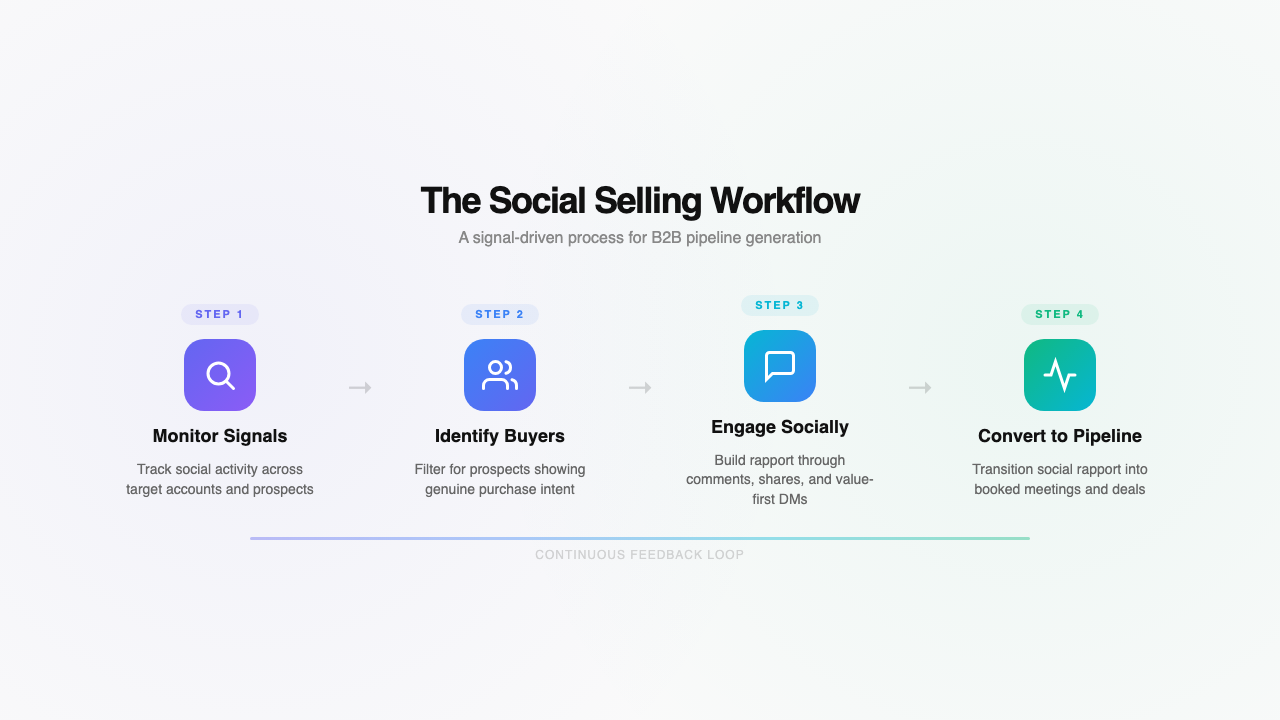
Social selling isn't a single tactic. It's a four-step workflow that turns social data into commercial conversations.
Step 1: Monitor signals. Track what your target accounts and prospects are doing across social platforms. Who's posting about problems your product solves? Who's engaging with competitor content? Who just got promoted into a decision-making role? These are buying signals hiding in plain sight.
Step 2: Identify active buyers. Not every signal means someone's ready to buy. Filter the noise. A prospect liking a post about "best CRM tools" is a weaker signal than one posting about their own CRM migration pain. Prioritise signals that indicate active evaluation or pain recognition.
Step 3: Engage socially. This doesn't mean sliding into DMs with a pitch. Engage with their content first. Leave thoughtful comments. Share relevant insights they'd find valuable. Build familiarity before you ask for anything. The goal is to become a known quantity before you ever send a connection request or meeting invite.
Step 4: Convert to pipeline. Once you've built enough social rapport, the transition to a commercial conversation feels natural. A direct message referencing their recent post about a specific challenge, with a relevant case study or resource, converts at dramatically higher rates than a generic cold outreach template.
This workflow is what separates social selling from social posting. It's proactive, signal-driven, and directly tied to revenue outcomes.
Not all social signals carry equal weight. B2B teams waste time tracking vanity metrics when they should focus on signals that correlate with purchase intent.
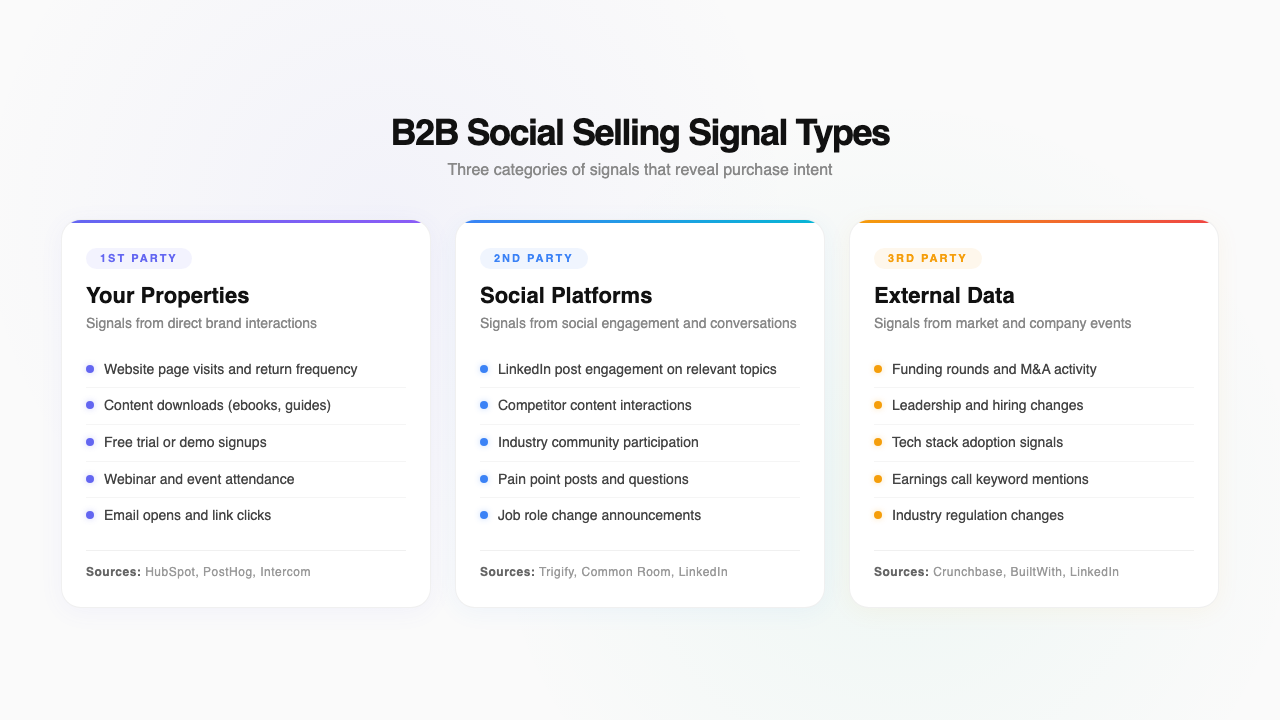
Social signals fall into three categories:
These come from your own properties. Website visits, content downloads, webinar attendance, free trial signups. You already track most of these through your marketing automation platform. They tell you who's engaging with your brand directly.
This is where social selling gets interesting. Second-party signals come from social platforms: professional networks engagement, X conversations, Reddit and community forum participation, Substack and YouTube engagement, Hacker News threads. Someone commenting on a competitor's product announcement, posting about a pain point your solution addresses, or engaging with industry content related to your category. These signals reveal intent before the buyer ever visits your website.
External data points that indicate a company might be in-market: funding announcements, leadership changes, hiring patterns, technology stack changes, earnings call mentions. A company that just raised a Series B and is hiring three SDRs is probably about to invest in sales tooling.
The most effective social selling teams combine all three signal types. First-party tells you who already knows you exist. Second-party reveals who's thinking about problems you solve. Third-party flags companies going through changes that create buying windows.
Social listening tools like Trigify let you monitor these second-party signals at scale, tracking engagement patterns across professional networks, Reddit, X, Substack, YouTube, and Hacker News to surface prospects showing genuine buying intent. Instead of manually scrolling through feeds, you get alerts when target accounts engage with relevant content. For a full breakdown of the best social listening tools for B2B, we've compared the top options.
Reading about social selling is easy. Building a motion that your team actually follows is hard. Here's a practical framework for getting started, broken into three maturity levels.
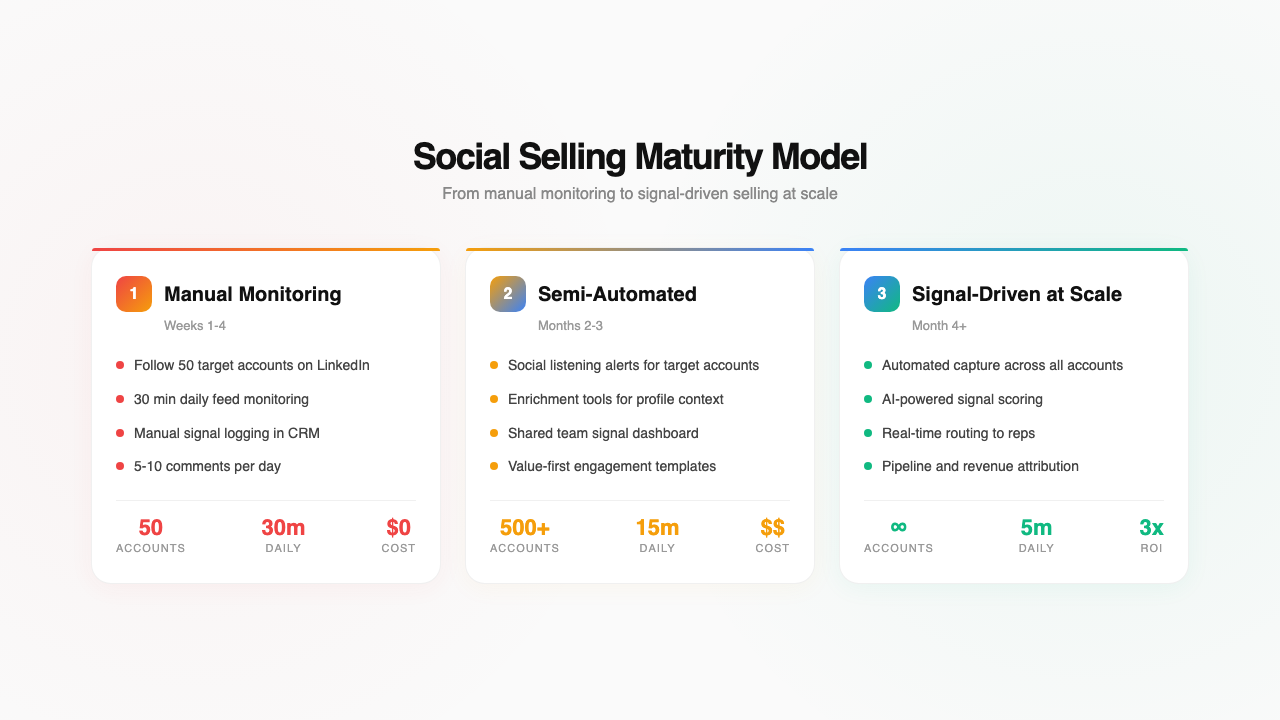
Start simple. Pick 50 target accounts. Follow key decision-makers on professional networks. Set aside 30 minutes daily to:
This level costs nothing except time. It teaches your team the habit of listening before pitching and shows early results that justify investing in tools.
Once you've validated the approach manually, add tooling to scale:
At this level, you're monitoring hundreds of accounts instead of 50, and signals come to you instead of requiring manual discovery.
This is where social selling becomes a true competitive advantage:
Teams running a signal-driven approach at this level report 3x higher response rates compared to cold outreach, because every interaction is contextually relevant and well-timed. We've covered the full comparison of social selling vs cold outreach if you want to see the data.
You don't need ten tools to start social selling. But as you scale, a purpose-built stack makes the difference between a team sport and a solo effort.
The modern social selling stack has four layers:
Signal capture: Tools that monitor social platforms for buying signals. This is the foundation. Without reliable signal capture, you're guessing who to engage. Trigify, Common Room, and Mention are strong options here, each with different strengths around platform coverage, signal types, and integration depth. For a full comparison, see our social selling tools roundup.
Enrichment: Once you spot a signal, you need context. Who is this person? What company? What's their tech stack? What's their budget likely to be? Tools like Clay, Apollo, and Clearbit fill these gaps.
Outreach: After enrichment, you need a channel to engage. Professional network native outreach tools like HeyReach and Dripify handle connection requests and messaging sequences, and LinkedIn Sales Navigator remains the default research layer for account-based work. Email tools like Instantly and Smartlead handle the email side. The key is matching your outreach channel to where your prospect is most active.
Measurement: Finally, you need to track what's working. Your CRM (HubSpot, Salesforce, Attio) is the system of record, but make sure social selling activity feeds into it so you can attribute pipeline to social engagement, not just the last-touch email.
For a deeper look at how to generate B2B leads through professional networks and the specific professional network prospecting workflows that book 20+ meetings weekly, we've written dedicated guides.
If you can't measure it, your VP of Sales will kill it. Social selling programs die when they can't prove ROI. Here's what to track:
Social-sourced pipeline as a percentage of total pipeline. Start tracking this from day one. Most teams running a mature social selling motion attribute 20-35% of pipeline to social engagement. If you're below 10%, your team is either not executing consistently or not tracking properly.
Pitching in DMs immediately. Nothing kills social selling faster than treating professional network DMs as another cold email channel. Engage with content first. Build familiarity. Then start conversations.
Ignoring signal quality. A prospect liking a generic industry post is not a buying signal. Focus on signals that indicate specific pain, evaluation activity, or purchase timing.
Treating it as a marketing responsibility. Social selling is a sales activity. Marketing can support with content and brand presence, but the actual social selling workflow, monitoring signals, engaging with prospects, converting conversations, sits with sales. Companies that build employee advocacy programs alongside social selling see the best results because reps become genuine thought leaders, not just salespeople with social profiles.
Not measuring commercially. Impressions and likes are not social selling metrics. Pipeline and revenue are.
Going dark after initial engagement. Consistency matters. Social selling is a daily practice, not a campaign you run for two weeks and abandon.
You don't need a budget, a tech stack, or executive buy-in to start social selling today. Here's a five-day sprint:
By Friday, you'll have built more genuine relationships than a month of cold emailing would produce. From there, you can decide whether to invest in tools that scale this motion across your entire team.
Social selling isn't complicated. It's listening before talking, engaging before pitching, and using data to focus your effort where it matters most. The teams that do it well don't just close more deals. They build the kind of market presence that makes inbound and outbound both work better.
Social selling sits inside a broader signal-driven GTM motion. If you're building the wider playbook, these guides go deeper on the adjacent pieces: